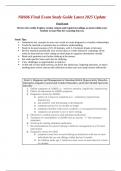
NR606 Final Exam Study Guide Latest 2025 Update
Final Exam
Review the weekly Explore section content and required readings as noted within your
Student Lesson Plan for Learning Success.
Study Tips:
Summarize key concepts in your own words or create diagrams to visualize relationships.
Teach the material to someone else to reinforce understanding.
Study in focused sessions of 25–50 minutes, with 5–10-minute breaks in between.
Review material periodically over several days or weeks instead of cramming. Write
notes by hand and use color coding or mind maps to organize information visually.
Read each question twice before looking at the answer
Set aside specific times each day for studying.
View challenges as opportunities to improve.
At the end of each study session, jot down key takeaways, lingering questions, or topics
needing more review and use this reflection to plan your next study session effectively
Week 5: Diagnosis and Management of Attention Deficit Hyperactivity Disorder,
Disruptive, Impulse-Control and Conduct Disorders, and Fetal Alcohol Spectrum
Disorder
1. Define symptoms of ADHD i.e.: selective attention, impulsivity, hyperactivity,
2. Effects of maturation on ADHD symptoms
3. Diagnostic criteria for ADHD:
o pattern of at least six symptoms (i.e.: inattention, hyperactivity-
impulsivity)
o that interfere with functioning or development
o symptoms persist for six months or longer
o symptoms interfere with social, academic, or occupational functioning
o symptoms are present in two or more settings
4. Measures to combat anorexia with stimulant medications
5. Treatment of comorbidities of ADHD such as anxiety – 1st line treatment
stimulants
6. Work up for starting stimulant medication
7. Recommendations for parent training in behavior management as a first-line
intervention
8. Diagnostic criteria for ODD
o symptoms must have occurred during an interaction with one or more
individuals that are not siblings within the last 6 months
o for children under age 5, behaviors must occur on most days for at least
six months
Final Exam
Review the weekly Explore section content and required readings as noted within your
Student Lesson Plan for Learning Success.
Study Tips:
Summarize key concepts in your own words or create diagrams to visualize relationships.
Teach the material to someone else to reinforce understanding.
Study in focused sessions of 25–50 minutes, with 5–10-minute breaks in between.
Review material periodically over several days or weeks instead of cramming. Write
notes by hand and use color coding or mind maps to organize information visually.
Read each question twice before looking at the answer
Set aside specific times each day for studying.
View challenges as opportunities to improve.
At the end of each study session, jot down key takeaways, lingering questions, or topics
needing more review and use this reflection to plan your next study session effectively
Week 5: Diagnosis and Management of Attention Deficit Hyperactivity Disorder,
Disruptive, Impulse-Control and Conduct Disorders, and Fetal Alcohol Spectrum
Disorder
1. Define symptoms of ADHD i.e.: selective attention, impulsivity, hyperactivity,
2. Effects of maturation on ADHD symptoms
3. Diagnostic criteria for ADHD:
o pattern of at least six symptoms (i.e.: inattention, hyperactivity-
impulsivity)
o that interfere with functioning or development
o symptoms persist for six months or longer
o symptoms interfere with social, academic, or occupational functioning
o symptoms are present in two or more settings
4. Measures to combat anorexia with stimulant medications
5. Treatment of comorbidities of ADHD such as anxiety – 1st line treatment
stimulants
6. Work up for starting stimulant medication
7. Recommendations for parent training in behavior management as a first-line
intervention
8. Diagnostic criteria for ODD
o symptoms must have occurred during an interaction with one or more
individuals that are not siblings within the last 6 months
o for children under age 5, behaviors must occur on most days for at least
six months