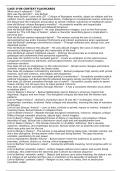
L’AGE D’OR CONTEXT FLASHCARDS
When was it released? – 1930
Who was the director? – Luis Buñuel
What were Buñuel’s aims with LD? – Critique of Bourgeois morality, attack on religion and the
catholic church, exploration of repressed desire, challenge to conventional cinema, embracing
the absurd and the irrational, provocation as artistic method, subversion of traditional values
How did Buñuel critique Bourgeois morality? – He presents wealthy and respectable
characters engaged in absurd and debased behaviour.
How did Buñuel attack religion? – He uses blasphemous imagery, such as the final scene
inspired by ‘The 120 Days of Sodom’, where a character resembling Jesus is implicated in
perverse acts
How did Buñuel explore repressed desire? – The woman sucking the toe of a stature,
demonstrating how erotic impulses find bizarre and indirect expressions when suppressed
How did Buñuel challenge conventional cinema? – Through nonlinear plot, abrupt cuts, and
disjointed scenes
How did Buñuel embrace the absurd? – He uses absurd imagery like cows on beds and
nonsensical dialogue to highlight the irrationality of life itself
How did Buñuel subvert traditional values? – Portrays the aristocrats as irrational and
grotesque and undermines their perceived superiority.
How does LD conform to the surrealist genre? – It puts an emphasis on the subconscious,
juxtaposes contradictory elements, anti-bourgeois theme, use of provocative imagery,
nonlinear narrative
How does LD put an emphasises on the subconscious? – Abrupt scene changes and bizarre
symbolic imagery that reflect the dream state
How does LD juxtapose contradictory elements? – Buñuel juxtaposes high society with primal
instincts, love with violence, and religion with blasphemy
How does LD subvert surrealism through political commentary? – Surrealists avoided explicit
political messages, but Buñuel directly attacked bourgeois society and the Catholic Church
How does LD subvert surrealism through use of satire? – Surrealism usually seeks to ignore
reason entirely, but LD uses irony to make pointed criticisms
How does LD subvert surrealism through themes? – It has a consistent thematic focus which
surrealism didn’t
Link to Todorov’s theory? – Buñuel deliberately rejects Todorov’s structure. Events feel
disjointed, illogical and non-linear. This disruption critiques the idea that life follows neat
patterns
Link to Propp’s theory? – Buñuel’s characters don’t fit into the 7 archetypes. They are
fragmented, nameless, irrational. Roles collapse into absurdity, mocking the idea of narrative
archetypes
Link to Levi-Strauss’ theory? – Love vs hate, civilised vs primal, reason vs instinct. Instead of
resolving these, Buñuel blends or collapses them.
Link to Neale’s theory? – Repeats through bourgeois melodrama, romance, religious critique.
Differs through surrealist structure, absurd logic, shock imagery
Link to Bazin’s theory? – Repeated themes of desire vs repression, anti-religious critique,
absurdity of logic. Buñuel has a distinctive visual style and anti-establishment tone
Link to Tasker’s theory? – The female character in LD defies ‘softening’. She’s sexually
assertive, rebellious, and challenges decorum. Buñuel shows her as powerful and untamed,
which was quite rare for the era
Link to Mulvey’s theory? – The woman is sexualised (licking statue toes, intimate scenes), but
she’s also disruptive, driving desire rather than just being desired. The gaze becomes
unstable, questioning its own power.
Link to Hypodermic Needle Theory? – Buñuel doesn’t treat the audiences as passive, he
provokes, confuses, shocks us, forcing critical engagement.
Link to Barthes’ hermeneutic codes? – Constantly withholds meaning, full of enigmas with no
solution
Link to Barthes’ proairetic codes? – Actions happen without clear reason and events break
continuity, this undermines the idea that plot is driven by rational sequence
Link to Barthes’ semantic codes? – Objects and actions carry extra meaning, the statue’s toe
is a critique of art worship and the cow in a bedroom is the absurdity of domestic life
Link to Barthes’ symbolic codes? – Religion vs sex, order vs chaos, love vs destruction
(symbolic codes)
When was it released? – 1930
Who was the director? – Luis Buñuel
What were Buñuel’s aims with LD? – Critique of Bourgeois morality, attack on religion and the
catholic church, exploration of repressed desire, challenge to conventional cinema, embracing
the absurd and the irrational, provocation as artistic method, subversion of traditional values
How did Buñuel critique Bourgeois morality? – He presents wealthy and respectable
characters engaged in absurd and debased behaviour.
How did Buñuel attack religion? – He uses blasphemous imagery, such as the final scene
inspired by ‘The 120 Days of Sodom’, where a character resembling Jesus is implicated in
perverse acts
How did Buñuel explore repressed desire? – The woman sucking the toe of a stature,
demonstrating how erotic impulses find bizarre and indirect expressions when suppressed
How did Buñuel challenge conventional cinema? – Through nonlinear plot, abrupt cuts, and
disjointed scenes
How did Buñuel embrace the absurd? – He uses absurd imagery like cows on beds and
nonsensical dialogue to highlight the irrationality of life itself
How did Buñuel subvert traditional values? – Portrays the aristocrats as irrational and
grotesque and undermines their perceived superiority.
How does LD conform to the surrealist genre? – It puts an emphasis on the subconscious,
juxtaposes contradictory elements, anti-bourgeois theme, use of provocative imagery,
nonlinear narrative
How does LD put an emphasises on the subconscious? – Abrupt scene changes and bizarre
symbolic imagery that reflect the dream state
How does LD juxtapose contradictory elements? – Buñuel juxtaposes high society with primal
instincts, love with violence, and religion with blasphemy
How does LD subvert surrealism through political commentary? – Surrealists avoided explicit
political messages, but Buñuel directly attacked bourgeois society and the Catholic Church
How does LD subvert surrealism through use of satire? – Surrealism usually seeks to ignore
reason entirely, but LD uses irony to make pointed criticisms
How does LD subvert surrealism through themes? – It has a consistent thematic focus which
surrealism didn’t
Link to Todorov’s theory? – Buñuel deliberately rejects Todorov’s structure. Events feel
disjointed, illogical and non-linear. This disruption critiques the idea that life follows neat
patterns
Link to Propp’s theory? – Buñuel’s characters don’t fit into the 7 archetypes. They are
fragmented, nameless, irrational. Roles collapse into absurdity, mocking the idea of narrative
archetypes
Link to Levi-Strauss’ theory? – Love vs hate, civilised vs primal, reason vs instinct. Instead of
resolving these, Buñuel blends or collapses them.
Link to Neale’s theory? – Repeats through bourgeois melodrama, romance, religious critique.
Differs through surrealist structure, absurd logic, shock imagery
Link to Bazin’s theory? – Repeated themes of desire vs repression, anti-religious critique,
absurdity of logic. Buñuel has a distinctive visual style and anti-establishment tone
Link to Tasker’s theory? – The female character in LD defies ‘softening’. She’s sexually
assertive, rebellious, and challenges decorum. Buñuel shows her as powerful and untamed,
which was quite rare for the era
Link to Mulvey’s theory? – The woman is sexualised (licking statue toes, intimate scenes), but
she’s also disruptive, driving desire rather than just being desired. The gaze becomes
unstable, questioning its own power.
Link to Hypodermic Needle Theory? – Buñuel doesn’t treat the audiences as passive, he
provokes, confuses, shocks us, forcing critical engagement.
Link to Barthes’ hermeneutic codes? – Constantly withholds meaning, full of enigmas with no
solution
Link to Barthes’ proairetic codes? – Actions happen without clear reason and events break
continuity, this undermines the idea that plot is driven by rational sequence
Link to Barthes’ semantic codes? – Objects and actions carry extra meaning, the statue’s toe
is a critique of art worship and the cow in a bedroom is the absurdity of domestic life
Link to Barthes’ symbolic codes? – Religion vs sex, order vs chaos, love vs destruction
(symbolic codes)