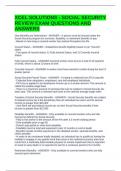
XCEL SOLUTIONS - SOCIAL SECURITY
REVIEW EXAM QUESTIONS AND
ANSWERS
How Benefits are Determined - ANSWER-- A person must be insured under the
Social Security program for survivors, disability, or retirement benefits to pay
- Based on how long a covered worker has worked throughout his life
Insured Status - ANSWER-- Establishes benefit eligibility based on an "insured"
status
- Two types of insured status: 1) Fully Insured Status, and 2) Currently Insured
Status
Fully Insured Status - ANSWER-Covered worker must accrue a total of 40 quarters
of credit, which is about 10 years of work
Currently Insured - ANSWER-A worker must have earned 6 credits during the last 13
quarter period
Social Security Payroll Taxes - ANSWER-- Funding is collected from FICA payrolls
- Collected from employers, employees, and self-employed individuals
- FICA tax is applied to an employees income up to a certain amount. This amount is
called the taxable wage base
- There is a maximum amount of earnings that can be subject to Social Security tax
each year. This amount is indexed each year to the national average wage index
Taxation of Social Security Benefits - ANSWER-- Social Security benefits are subject
to federal income tax if the beneficiary files an individual tax return and his annual
income is greater than $25,000
- Joint filers will pay federal income tax on their Social Security benefits if their
income is greater than $32,000
Disability Benefits - ANSWER-- Only available to covered workers who are fully
insured as defined by Social Security
- Paid to the worker in the amount of the PIA after a 5 month waiting period
- Only available prior to age 65
- Doesn't pay partial or short-term disability
- Disability must be total and expected to last 12 months or end in death
- Benefits include monthly payments to the disabled worker, spousal benefits, and
child's benefits
- In order to be considered totally disabled, an individual has to qualify by having the
inability to engage in any gainful work that exists in the national economy and must
result from a medically determinable physical or mental impairment that is expected
to result in early death or is expected to last for a continues period of 12 months
Retirement Benefits - ANSWER-- Only available to covered workers who are fully
insured upon retirement
REVIEW EXAM QUESTIONS AND
ANSWERS
How Benefits are Determined - ANSWER-- A person must be insured under the
Social Security program for survivors, disability, or retirement benefits to pay
- Based on how long a covered worker has worked throughout his life
Insured Status - ANSWER-- Establishes benefit eligibility based on an "insured"
status
- Two types of insured status: 1) Fully Insured Status, and 2) Currently Insured
Status
Fully Insured Status - ANSWER-Covered worker must accrue a total of 40 quarters
of credit, which is about 10 years of work
Currently Insured - ANSWER-A worker must have earned 6 credits during the last 13
quarter period
Social Security Payroll Taxes - ANSWER-- Funding is collected from FICA payrolls
- Collected from employers, employees, and self-employed individuals
- FICA tax is applied to an employees income up to a certain amount. This amount is
called the taxable wage base
- There is a maximum amount of earnings that can be subject to Social Security tax
each year. This amount is indexed each year to the national average wage index
Taxation of Social Security Benefits - ANSWER-- Social Security benefits are subject
to federal income tax if the beneficiary files an individual tax return and his annual
income is greater than $25,000
- Joint filers will pay federal income tax on their Social Security benefits if their
income is greater than $32,000
Disability Benefits - ANSWER-- Only available to covered workers who are fully
insured as defined by Social Security
- Paid to the worker in the amount of the PIA after a 5 month waiting period
- Only available prior to age 65
- Doesn't pay partial or short-term disability
- Disability must be total and expected to last 12 months or end in death
- Benefits include monthly payments to the disabled worker, spousal benefits, and
child's benefits
- In order to be considered totally disabled, an individual has to qualify by having the
inability to engage in any gainful work that exists in the national economy and must
result from a medically determinable physical or mental impairment that is expected
to result in early death or is expected to last for a continues period of 12 months
Retirement Benefits - ANSWER-- Only available to covered workers who are fully
insured upon retirement