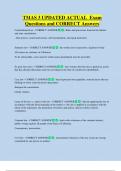
TMAS 3 UPDATED ACTUAL Exam
Questions and CORRECT Answers
Constitutional Law - CORRECT ANSWER - Rules and provisions found in the federal
and state constitutions
- Due process, search and seizure, self incrimination, and equal protection
Statutory law - CORRECT ANSWER - the written laws enacted by a legislative body
All crimes are statutory in California
To be enforceable, a law must be written and a punishment must be provided
Ex post facto laws - CORRECT ANSWER - laws written after the fact to punish an action
that has already taken place and was not illegal at the time of commission (prohibited)
Case law - CORRECT ANSWER - based upon previous appellate court decisions that are
binding on lower court decisions (precedent)
Interpret the constitution
Clarify statutes
Letter of the law vs. spirit of the law - CORRECT ANSWER - Strictly applying the law in
accordance with the literal meaning of the statute vs. the law is applied in accordance with the
intent of the legislature, the promotion of fairness and justice, and not solely in literal
compliance.
Criminal law - CORRECT ANSWER - deals with violations of the criminal statutes;
public wrongs against all people of the State of California.
Consequence: prosecution
Civil law - CORRECT ANSWER - noncriminal violations of the law or private wrongs
committed by one person to another.
,Civil wrong: Tort
Redress: righting a wrong
Injured parties may file a lawsuit for monetary compensation, not including incarceration.
Peace officers have a duty to investigate any potential criminal violations, even in civil matters
If only civil: LEOs lack authority to force a resolution to the dispute. The duty is to stand by,
preserve the peace and maintain order.
Tort by omission - CORRECT ANSWER - omission of an act or negligence may also be a
tort if it violates a legal duty owed to another person
Civil actions by crime victims - CORRECT ANSWER - victim of a crime can file a civil
action even though the state files criminal charges
Punishment for a crime - CORRECT ANSWER - death, imprisonment, fine or removal
from office, disqualification to hold and enjoy any office of honor, trust, or profit in the state of
california.
27 PC LD: 5 - CORRECT ANSWER - persons liable for punishment:
All persons who commit, in whole or in part, any crime within california
All persons who commit an offense outside of California which, if committed inside California,
would be larceny, carjacking, robbery, or embezzlement and bring or are found with any portion
of the stolen or embezzled property in california.
All persons outside of california who cause, aid, advise, or encourage another person to commit a
crime within california, and who are afterwards found in california.
Criminal intent - CORRECT ANSWER - must exist to distinguish the crime from an
accident or mistake of fact
General intent crimes - CORRECT ANSWER - intent is presumed and does not have to be
proven
Ex: battery, arson, transportation of drugs
, Person was aware of their actions or their conduct (ignorance of the law is no excuse).
Specific intent crimes - CORRECT ANSWER - intent is an element of the offense that
must be proven
Burglary, kidnapping for ransom
Transferred intent - CORRECT ANSWER - when an unlawful act affects a person other
than or in addition to the person it was intended to affect.
Intent may be transferred only if the act involved does not require a different state of mind or
criminal intent.
Criminal negligence - CORRECT ANSWER - failure to exercise ordinary care; a
negligent act that is aggravated or reckless and constitutes indifference to the consequences.
Felony - CORRECT ANSWER - punishable by a fine and/or imprisonment in state prison,
death, or removal from office.
Misdemeanor - CORRECT ANSWER - crime of lesser gravity than a felony.
Punishable by a fine and/or imprisonment in a county jail.
Wobbler - CORRECT ANSWER - a crime that can be either a misdemeanor or felony.
Punishable by imprisonment in either the state prison or county jail and/or fine.
Treated as felonies by LEOs.
Infraction - CORRECT ANSWER - issued citation instead of arrest
Not entitled to a jury trial or to representation by a public defender, except in cases involving
arrest.
Post release Community Supervision (PRCS) - CORRECT ANSWER - Subject to
warrantless searches
Questions and CORRECT Answers
Constitutional Law - CORRECT ANSWER - Rules and provisions found in the federal
and state constitutions
- Due process, search and seizure, self incrimination, and equal protection
Statutory law - CORRECT ANSWER - the written laws enacted by a legislative body
All crimes are statutory in California
To be enforceable, a law must be written and a punishment must be provided
Ex post facto laws - CORRECT ANSWER - laws written after the fact to punish an action
that has already taken place and was not illegal at the time of commission (prohibited)
Case law - CORRECT ANSWER - based upon previous appellate court decisions that are
binding on lower court decisions (precedent)
Interpret the constitution
Clarify statutes
Letter of the law vs. spirit of the law - CORRECT ANSWER - Strictly applying the law in
accordance with the literal meaning of the statute vs. the law is applied in accordance with the
intent of the legislature, the promotion of fairness and justice, and not solely in literal
compliance.
Criminal law - CORRECT ANSWER - deals with violations of the criminal statutes;
public wrongs against all people of the State of California.
Consequence: prosecution
Civil law - CORRECT ANSWER - noncriminal violations of the law or private wrongs
committed by one person to another.
,Civil wrong: Tort
Redress: righting a wrong
Injured parties may file a lawsuit for monetary compensation, not including incarceration.
Peace officers have a duty to investigate any potential criminal violations, even in civil matters
If only civil: LEOs lack authority to force a resolution to the dispute. The duty is to stand by,
preserve the peace and maintain order.
Tort by omission - CORRECT ANSWER - omission of an act or negligence may also be a
tort if it violates a legal duty owed to another person
Civil actions by crime victims - CORRECT ANSWER - victim of a crime can file a civil
action even though the state files criminal charges
Punishment for a crime - CORRECT ANSWER - death, imprisonment, fine or removal
from office, disqualification to hold and enjoy any office of honor, trust, or profit in the state of
california.
27 PC LD: 5 - CORRECT ANSWER - persons liable for punishment:
All persons who commit, in whole or in part, any crime within california
All persons who commit an offense outside of California which, if committed inside California,
would be larceny, carjacking, robbery, or embezzlement and bring or are found with any portion
of the stolen or embezzled property in california.
All persons outside of california who cause, aid, advise, or encourage another person to commit a
crime within california, and who are afterwards found in california.
Criminal intent - CORRECT ANSWER - must exist to distinguish the crime from an
accident or mistake of fact
General intent crimes - CORRECT ANSWER - intent is presumed and does not have to be
proven
Ex: battery, arson, transportation of drugs
, Person was aware of their actions or their conduct (ignorance of the law is no excuse).
Specific intent crimes - CORRECT ANSWER - intent is an element of the offense that
must be proven
Burglary, kidnapping for ransom
Transferred intent - CORRECT ANSWER - when an unlawful act affects a person other
than or in addition to the person it was intended to affect.
Intent may be transferred only if the act involved does not require a different state of mind or
criminal intent.
Criminal negligence - CORRECT ANSWER - failure to exercise ordinary care; a
negligent act that is aggravated or reckless and constitutes indifference to the consequences.
Felony - CORRECT ANSWER - punishable by a fine and/or imprisonment in state prison,
death, or removal from office.
Misdemeanor - CORRECT ANSWER - crime of lesser gravity than a felony.
Punishable by a fine and/or imprisonment in a county jail.
Wobbler - CORRECT ANSWER - a crime that can be either a misdemeanor or felony.
Punishable by imprisonment in either the state prison or county jail and/or fine.
Treated as felonies by LEOs.
Infraction - CORRECT ANSWER - issued citation instead of arrest
Not entitled to a jury trial or to representation by a public defender, except in cases involving
arrest.
Post release Community Supervision (PRCS) - CORRECT ANSWER - Subject to
warrantless searches