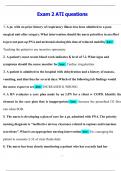
Exam 2 ATI questions
1. A pt. with no prior history of respiratory illness has been admitted to a post-
surgical unit after surgery. What intervention should the nurse prioritize in an effort
to prevent post-op PNA and atelectasis during this time of reduced mobility Ans:
Teaching the patient to use incentive spirometry
2. A patient's most recent blood work indicates K level of 7.2. What signs and
symptoms should the nurse monitor for Ans: Cardiac irregularities
3. A patient is admitted to the hospital with dehydration and a history of nausea,
vomiting, and diarrhea for several days. Which of the following lab findings would
the nurse expect to see Ans: INCREASED K WRONG
4. A RN evaluates a care plan made by an LPN for a client w COPD. Identify the
element in the care plan that is inappropriate Ans: Increase the prescribed O2 flow
rate when SOB.
5. The nurse is developing a plan of care for a pt. admitted with PNA. The priority
nursing diagnosis is "ineffective airway clearance related to copious and tenacious
secretions". What is an appropriate nursing intervention Ans: En- couraging the
patient to consume 2-3L of clear fluids daily
6. The nurse has been closely monitoring a patient who has recently had her
1/7
, indwelling cath removed. In the 6 hours since it was removed, the pt. has yet to void.
How should the nurse first respond Ans: Assess the patient's bladder by palpation and
bedside US.
7. An older adult client in a LTC facility had a CVA 4 weeks ago and has
been unable to move independently since that time. The nurse should observe which
finding that indicates a complication of immobility Ans: Reddened area over the sacrum
8. A nurse is caring for a client w COPD. When developing this client's plan of care,
the nurse should include which intervention Ans: Instruct the patient to use pursed-lip
breathing.
9. A nurse is caring for a client w asthma. The client is prescribed Flovent. Which
is a common adverse effect Ans: Oropharyngeal candidiasis
10. A nurse working in an ortho unit is caring for 4 clients.Which is at greatest risk for
skin breakdown Ans: An older adult client who has a hip fracture and is in Buck's
traction
11. Regardless of the type of anemia, what major physiologic effect underlies the
resulting symptoms Ans: Reduced O2 availability for tissues
12. A nurse is providing discharge teaching for a client who has a new Rx for home
O2. Which of the following should the nurse give to the client Ans: Check the cord for
frays or tearing, Monitor for signs of hypoxia, select clothing and bedding made of synthetic
2/7
1. A pt. with no prior history of respiratory illness has been admitted to a post-
surgical unit after surgery. What intervention should the nurse prioritize in an effort
to prevent post-op PNA and atelectasis during this time of reduced mobility Ans:
Teaching the patient to use incentive spirometry
2. A patient's most recent blood work indicates K level of 7.2. What signs and
symptoms should the nurse monitor for Ans: Cardiac irregularities
3. A patient is admitted to the hospital with dehydration and a history of nausea,
vomiting, and diarrhea for several days. Which of the following lab findings would
the nurse expect to see Ans: INCREASED K WRONG
4. A RN evaluates a care plan made by an LPN for a client w COPD. Identify the
element in the care plan that is inappropriate Ans: Increase the prescribed O2 flow
rate when SOB.
5. The nurse is developing a plan of care for a pt. admitted with PNA. The priority
nursing diagnosis is "ineffective airway clearance related to copious and tenacious
secretions". What is an appropriate nursing intervention Ans: En- couraging the
patient to consume 2-3L of clear fluids daily
6. The nurse has been closely monitoring a patient who has recently had her
1/7
, indwelling cath removed. In the 6 hours since it was removed, the pt. has yet to void.
How should the nurse first respond Ans: Assess the patient's bladder by palpation and
bedside US.
7. An older adult client in a LTC facility had a CVA 4 weeks ago and has
been unable to move independently since that time. The nurse should observe which
finding that indicates a complication of immobility Ans: Reddened area over the sacrum
8. A nurse is caring for a client w COPD. When developing this client's plan of care,
the nurse should include which intervention Ans: Instruct the patient to use pursed-lip
breathing.
9. A nurse is caring for a client w asthma. The client is prescribed Flovent. Which
is a common adverse effect Ans: Oropharyngeal candidiasis
10. A nurse working in an ortho unit is caring for 4 clients.Which is at greatest risk for
skin breakdown Ans: An older adult client who has a hip fracture and is in Buck's
traction
11. Regardless of the type of anemia, what major physiologic effect underlies the
resulting symptoms Ans: Reduced O2 availability for tissues
12. A nurse is providing discharge teaching for a client who has a new Rx for home
O2. Which of the following should the nurse give to the client Ans: Check the cord for
frays or tearing, Monitor for signs of hypoxia, select clothing and bedding made of synthetic
2/7