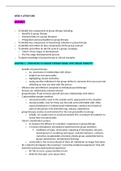
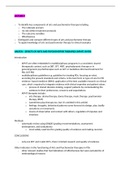
PCC Exam 2 Blueprint
Discuss the differences between race, ethnicity, and culture. -correct answer_*race*: -unlike
ethnicity -*strictly related to biology* -groupings based on biologic similarities *ethnicity*:
-similar to culture -refers to *groups sharing common social and cultural heritage* -passed
down through generations -way of categorizing people based off of shared characteristics
-never assume a patients ethnicity, always ask "what is your ethnicity?" -ethnic groups:
--characteristics in common --physical, race, ancestry, religion *culture*: -a *learned*, pattern
behavior response acquired over time -includes *beliefs, attitudes, values, customs, art, taboos,
and ways of life* -*primarily learned and passed on by families and social organizations*
-guides decision making -impacts worldview -facilitates self worth and identity
-*characteristics*: --beliefs provide *identity* and sense of belonging --consist of common
beliefs and practices --exist at many levels (material - art, dress; non-material - customs,
language, practices) --learned and taught --dynamic and adaptive to environment --complex
--diverse --all-encompassing -culture is *individualized* -every person has a culture -culture is
dynamic (it changes) -*nurses culture*: personal beliefs and nursing's professional values
Define key concepts related to cultural competency. -correct answer_*cultural competency*: an
ongoing process that consists of the attitudes, knowledge, and skills necessary for providing
quality care to diverse populations -healthcare providers continuously strive to achieve the
availability and ability to effectively work within the cultural context of the client
*verbal/non-verbal* cultural considerations: -touch? -eye contact? -how should you address
the patient? *ASKED* Model: cultural competency is a process not an end point *A*wareness:
check yourself at the door - assess your own biases in an open and honest manner *S*kills:
your ability to conduct a cultural assessment with sensitivity *K*nowledge: do you have the
appropriate knowledge/information about cultural worldviews? *E*ncounters: it takes practice
to become competent - is touch allowed, how should you refer to the patient, and can you
make eye contact? *D*esire: you must want to be culturally competent *ETHNIC* Tool:
*E*xplanation: -why do you believe you have this problem/illness? *T*reatment: -what
medication, home remedies, or other treatments have you tried for this illness? -is there
anything you eat, drink, do, or avoid on a daily basis to stay healthy? -what kind of treatment
are you seeking today? *H*ealers: -have you sought help/advice/treatment from others
(alternate healers, folk healers, friends, etc), who are not doctors for help regarding your
illnesses? *N*egotiate: -try to find mutual options that benefit both you and your patient and
goes along with their beliefs, rather than contradicting them *I*ntervention: -determine an
intervention with your patient that may include alternate treatments, spirituality, healers, and
other cultural practices (ex: food eaten/avoided, when sick or in general) *C*ollaboration:
-collaborate with patient, family, other members of the healthcare team, healers, and Discuss
components of a cultural assessment. -correct answer_-cultural background -rituals and
customs -communication patterns/norms -nutritional practices -family relationships -decision
making on consent for treatment -beliefs & perceptions relating to health, illness, & treatment
-self-care v. being cared for -individual time keeping beliefs and practices -boundaries related
to privacy -views of hospitals, nurses, doctors, & other healers -issues affecting delivery of care
-both formal and informal education Discuss strategies to complete an assessment of cultural
preferences. -correct answer_-ask open-ended questions -allow patient time to answer
questions -listen respectfully -listen without bias -remain non-judgmental --be mindful of your
non-verbal communication Explain nursing techniques to address cultural barriers relating to
patient care. -correct answer_-is the practice good or bad? -how does the practice effect the
patients care? *practice is efficacious-helpful*: -help patient preserve -encourage family to
brings in food appropriate for their diet *practice is neutral-neither helpful nor harmful*: -do
not interfere with practices -ex: fasting, prayers *effects of the practice are unknown*: -do not
encourage or discourage until you obtain more information *practice is dysfunctional*:
, -discourage harmful practices -support client to modify behaviors and to adopt new, beneficial
health behaviors -respect clients values and beliefs *barriers include*: -lack of knowledge
-emotional responses -ethnocentrism -cultural stereotypes -prejudice -discrimination -racism
-sexism -language barrier -street talk, slang, jargon -healthcare jargon Discuss cultural
considerations that impact health care delivery. -correct answer_*communication*: -*verbal*
and *non-verbal* -if there is a *communication barrier* then an interpreter is needed
-*non-verbal communication* is important to because different things have different
meanings in different cultures --what therapeutic touch means in that culture, it may not be
accepted --next eye contact, in some cultures avoiding eye contact is a sign of respect --what
do your gestures and body language mean in that culture? *personal space*: -personal space
varies -intimate: <18 in. -personal: 18 in-4 ft. -social: 4 ft.-12 ft. -public: >12 ft. *time
orientation*: -present or future oriented -how do they feel about showing up on time for an
appointment? -how do they feel about being late? -what are their religious or ethnic holidays
related to time orientation? *social organization*: -family units and broader groups -who is in
charge? -who is the head of household? -who is the decision maker? *environmental control*:
-perception of pain, exercise, and diet *biological variations*: -enzymatic and genetic, drug
metabolism *religion and philosophy*: -acceptable healthcare, blood transfusions *politics,
law*: -government policies, limits for NP's *economy*: -public funding, medicare *education*:
-knowledge, expectations of care Utilize the patient chart to provide safe and effective care.
-correct answer_*admission documents*: -nursing admission assessment -baseline data from
which to monitor change discharge planning information/needs -admission database -chief
complaint/reason for admission -physical assessment -vital signs -allergies -current
medication -ADL status client support system and contact information *Kardex*: -demographic
data -medical diagnoses -allergies -diet/activity orders -safety precautions -intravenous
therapy orders -ordered treatments (wound care, physical therapy), surgery, laboratory, and
tests -summary of medications ordered -isolation orders -DNR (do not resuscitate) orders
*flow sheets*: -record routine aspects of care (hygiene, turning) -document assessments;
usually organized according to body systems -track client response to care (wound care, pain,
intravenous fluids) -graphic records: used to record vital signs -I&O (intake and output) record
*MAR*: -comprehensive list of all ordered medications --allergies -documents
-scheduled/routine --PRN (as needed) ---Ex. Pain medications --STAT (give immediately)
--omitted doses ---additional explanation may be required for non-routine or omitted
medications. *discharge summary*: -time of departure and method of transportation -name
and relationship of person(s) accompanying -condition at discharge -teaching conducted and
handouts/informational matter provided to client -discharge instructions (including
medications, treatments, or activity) -follow-up appointments or referrals given -most
standardized in EHR *tips for documentation*: -discharge planning begins on admission
-document immediately after you administer medication, NEVER before -drug allergies are
always noted on MAR -dosage range prescriptions are NO longer allowed in electronic MAR
system -report ALL errors --*INCIDENT REPORTS NEVER GO IN THE PATIENT CHART* -report
changes in Document nursing care in accordance with professional standards. -correct
answer_*chart on right patient* -double check to make sure you are in the correct patients
chart *be timely* -document asap *correct terminology, grammar, & spelling* -avoid
abbreviations when possible *be factual* -avoid conjecture *know military clock* -no : -1200 =
12pm; 2400 = 12am; 1400=2pm; 0200 = 2am *sign all documents* types of documentation:
*source oriented documentation*: -disciplines charted separately -variety of sections (e.g.,
admission, H&P, diagnostic, graphic, nurses' notes, progress notes, lab, rehab, DC plan, etc.)
-data scattered; may lead to fragmentation *problem oriented documentation*: -organized
around client problems -four components: --database --problem list --plan of care --progress
notes -allows greater collaboration *narrative charting*: -use with source or problem-oriented
system -chronological story of care -tracks client's changing status -can be lengthy and
Discuss the differences between race, ethnicity, and culture. -correct answer_*race*: -unlike
ethnicity -*strictly related to biology* -groupings based on biologic similarities *ethnicity*:
-similar to culture -refers to *groups sharing common social and cultural heritage* -passed
down through generations -way of categorizing people based off of shared characteristics
-never assume a patients ethnicity, always ask "what is your ethnicity?" -ethnic groups:
--characteristics in common --physical, race, ancestry, religion *culture*: -a *learned*, pattern
behavior response acquired over time -includes *beliefs, attitudes, values, customs, art, taboos,
and ways of life* -*primarily learned and passed on by families and social organizations*
-guides decision making -impacts worldview -facilitates self worth and identity
-*characteristics*: --beliefs provide *identity* and sense of belonging --consist of common
beliefs and practices --exist at many levels (material - art, dress; non-material - customs,
language, practices) --learned and taught --dynamic and adaptive to environment --complex
--diverse --all-encompassing -culture is *individualized* -every person has a culture -culture is
dynamic (it changes) -*nurses culture*: personal beliefs and nursing's professional values
Define key concepts related to cultural competency. -correct answer_*cultural competency*: an
ongoing process that consists of the attitudes, knowledge, and skills necessary for providing
quality care to diverse populations -healthcare providers continuously strive to achieve the
availability and ability to effectively work within the cultural context of the client
*verbal/non-verbal* cultural considerations: -touch? -eye contact? -how should you address
the patient? *ASKED* Model: cultural competency is a process not an end point *A*wareness:
check yourself at the door - assess your own biases in an open and honest manner *S*kills:
your ability to conduct a cultural assessment with sensitivity *K*nowledge: do you have the
appropriate knowledge/information about cultural worldviews? *E*ncounters: it takes practice
to become competent - is touch allowed, how should you refer to the patient, and can you
make eye contact? *D*esire: you must want to be culturally competent *ETHNIC* Tool:
*E*xplanation: -why do you believe you have this problem/illness? *T*reatment: -what
medication, home remedies, or other treatments have you tried for this illness? -is there
anything you eat, drink, do, or avoid on a daily basis to stay healthy? -what kind of treatment
are you seeking today? *H*ealers: -have you sought help/advice/treatment from others
(alternate healers, folk healers, friends, etc), who are not doctors for help regarding your
illnesses? *N*egotiate: -try to find mutual options that benefit both you and your patient and
goes along with their beliefs, rather than contradicting them *I*ntervention: -determine an
intervention with your patient that may include alternate treatments, spirituality, healers, and
other cultural practices (ex: food eaten/avoided, when sick or in general) *C*ollaboration:
-collaborate with patient, family, other members of the healthcare team, healers, and Discuss
components of a cultural assessment. -correct answer_-cultural background -rituals and
customs -communication patterns/norms -nutritional practices -family relationships -decision
making on consent for treatment -beliefs & perceptions relating to health, illness, & treatment
-self-care v. being cared for -individual time keeping beliefs and practices -boundaries related
to privacy -views of hospitals, nurses, doctors, & other healers -issues affecting delivery of care
-both formal and informal education Discuss strategies to complete an assessment of cultural
preferences. -correct answer_-ask open-ended questions -allow patient time to answer
questions -listen respectfully -listen without bias -remain non-judgmental --be mindful of your
non-verbal communication Explain nursing techniques to address cultural barriers relating to
patient care. -correct answer_-is the practice good or bad? -how does the practice effect the
patients care? *practice is efficacious-helpful*: -help patient preserve -encourage family to
brings in food appropriate for their diet *practice is neutral-neither helpful nor harmful*: -do
not interfere with practices -ex: fasting, prayers *effects of the practice are unknown*: -do not
encourage or discourage until you obtain more information *practice is dysfunctional*:
, -discourage harmful practices -support client to modify behaviors and to adopt new, beneficial
health behaviors -respect clients values and beliefs *barriers include*: -lack of knowledge
-emotional responses -ethnocentrism -cultural stereotypes -prejudice -discrimination -racism
-sexism -language barrier -street talk, slang, jargon -healthcare jargon Discuss cultural
considerations that impact health care delivery. -correct answer_*communication*: -*verbal*
and *non-verbal* -if there is a *communication barrier* then an interpreter is needed
-*non-verbal communication* is important to because different things have different
meanings in different cultures --what therapeutic touch means in that culture, it may not be
accepted --next eye contact, in some cultures avoiding eye contact is a sign of respect --what
do your gestures and body language mean in that culture? *personal space*: -personal space
varies -intimate: <18 in. -personal: 18 in-4 ft. -social: 4 ft.-12 ft. -public: >12 ft. *time
orientation*: -present or future oriented -how do they feel about showing up on time for an
appointment? -how do they feel about being late? -what are their religious or ethnic holidays
related to time orientation? *social organization*: -family units and broader groups -who is in
charge? -who is the head of household? -who is the decision maker? *environmental control*:
-perception of pain, exercise, and diet *biological variations*: -enzymatic and genetic, drug
metabolism *religion and philosophy*: -acceptable healthcare, blood transfusions *politics,
law*: -government policies, limits for NP's *economy*: -public funding, medicare *education*:
-knowledge, expectations of care Utilize the patient chart to provide safe and effective care.
-correct answer_*admission documents*: -nursing admission assessment -baseline data from
which to monitor change discharge planning information/needs -admission database -chief
complaint/reason for admission -physical assessment -vital signs -allergies -current
medication -ADL status client support system and contact information *Kardex*: -demographic
data -medical diagnoses -allergies -diet/activity orders -safety precautions -intravenous
therapy orders -ordered treatments (wound care, physical therapy), surgery, laboratory, and
tests -summary of medications ordered -isolation orders -DNR (do not resuscitate) orders
*flow sheets*: -record routine aspects of care (hygiene, turning) -document assessments;
usually organized according to body systems -track client response to care (wound care, pain,
intravenous fluids) -graphic records: used to record vital signs -I&O (intake and output) record
*MAR*: -comprehensive list of all ordered medications --allergies -documents
-scheduled/routine --PRN (as needed) ---Ex. Pain medications --STAT (give immediately)
--omitted doses ---additional explanation may be required for non-routine or omitted
medications. *discharge summary*: -time of departure and method of transportation -name
and relationship of person(s) accompanying -condition at discharge -teaching conducted and
handouts/informational matter provided to client -discharge instructions (including
medications, treatments, or activity) -follow-up appointments or referrals given -most
standardized in EHR *tips for documentation*: -discharge planning begins on admission
-document immediately after you administer medication, NEVER before -drug allergies are
always noted on MAR -dosage range prescriptions are NO longer allowed in electronic MAR
system -report ALL errors --*INCIDENT REPORTS NEVER GO IN THE PATIENT CHART* -report
changes in Document nursing care in accordance with professional standards. -correct
answer_*chart on right patient* -double check to make sure you are in the correct patients
chart *be timely* -document asap *correct terminology, grammar, & spelling* -avoid
abbreviations when possible *be factual* -avoid conjecture *know military clock* -no : -1200 =
12pm; 2400 = 12am; 1400=2pm; 0200 = 2am *sign all documents* types of documentation:
*source oriented documentation*: -disciplines charted separately -variety of sections (e.g.,
admission, H&P, diagnostic, graphic, nurses' notes, progress notes, lab, rehab, DC plan, etc.)
-data scattered; may lead to fragmentation *problem oriented documentation*: -organized
around client problems -four components: --database --problem list --plan of care --progress
notes -allows greater collaboration *narrative charting*: -use with source or problem-oriented
system -chronological story of care -tracks client's changing status -can be lengthy and