Psychology Unit 4
Section A
Section B
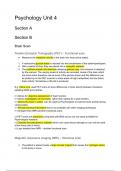
Brain Scan
Position Emission Tomography (PET) – Functional scan
● Measures the metabolic activity in the brain (the most active areas).
1. A radioactive glucose tracer is injected into the bloodstream of the patient/participant.
2. After a period of time, they are placed into a computer scanner.
3. The positrons smash into electrons releasing gamma rays, this emission is detected
by the scanner. The varying levels of activity are recorded. Areas of the brain which
are more active therefore use up more of the glucose tracer and this difference can
be picked up on the PET scanner to show areas of high (red/yellow) and low (blue)
brain activity. Sometimes a 3D plot is produced.
E.g. Raine et al. used PET scans to show differences in brain activity between murderers
pleading NGRI and controls.
(+) Allows for objective assessment of brain function.
(+) Allows investigation of live brains, rather than waiting for a post-mortem.
(+) Shows the brain in action. Can be used by Psychologists to examine brain activity during
various tasks.
(+) Reveal chemical information that is not available with other imaging techniques
(+) Cheaper than fMRI (another functional scan).
(-) PET scans are expensive (compared with MRI) and so are not easily available for
Psychological research.
(-) Exposes the participant to radiation which can cause tissue damage so can only be used
a few times (risk of harm).
(-) Less detailed than fMRI – another functional scan.
Magnetic resonance imaging (MRI) – Structural scan
1. The patient is placed inside a large circular magnet that causes the hydrogen atoms
in the body to move.
, 2. When the magnet is turned off, these revert to their original positions, producing an
electromagnetic signal translated by the computer into pictures of brain tissue. Used
to map the structure of the brain.
E.g. Andreasen (1988) studied MRI scans of individuals with and without schizophrenia and
found that those with schizophrenia had ventricles which were 20% to 50% larger than
non-schizophrenics.
(+) Allows for objective assessment of brain structure.
(+) Allows investigation of live brains, rather than waiting for post-mortem.
(+) Does not expose the patient to radiation (unlike PET) and so is more appropriate when
multiple scans are needed of the same patient.
(+) More detailed than older structural scans (e.g. CT).
(-) They take a long time and the process can be uncomfortable and psychologically
distressing for some patients, especially those with claustrophobia (ethical issues).
(-) Very noisy
(-) Magnetic fields used mean that patients with metal implants in their bodies are unable to
have an MRI scan.
Q. Describe how brain scans have been used in psychology. (6)
In MRI, the patient is placed inside a large circular magnet that causes the hydrogen atoms
in the body to move. When the magnet is turned off, these Hydrogen atoms revert to their
original positions, producing an electromagnetic signal that is translated by the computer into
pictures of brain tissue.
eg. Andreason studied MRI scans of individuals with and without scz and found that those
with scz had 20-50% larger ventricles than non-schizophrenics.
In PET, a radioactive tracer is combined with sugar (fluorodeoxyglucose); a hormone
(norepinephrine) or a protein (Cyclo RGDIC). A radioactive tracer is injected into the
participant/patient awaiting the scan. After a period of time, the patient/participant is placed
into a computer scanner. The positrons smash into electrons releasing gamma rays, this
emission is detected by the scanner. The detected emissions are plotted in the varying levels
of activity in the brain are recorded, sometimes a 3-D plot is produced.
eg. Raine et al study the difference between the brain structure in murderers pleading NGRI
and control groups.
Research Methods
Longitudinal Research
Definition: A study of the same participants over a long period of time (months or years). The
aim is to observe long-term changes in behaviour. For example, changes in behaviour over
the lifespan. It may utilise a range of other methodologies such as case studies, interviews
etc. It is usually observational in nature.
Section A
Section B
Brain Scan
Position Emission Tomography (PET) – Functional scan
● Measures the metabolic activity in the brain (the most active areas).
1. A radioactive glucose tracer is injected into the bloodstream of the patient/participant.
2. After a period of time, they are placed into a computer scanner.
3. The positrons smash into electrons releasing gamma rays, this emission is detected
by the scanner. The varying levels of activity are recorded. Areas of the brain which
are more active therefore use up more of the glucose tracer and this difference can
be picked up on the PET scanner to show areas of high (red/yellow) and low (blue)
brain activity. Sometimes a 3D plot is produced.
E.g. Raine et al. used PET scans to show differences in brain activity between murderers
pleading NGRI and controls.
(+) Allows for objective assessment of brain function.
(+) Allows investigation of live brains, rather than waiting for a post-mortem.
(+) Shows the brain in action. Can be used by Psychologists to examine brain activity during
various tasks.
(+) Reveal chemical information that is not available with other imaging techniques
(+) Cheaper than fMRI (another functional scan).
(-) PET scans are expensive (compared with MRI) and so are not easily available for
Psychological research.
(-) Exposes the participant to radiation which can cause tissue damage so can only be used
a few times (risk of harm).
(-) Less detailed than fMRI – another functional scan.
Magnetic resonance imaging (MRI) – Structural scan
1. The patient is placed inside a large circular magnet that causes the hydrogen atoms
in the body to move.
, 2. When the magnet is turned off, these revert to their original positions, producing an
electromagnetic signal translated by the computer into pictures of brain tissue. Used
to map the structure of the brain.
E.g. Andreasen (1988) studied MRI scans of individuals with and without schizophrenia and
found that those with schizophrenia had ventricles which were 20% to 50% larger than
non-schizophrenics.
(+) Allows for objective assessment of brain structure.
(+) Allows investigation of live brains, rather than waiting for post-mortem.
(+) Does not expose the patient to radiation (unlike PET) and so is more appropriate when
multiple scans are needed of the same patient.
(+) More detailed than older structural scans (e.g. CT).
(-) They take a long time and the process can be uncomfortable and psychologically
distressing for some patients, especially those with claustrophobia (ethical issues).
(-) Very noisy
(-) Magnetic fields used mean that patients with metal implants in their bodies are unable to
have an MRI scan.
Q. Describe how brain scans have been used in psychology. (6)
In MRI, the patient is placed inside a large circular magnet that causes the hydrogen atoms
in the body to move. When the magnet is turned off, these Hydrogen atoms revert to their
original positions, producing an electromagnetic signal that is translated by the computer into
pictures of brain tissue.
eg. Andreason studied MRI scans of individuals with and without scz and found that those
with scz had 20-50% larger ventricles than non-schizophrenics.
In PET, a radioactive tracer is combined with sugar (fluorodeoxyglucose); a hormone
(norepinephrine) or a protein (Cyclo RGDIC). A radioactive tracer is injected into the
participant/patient awaiting the scan. After a period of time, the patient/participant is placed
into a computer scanner. The positrons smash into electrons releasing gamma rays, this
emission is detected by the scanner. The detected emissions are plotted in the varying levels
of activity in the brain are recorded, sometimes a 3-D plot is produced.
eg. Raine et al study the difference between the brain structure in murderers pleading NGRI
and control groups.
Research Methods
Longitudinal Research
Definition: A study of the same participants over a long period of time (months or years). The
aim is to observe long-term changes in behaviour. For example, changes in behaviour over
the lifespan. It may utilise a range of other methodologies such as case studies, interviews
etc. It is usually observational in nature.