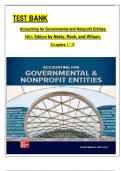
TEST BANK
Accounting for Governmental and Nonprofit Entities
19th Edition by Neely, Reck, and Wilson,
Chapters 1 - 17
,TABLE OF CONTENTS
Chapter 1: Introduction to Accounting and Financial Reportingfor Government and Not-for-Profit
Entities
PART ONE: State and Local Governments
Chapter 2: Principles of Accounting and Financial Reportingfor State and Local Governments C
hapter 3: Governmental Operating Statement Accounts;Budgetary Accounting
Chapter 4: Accounting for Governmental Operating Activities—Illustrative Transactions and Financial
Statements
Chapter 5: Accounting for General Capital Assets and CapitalProjects Ch
apter 6: Accounting for General Long-Term Liabilities andDebt Service
Chapter 7: Accounting for the Business-type Activities ofState and Local Governments Ch
apter 8: Accounting for Fiduciary Activities—Custodial andTrust Funds
Chapter 9: FinancialReporting of State and Local Governments
PART TWO: Accountability for Public Funds
Chapter 10: Analysis of Government Financial Performance
Chapter 11: Auditing of Government and Not-for-ProfitOrganizations Ch
apter 12: Budgeting and Performance Measurement
PART THREE: Accounting and Financial Reporting for Not-for-ProfitOrganizations and the
Federal Government
Chapter 13: Not-for-Profit Organizations— Regulatory,Taxation, and Performance Issues Ch
apter 14: Accounting for Not-for-Profit Organizations
Chapter 15: Accounting for Colleges and Universities C
hapter 16: Accounting for Health Care Organizations
Chapter 17: Accounting and Reporting for the Federal Government
Chapter 1: Introduction to Accounting and Financial Reportingfor
Government and Not-for-Profit Entities
,ANSWERS AT THE END OF EACH CHAPTER
1) Explain the essential differences between general purpose and
special purpose governments and give several examples of each.
2) Identify and explain the characteristics that distinguish governments and not-for-
profit entities from business entities.
3) GASB and FASB standards are concerned only with external financial reporting; wh
ereas, FASAB standards are concerned with both internal and external financial reporting. Do
you agree with this statement? Why or why not?
4) Why should persons interested in reading financial reports of governments and not-
for- profit entities be familiar with standards set by the GASB and the FASB?
, 5) Explain in your own words why accountability is the cornerstone of all
financial reporting in government.
6) In your own words state the primary needs the GASB believes external users have
for financial reports of state and local governments. For contrast, state the uses the FASB
believes external users have for the financial reports of not-for-profit organizations.
7) Describe the difference between a comprehensive annual financial report (CAFR)
and GASB general purpose external financial reporting for state and local governments.
8) Identify and briefly explain the four sections of the performance and accountability
report (PAR) that the Office of Management and Budget requires major federal departments
and agencies to prepare.
Accounting for Governmental and Nonprofit Entities
19th Edition by Neely, Reck, and Wilson,
Chapters 1 - 17
,TABLE OF CONTENTS
Chapter 1: Introduction to Accounting and Financial Reportingfor Government and Not-for-Profit
Entities
PART ONE: State and Local Governments
Chapter 2: Principles of Accounting and Financial Reportingfor State and Local Governments C
hapter 3: Governmental Operating Statement Accounts;Budgetary Accounting
Chapter 4: Accounting for Governmental Operating Activities—Illustrative Transactions and Financial
Statements
Chapter 5: Accounting for General Capital Assets and CapitalProjects Ch
apter 6: Accounting for General Long-Term Liabilities andDebt Service
Chapter 7: Accounting for the Business-type Activities ofState and Local Governments Ch
apter 8: Accounting for Fiduciary Activities—Custodial andTrust Funds
Chapter 9: FinancialReporting of State and Local Governments
PART TWO: Accountability for Public Funds
Chapter 10: Analysis of Government Financial Performance
Chapter 11: Auditing of Government and Not-for-ProfitOrganizations Ch
apter 12: Budgeting and Performance Measurement
PART THREE: Accounting and Financial Reporting for Not-for-ProfitOrganizations and the
Federal Government
Chapter 13: Not-for-Profit Organizations— Regulatory,Taxation, and Performance Issues Ch
apter 14: Accounting for Not-for-Profit Organizations
Chapter 15: Accounting for Colleges and Universities C
hapter 16: Accounting for Health Care Organizations
Chapter 17: Accounting and Reporting for the Federal Government
Chapter 1: Introduction to Accounting and Financial Reportingfor
Government and Not-for-Profit Entities
,ANSWERS AT THE END OF EACH CHAPTER
1) Explain the essential differences between general purpose and
special purpose governments and give several examples of each.
2) Identify and explain the characteristics that distinguish governments and not-for-
profit entities from business entities.
3) GASB and FASB standards are concerned only with external financial reporting; wh
ereas, FASAB standards are concerned with both internal and external financial reporting. Do
you agree with this statement? Why or why not?
4) Why should persons interested in reading financial reports of governments and not-
for- profit entities be familiar with standards set by the GASB and the FASB?
, 5) Explain in your own words why accountability is the cornerstone of all
financial reporting in government.
6) In your own words state the primary needs the GASB believes external users have
for financial reports of state and local governments. For contrast, state the uses the FASB
believes external users have for the financial reports of not-for-profit organizations.
7) Describe the difference between a comprehensive annual financial report (CAFR)
and GASB general purpose external financial reporting for state and local governments.
8) Identify and briefly explain the four sections of the performance and accountability
report (PAR) that the Office of Management and Budget requires major federal departments
and agencies to prepare.