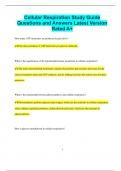
Cellular Respiration Study Guide
Questions and Answers Latest Version
Rated A+
How many ATP molecules are produced in glycolysis?
✔✔Glycolysis produces 2 ATP molecules per glucose molecule.
What is the significance of the mitochondrial inner membrane in cellular respiration?
✔✔The inner mitochondrial membrane contains the proteins and enzymes necessary for the
electron transport chain and ATP synthesis, and its folding increases the surface area for these
processes.
What is the relationship between photosynthesis and cellular respiration?
✔✔Photosynthesis produces glucose and oxygen, which are the reactants in cellular respiration,
while cellular respiration produces carbon dioxide and water, which are the reactants in
photosynthesis.
How is glucose metabolized in cellular respiration?
1
, ✔✔Glucose is broken down into pyruvate during glycolysis, then further processed into acetyl-
CoA in the citric acid cycle, and the energy from glucose is transferred to ATP, NADH, and
FADH2.
What happens in the mitochondria during cellular respiration?
✔✔In the mitochondria, glycolysis occurs in the cytoplasm, while the citric acid cycle and
electron transport chain occur in the mitochondria, ultimately producing ATP.
What would happen if the citric acid cycle were blocked?
✔✔If the citric acid cycle were blocked, the production of ATP would decrease significantly, as
the cycle generates key molecules (NADH and FADH2) for the electron transport chain.
What are the two major phases of cellular respiration?
✔✔The two major phases of cellular respiration are the anaerobic phase (glycolysis) and the
aerobic phase (citric acid cycle and electron transport chain).
What is the role of the proton gradient in ATP production?
✔✔The proton gradient created by the electron transport chain provides the energy needed for
ATP synthase to generate ATP as protons flow back into the mitochondrial matrix.
2
Questions and Answers Latest Version
Rated A+
How many ATP molecules are produced in glycolysis?
✔✔Glycolysis produces 2 ATP molecules per glucose molecule.
What is the significance of the mitochondrial inner membrane in cellular respiration?
✔✔The inner mitochondrial membrane contains the proteins and enzymes necessary for the
electron transport chain and ATP synthesis, and its folding increases the surface area for these
processes.
What is the relationship between photosynthesis and cellular respiration?
✔✔Photosynthesis produces glucose and oxygen, which are the reactants in cellular respiration,
while cellular respiration produces carbon dioxide and water, which are the reactants in
photosynthesis.
How is glucose metabolized in cellular respiration?
1
, ✔✔Glucose is broken down into pyruvate during glycolysis, then further processed into acetyl-
CoA in the citric acid cycle, and the energy from glucose is transferred to ATP, NADH, and
FADH2.
What happens in the mitochondria during cellular respiration?
✔✔In the mitochondria, glycolysis occurs in the cytoplasm, while the citric acid cycle and
electron transport chain occur in the mitochondria, ultimately producing ATP.
What would happen if the citric acid cycle were blocked?
✔✔If the citric acid cycle were blocked, the production of ATP would decrease significantly, as
the cycle generates key molecules (NADH and FADH2) for the electron transport chain.
What are the two major phases of cellular respiration?
✔✔The two major phases of cellular respiration are the anaerobic phase (glycolysis) and the
aerobic phase (citric acid cycle and electron transport chain).
What is the role of the proton gradient in ATP production?
✔✔The proton gradient created by the electron transport chain provides the energy needed for
ATP synthase to generate ATP as protons flow back into the mitochondrial matrix.
2