BSW SOCIAL WORK EXIT EXAM
QUESTIONS WITH COMPLETE
SOLUTIONS
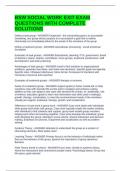
Define a task group - ANSWER-Organized - the overarching goal is to accomplish
something. any group whose purpose is to accomplish a goal that is neither
intrinsically nor immediately linked to the needs of the members of the group
Define a treatment group - ANSWER-educational, processing - social emotional
foundation
Examples of task groups - ANSWER-Educational, planning, PTA, government, board
of directors, teams, boards, committees, focus groups, treatment conferences, staff
development, and policy planning
Advantages of task groups - ANSWER-Used to find solutions to organizational
problems, generate new ideas, and make new decisions. Specific goals and agenda.
Specific roles. Infrequent disclosure. More formal. Composed of members with
necessary resources and expertise.
Examples of treatment groups - ANSWER-therapy or recovery
Goals of a treatment group - ANSWER-support goals (to foster mutual aid, to help
members cope with stressful life events and to revitalize and enhance coping
abilities so they can adapt to and cope with stressful life events, ex: leadership, role
of worker), education (goals to learn new information and skills used in settings),
growth, therapy, socialization, to meet the socioemotional needs of the members.
Usually are support, treatment, therapy, growth, and socialization.
Difference of case work & group work - ANSWER-Case work deals with individuals
while group work deals with groups. Case work typically entails the worker working
with individual to find solutions and support, group work entails group members
helping each other and working together. Case work develops the individual, group
work develops the group. Members versus clients, Shared interaction and decision
making, Emphasis on process, Enjoyment and socialization as well as problem
solving
Systems Theory - ANSWER-Attempts to understand the group as a system of
interacting elements, Most widely used
Learning Theory - ANSWER-Primary focus is on the behavior of individuals rather
than on the behavior of the group, Ignores the importance of group dynamics,
Bandura
Field Theory (need to check) - ANSWER-Kurt Lewin, Similar to systems theory,
About the interactions and connections people make, Psychology based, Group has
life space, goal oriented
,Narrative Theory - ANSWER-Focus is on how group members create and maintain,
Tell a story - what is your story? Heal through your story
Cognitive Behavioral Therapy - ANSWER-is a psycho-social intervention that aims to
improve mental health. CBT focuses on challenging and changing unhelpful
cognitive distortions and behaviors, improving emotional regulation, and the
development of personal coping strategies that target solving current problems.
Motivational Interviewing - ANSWER-is a directive, client-centered counseling style
for eliciting behavior change by helping clients to explore and resolve ambivalence. It
is most centrally defined not by technique but by its spirit as a facilitative style for
interpersonal relationship
Group cohesion - ANSWER-a result of all forces acting on members to remain in a
group
Group dynamics - ANSWER-Communication and interaction patterns, Cohesion,
Social integration, Group culture
How does a facilitator create and manage safety in group work? - ANSWER-Setting
ground rules when group starts, lay a foundation of expectations and norms,
screening
What are the stages of group development? - ANSWER-Beginning: Forming, Middle:
Storming, End: Norming
What are the power bases of leadership? - ANSWER-legitimate, reward, expert,
referent, coercive, informational
Describe the legitimate power base of leadership - ANSWER-authority, the leader is
credible and legitimate
Describe the reward power base of leadership - ANSWER-the ability of leader to
give members rewards
Describe the expert power base of leadership - ANSWER-the leader is an expert in
the field and is very knowledgeable
Describe the referent power base of leadership - ANSWER-the leader deserves
respect and is likeable
Describe the informational power base of leadership - ANSWER-the leader is the
person who has the information members may need
Describe the coercive power base of leadership - ANSWER-the leader is persuasive
and can reward or punish members
What is the interactional model of leadership? - ANSWER-Focuses exclusively on
the leader, the model of the leadership presented in this book focuses on the group,
,the worker as designated leader, the members, and the environment in which the
group functions.
What group leadership skills are needed to facilitate a group? - ANSWER-Involving
group members, attending skills, expressive skills, responding skills, focusing skills,
explicit processes, clarifying content, and group interactions.
What frameworks need to be kept in mind for leading diverse group? - ANSWER-
Intervening with sensitivity to diversity, Advocating for members, Cultural humility,
Assessing cultural influences
What are the steps for planning groups? - ANSWER-Purpose, Sponsorship,
Assessing potential membership, composing group, orienting members, contracting,
preparing the environment, reviewing the literature, evaluation, writing group
proposal
Describe the purpose step - ANSWER-Statements explaining the purpose includes
info on the problems or issues the group is designed to address
Describe the sponsorship step - ANSWER-Assess sponsoring agency and the
potential membership base to plan for the group, Determines level of support and
resources available
Describe the assessing potential membership step - ANSWER-the extent of problem
or need, cultural differences, members perceptions about the purpose of the group,
demographic differences, potential benefits to members, barriers, obstacles,
drawbacks, resources needed from the organization
Describe the step of composing group - ANSWER-All the same kind of members
purposes and certain personal characteristics, Diversity of member coping skills, life
experiences, and expertise, A range of members qualities and expertise
Describe the orienting members step - ANSWER-Primary orientation method for
treatment groups is intake interview. 3 purposes for orientation: Explaining the
purpose of the group, Familiarizing members with group procedures, Screening
members for appropriateness
Describe the contracting step - ANSWER-Frequency of the group, when they will
meet, for how long, etc
Describe the preparing the environment step - ANSWER-Room size, Furnishing,
Technology, Atmosphere, Special needs
Describe reviewing the literature step - ANSWER-Search literature that is about the
group that is being planned. Ex: Articles, books, evidence based manuals etc
Describe the evaluation step - ANSWER-Monitoring the groups change process and
progress can help it stay on track and make sure agreed-upon goals are explicit and
being accomplished
, Describe the writing group proposal step - ANSWER-Inform members about the
group
What criteria enters into developing a group proposal? - ANSWER-Purpose,
Purpose statement, Membership, Recruitment, Orientation, Contract, Environment
What are the objectives for the beginning stage of a group? - ANSWER-1. Ensuring
secure environment, 2. Introducing new members, 3. Defining purpose of groups, 4.
Confidentiality, 5. Helping members feel a part of the group, 6. Guiding development,
7. Goal setting, 8. Contracting, 9. Providing motivation, 10. Working with
Ambivalence or resistance, 11. Working with involuntary members
What criteria enters into developing a group proposal? - ANSWER-Purpose,
Purpose statement, Membership, Recruitment, Orientation, Contract, Environment
Examples of interaction patterns - ANSWER-Maypole, Round Robin, Hot Seat, Free
Floating
Describe maypole - ANSWER-when the leader is the central figure and
communication occurs from the leader to the member and from the member to the
leader
Describe round robin - ANSWER-when members take turns talking in an organized
fashion
Describe hot seat - ANSWER-when there is an extended back-and-forth between the
leader and one member as the other members watch
Autism Spectrum Disorder (ASD) - ANSWER-Conditions that share similar
characteristics in the areas of social interaction, verbal or nonverbal communication,
and repetitive behaviours or interests. Unusual responses to sensory stimuli are
often present. Key word: Spectrum! There are similar characteristics but great
variance in the behaviours that are exhibited.
What is the definition of HMOs? - ANSWER-Health Maintenance Organization. An
individual must seek care within that specific network to get coverage (ex: Kaiser
Permanente). Type of insurance that you have to do in the specific place you are
told.
In relation to Values and Ethics, what is the definition of self-determination? -
ANSWER-Self-determination each individual's right to make his or her own
decisions. Practitioner's are responsible for informing clients about available
resources; helping them to find and articulate their alternatives; and assisting them in
evaluating the consequences of each option.The goal is to assist clients in making
the best, most informed choices possible.
In relation to social work practice, what is feedback? - ANSWER-Feedback is the
process of giving people information (positive or negative) about their
performance/behavior.
QUESTIONS WITH COMPLETE
SOLUTIONS
Define a task group - ANSWER-Organized - the overarching goal is to accomplish
something. any group whose purpose is to accomplish a goal that is neither
intrinsically nor immediately linked to the needs of the members of the group
Define a treatment group - ANSWER-educational, processing - social emotional
foundation
Examples of task groups - ANSWER-Educational, planning, PTA, government, board
of directors, teams, boards, committees, focus groups, treatment conferences, staff
development, and policy planning
Advantages of task groups - ANSWER-Used to find solutions to organizational
problems, generate new ideas, and make new decisions. Specific goals and agenda.
Specific roles. Infrequent disclosure. More formal. Composed of members with
necessary resources and expertise.
Examples of treatment groups - ANSWER-therapy or recovery
Goals of a treatment group - ANSWER-support goals (to foster mutual aid, to help
members cope with stressful life events and to revitalize and enhance coping
abilities so they can adapt to and cope with stressful life events, ex: leadership, role
of worker), education (goals to learn new information and skills used in settings),
growth, therapy, socialization, to meet the socioemotional needs of the members.
Usually are support, treatment, therapy, growth, and socialization.
Difference of case work & group work - ANSWER-Case work deals with individuals
while group work deals with groups. Case work typically entails the worker working
with individual to find solutions and support, group work entails group members
helping each other and working together. Case work develops the individual, group
work develops the group. Members versus clients, Shared interaction and decision
making, Emphasis on process, Enjoyment and socialization as well as problem
solving
Systems Theory - ANSWER-Attempts to understand the group as a system of
interacting elements, Most widely used
Learning Theory - ANSWER-Primary focus is on the behavior of individuals rather
than on the behavior of the group, Ignores the importance of group dynamics,
Bandura
Field Theory (need to check) - ANSWER-Kurt Lewin, Similar to systems theory,
About the interactions and connections people make, Psychology based, Group has
life space, goal oriented
,Narrative Theory - ANSWER-Focus is on how group members create and maintain,
Tell a story - what is your story? Heal through your story
Cognitive Behavioral Therapy - ANSWER-is a psycho-social intervention that aims to
improve mental health. CBT focuses on challenging and changing unhelpful
cognitive distortions and behaviors, improving emotional regulation, and the
development of personal coping strategies that target solving current problems.
Motivational Interviewing - ANSWER-is a directive, client-centered counseling style
for eliciting behavior change by helping clients to explore and resolve ambivalence. It
is most centrally defined not by technique but by its spirit as a facilitative style for
interpersonal relationship
Group cohesion - ANSWER-a result of all forces acting on members to remain in a
group
Group dynamics - ANSWER-Communication and interaction patterns, Cohesion,
Social integration, Group culture
How does a facilitator create and manage safety in group work? - ANSWER-Setting
ground rules when group starts, lay a foundation of expectations and norms,
screening
What are the stages of group development? - ANSWER-Beginning: Forming, Middle:
Storming, End: Norming
What are the power bases of leadership? - ANSWER-legitimate, reward, expert,
referent, coercive, informational
Describe the legitimate power base of leadership - ANSWER-authority, the leader is
credible and legitimate
Describe the reward power base of leadership - ANSWER-the ability of leader to
give members rewards
Describe the expert power base of leadership - ANSWER-the leader is an expert in
the field and is very knowledgeable
Describe the referent power base of leadership - ANSWER-the leader deserves
respect and is likeable
Describe the informational power base of leadership - ANSWER-the leader is the
person who has the information members may need
Describe the coercive power base of leadership - ANSWER-the leader is persuasive
and can reward or punish members
What is the interactional model of leadership? - ANSWER-Focuses exclusively on
the leader, the model of the leadership presented in this book focuses on the group,
,the worker as designated leader, the members, and the environment in which the
group functions.
What group leadership skills are needed to facilitate a group? - ANSWER-Involving
group members, attending skills, expressive skills, responding skills, focusing skills,
explicit processes, clarifying content, and group interactions.
What frameworks need to be kept in mind for leading diverse group? - ANSWER-
Intervening with sensitivity to diversity, Advocating for members, Cultural humility,
Assessing cultural influences
What are the steps for planning groups? - ANSWER-Purpose, Sponsorship,
Assessing potential membership, composing group, orienting members, contracting,
preparing the environment, reviewing the literature, evaluation, writing group
proposal
Describe the purpose step - ANSWER-Statements explaining the purpose includes
info on the problems or issues the group is designed to address
Describe the sponsorship step - ANSWER-Assess sponsoring agency and the
potential membership base to plan for the group, Determines level of support and
resources available
Describe the assessing potential membership step - ANSWER-the extent of problem
or need, cultural differences, members perceptions about the purpose of the group,
demographic differences, potential benefits to members, barriers, obstacles,
drawbacks, resources needed from the organization
Describe the step of composing group - ANSWER-All the same kind of members
purposes and certain personal characteristics, Diversity of member coping skills, life
experiences, and expertise, A range of members qualities and expertise
Describe the orienting members step - ANSWER-Primary orientation method for
treatment groups is intake interview. 3 purposes for orientation: Explaining the
purpose of the group, Familiarizing members with group procedures, Screening
members for appropriateness
Describe the contracting step - ANSWER-Frequency of the group, when they will
meet, for how long, etc
Describe the preparing the environment step - ANSWER-Room size, Furnishing,
Technology, Atmosphere, Special needs
Describe reviewing the literature step - ANSWER-Search literature that is about the
group that is being planned. Ex: Articles, books, evidence based manuals etc
Describe the evaluation step - ANSWER-Monitoring the groups change process and
progress can help it stay on track and make sure agreed-upon goals are explicit and
being accomplished
, Describe the writing group proposal step - ANSWER-Inform members about the
group
What criteria enters into developing a group proposal? - ANSWER-Purpose,
Purpose statement, Membership, Recruitment, Orientation, Contract, Environment
What are the objectives for the beginning stage of a group? - ANSWER-1. Ensuring
secure environment, 2. Introducing new members, 3. Defining purpose of groups, 4.
Confidentiality, 5. Helping members feel a part of the group, 6. Guiding development,
7. Goal setting, 8. Contracting, 9. Providing motivation, 10. Working with
Ambivalence or resistance, 11. Working with involuntary members
What criteria enters into developing a group proposal? - ANSWER-Purpose,
Purpose statement, Membership, Recruitment, Orientation, Contract, Environment
Examples of interaction patterns - ANSWER-Maypole, Round Robin, Hot Seat, Free
Floating
Describe maypole - ANSWER-when the leader is the central figure and
communication occurs from the leader to the member and from the member to the
leader
Describe round robin - ANSWER-when members take turns talking in an organized
fashion
Describe hot seat - ANSWER-when there is an extended back-and-forth between the
leader and one member as the other members watch
Autism Spectrum Disorder (ASD) - ANSWER-Conditions that share similar
characteristics in the areas of social interaction, verbal or nonverbal communication,
and repetitive behaviours or interests. Unusual responses to sensory stimuli are
often present. Key word: Spectrum! There are similar characteristics but great
variance in the behaviours that are exhibited.
What is the definition of HMOs? - ANSWER-Health Maintenance Organization. An
individual must seek care within that specific network to get coverage (ex: Kaiser
Permanente). Type of insurance that you have to do in the specific place you are
told.
In relation to Values and Ethics, what is the definition of self-determination? -
ANSWER-Self-determination each individual's right to make his or her own
decisions. Practitioner's are responsible for informing clients about available
resources; helping them to find and articulate their alternatives; and assisting them in
evaluating the consequences of each option.The goal is to assist clients in making
the best, most informed choices possible.
In relation to social work practice, what is feedback? - ANSWER-Feedback is the
process of giving people information (positive or negative) about their
performance/behavior.