LCSW Exam: Human Growth and
Development Exam 2025 Questions
and Answers 100% Pass
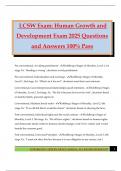
Pre-conventional, Avoiding punishment - ✔✔Kohlberg's Stages of Morality, Level 1, 1st
stage. Ex. "Stealing is wrong", decisions avoid punishment
Pre-conventional, Individualism and exchange - ✔✔Kohlberg's Stages of Morality,
Level 1, 2nd stage. Ex. "What's in it for me?", decisions meet their own interests.
Conventional, Good interpersonal relationships/good intentions - ✔✔Kohlberg's Stages
of Morality, Level 2, 3rd stage. Ex. "He did it because he loves his wife", decisions based
on family beliefs, personal approval.
Conventional, Maintain Social order - ✔✔Kohlberg's Stages of Morality, Level 2, 4th
stage. Ex. "If we all did this it would be chaos!", decisions based on obeying the laws.
Post-conventional, Individual rights and the social contract - ✔✔Kohlberg's Stages of
Morality, Level 3, 5th stage. Ex. "We all have rights.", decisions based on human rights
and democratic ideals, believes humans should change a rule if it is 'unfair' and would
benefit the common good.
Post-conventional, Universal Principles - ✔✔Kohlberg's Stages of Morality, Level 3, 6th
stage. Ex. "I must not obey this law because it is my obligation to my society, but I
COPYRIGHT © 2025 BY GRACE AMELIA, ALL RIGHTS RESERVED 1
, should not use violence as that harms the common good. Justice is more important than
obedience."
Infancy - ✔✔Stage in Erikson's psychosocial development theory. Conflict: *trust vs
mistrust* (feeding/comfort). Children develop a sense of trust when caregivers provide
reliability, care and affection. A lack of this will lead to mistrust. (0-18 months)
autonomy vs shame and doubt - ✔✔Stage in Erikson's psychosocial development
theory. Early Childhood (2-3) (toilet training/dressing). Children need to develop a
sense of personal control over physical skills and a sense of independence.
initiative vs guilt - ✔✔Stage in Erikson's psychosocial development theory. Preschool (3
to 5) (exploration/play). Children need to begin asserting control and power over the
environment. Success in this state leads to a sense of purpose.
industry vs inferiority - ✔✔Stage in Erikson's psychosocial development theory. School
Age (6-11) (school/activities). Children need to cope with new social and academic
demands.
identity vs role confusion - ✔✔Stage in Erikson's psychosocial development theory.
Adolescence (12-18) (social relationships/identity). Teens need to develop a sense of self
and personal identity.
intimacy vs isolation - ✔✔Stage in Erikson's psychosocial development theory. Young
Adult (19-40) (intimate relationships). Young adults need to form intimate, loving
relationships with other people.
generativity vs stagnation - ✔✔Stage in Erikson's psychosocial development theory.
Middle Adulthood (40-65) (work and parenthood). Adults need to create or nurture
things that will outlast them, often by having children or creating a positive change that
benefits other people.
COPYRIGHT © 2025 BY GRACE AMELIA, ALL RIGHTS RESERVED 2
Development Exam 2025 Questions
and Answers 100% Pass
Pre-conventional, Avoiding punishment - ✔✔Kohlberg's Stages of Morality, Level 1, 1st
stage. Ex. "Stealing is wrong", decisions avoid punishment
Pre-conventional, Individualism and exchange - ✔✔Kohlberg's Stages of Morality,
Level 1, 2nd stage. Ex. "What's in it for me?", decisions meet their own interests.
Conventional, Good interpersonal relationships/good intentions - ✔✔Kohlberg's Stages
of Morality, Level 2, 3rd stage. Ex. "He did it because he loves his wife", decisions based
on family beliefs, personal approval.
Conventional, Maintain Social order - ✔✔Kohlberg's Stages of Morality, Level 2, 4th
stage. Ex. "If we all did this it would be chaos!", decisions based on obeying the laws.
Post-conventional, Individual rights and the social contract - ✔✔Kohlberg's Stages of
Morality, Level 3, 5th stage. Ex. "We all have rights.", decisions based on human rights
and democratic ideals, believes humans should change a rule if it is 'unfair' and would
benefit the common good.
Post-conventional, Universal Principles - ✔✔Kohlberg's Stages of Morality, Level 3, 6th
stage. Ex. "I must not obey this law because it is my obligation to my society, but I
COPYRIGHT © 2025 BY GRACE AMELIA, ALL RIGHTS RESERVED 1
, should not use violence as that harms the common good. Justice is more important than
obedience."
Infancy - ✔✔Stage in Erikson's psychosocial development theory. Conflict: *trust vs
mistrust* (feeding/comfort). Children develop a sense of trust when caregivers provide
reliability, care and affection. A lack of this will lead to mistrust. (0-18 months)
autonomy vs shame and doubt - ✔✔Stage in Erikson's psychosocial development
theory. Early Childhood (2-3) (toilet training/dressing). Children need to develop a
sense of personal control over physical skills and a sense of independence.
initiative vs guilt - ✔✔Stage in Erikson's psychosocial development theory. Preschool (3
to 5) (exploration/play). Children need to begin asserting control and power over the
environment. Success in this state leads to a sense of purpose.
industry vs inferiority - ✔✔Stage in Erikson's psychosocial development theory. School
Age (6-11) (school/activities). Children need to cope with new social and academic
demands.
identity vs role confusion - ✔✔Stage in Erikson's psychosocial development theory.
Adolescence (12-18) (social relationships/identity). Teens need to develop a sense of self
and personal identity.
intimacy vs isolation - ✔✔Stage in Erikson's psychosocial development theory. Young
Adult (19-40) (intimate relationships). Young adults need to form intimate, loving
relationships with other people.
generativity vs stagnation - ✔✔Stage in Erikson's psychosocial development theory.
Middle Adulthood (40-65) (work and parenthood). Adults need to create or nurture
things that will outlast them, often by having children or creating a positive change that
benefits other people.
COPYRIGHT © 2025 BY GRACE AMELIA, ALL RIGHTS RESERVED 2