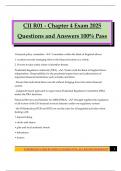
CII R01 - Chapter 4 Exam 2025
Questions and Answers 100% Pass
Financial policy committee - ✔✔- Committee within the Bank of England allows:
1. scrutiny towards emerging risks to the financial system as a whole
2. Powers to take action where it identifies threats.
Prudential Regulation Authority (PRA) - ✔✔- Works with the Bank of England but is
independent.- Responsibility for the prudential supervision and authorisation of
important financial institutions such as banks and firms
- Ensure that individual firms can fail without bringing down the entire financial
system.
- 'judgment based' approach to supervision,Prudential Regulation Committee (PRC)
makes the PRA decisions.
Financial Services and Markets Act 2000 (FSMA) - ✔✔- Brought together the regulation
of all sectors of the UK financial services industry under one regulatory system
- the FSAIntroduced FOS and FSCS set out the rules for all regulated activities when
dealing with:
• deposit taking
• stocks and shares
• gilts and local authority bonds
• debentures
• futures
COPYRIGHT © 2025 BY EMILLY CHARLOTTE, ALL RIGHTS RESERVED 1
Questions and Answers 100% Pass
Financial policy committee - ✔✔- Committee within the Bank of England allows:
1. scrutiny towards emerging risks to the financial system as a whole
2. Powers to take action where it identifies threats.
Prudential Regulation Authority (PRA) - ✔✔- Works with the Bank of England but is
independent.- Responsibility for the prudential supervision and authorisation of
important financial institutions such as banks and firms
- Ensure that individual firms can fail without bringing down the entire financial
system.
- 'judgment based' approach to supervision,Prudential Regulation Committee (PRC)
makes the PRA decisions.
Financial Services and Markets Act 2000 (FSMA) - ✔✔- Brought together the regulation
of all sectors of the UK financial services industry under one regulatory system
- the FSAIntroduced FOS and FSCS set out the rules for all regulated activities when
dealing with:
• deposit taking
• stocks and shares
• gilts and local authority bonds
• debentures
• futures
COPYRIGHT © 2025 BY EMILLY CHARLOTTE, ALL RIGHTS RESERVED 1