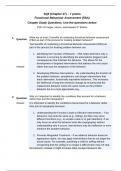
SQ3 (Chapter 12) – 21 points
Behaviour Skills Training
Chapter Questions: Use the Practice Test, Applications, and
Misapplications, as indicated below
Miltenberger 7th Edition
Practice Test
What four procedures are components of the BST procedure?
1. Question
Describe each component procedure.
Behavioral Skills Training (BST) procedures consist of four
components: instructions, modeling, rehearsal, and feedback.
1. Instructions: The trainer describes the important aspects of the
behavior to the learner. These instructions provide a clear
understanding of what the learner needs to do.
2. Modeling: The trainer demonstrates the behavior through live or
symbolic modeling. This allows the learner to observe exactly
Answer
how the behavior should be executed.
3. Rehearsal: The learner practices the behavior in a simulated
situation that closely resembles the natural context in which the
skill is required.
4. Feedback: After rehearsal, the trainer provides feedback by
reinforcing the correct aspects of the behavior and offering
guidance on how to improve any incorrect elements.
2. Question Describe the use of the BST procedure.
The appropriate time to use BST procedures is when the learner can
benefit from instructions and modeling and does not need more
Answer
intensive training procedures (such as chaining procedures) to learn
the skills.
, Provide two examples (not from this chapter) of skills that could
3. Question
be taught through the BST procedure.
1. Crossing the Street Safely
Answer
2. Making a Phone Call
For both of these examples, describe how you would use the BST
4. Question
procedure.
1. Crossing the Street Safely
Instructions: The trainer explains the steps to safely cross a
street, such as stopping at the curb, looking both ways, listening
for cars, and crossing when it is safe.
Modeling: The trainer demonstrates crossing a street safely,
emphasizing each step.
Rehearsal: The learner practices crossing a simulated or quiet
street while the trainer observes.
Feedback: The trainer praises the learner for looking both ways
and stopping at the curb but provides corrective feedback if the
learner forgets to listen for cars.
Answer
2. Making a Phone Call
Instructions: The trainer describes how to make a phone call,
such as dialing the number, introducing oneself, and asking for
the desired person or service.
Modeling: The trainer demonstrates making a phone call,
showing how to speak clearly and politely.
Rehearsal: The learner practices dialing a number and speaking
to the trainer in a role-play scenario.
Feedback: The trainer reinforces correct behaviors, like dialing
the number accurately, and suggests improvements if the
learner forgets to introduce themselves.
Why is the use of instructions or modeling alone usually not
5. Question
effective in the long run?
Using instructions or modeling alone is usually not effective in the long
Answer run because these components do not provide opportunities for the
learner to actively practice the skill or receive corrective feedback.
Behaviour Skills Training
Chapter Questions: Use the Practice Test, Applications, and
Misapplications, as indicated below
Miltenberger 7th Edition
Practice Test
What four procedures are components of the BST procedure?
1. Question
Describe each component procedure.
Behavioral Skills Training (BST) procedures consist of four
components: instructions, modeling, rehearsal, and feedback.
1. Instructions: The trainer describes the important aspects of the
behavior to the learner. These instructions provide a clear
understanding of what the learner needs to do.
2. Modeling: The trainer demonstrates the behavior through live or
symbolic modeling. This allows the learner to observe exactly
Answer
how the behavior should be executed.
3. Rehearsal: The learner practices the behavior in a simulated
situation that closely resembles the natural context in which the
skill is required.
4. Feedback: After rehearsal, the trainer provides feedback by
reinforcing the correct aspects of the behavior and offering
guidance on how to improve any incorrect elements.
2. Question Describe the use of the BST procedure.
The appropriate time to use BST procedures is when the learner can
benefit from instructions and modeling and does not need more
Answer
intensive training procedures (such as chaining procedures) to learn
the skills.
, Provide two examples (not from this chapter) of skills that could
3. Question
be taught through the BST procedure.
1. Crossing the Street Safely
Answer
2. Making a Phone Call
For both of these examples, describe how you would use the BST
4. Question
procedure.
1. Crossing the Street Safely
Instructions: The trainer explains the steps to safely cross a
street, such as stopping at the curb, looking both ways, listening
for cars, and crossing when it is safe.
Modeling: The trainer demonstrates crossing a street safely,
emphasizing each step.
Rehearsal: The learner practices crossing a simulated or quiet
street while the trainer observes.
Feedback: The trainer praises the learner for looking both ways
and stopping at the curb but provides corrective feedback if the
learner forgets to listen for cars.
Answer
2. Making a Phone Call
Instructions: The trainer describes how to make a phone call,
such as dialing the number, introducing oneself, and asking for
the desired person or service.
Modeling: The trainer demonstrates making a phone call,
showing how to speak clearly and politely.
Rehearsal: The learner practices dialing a number and speaking
to the trainer in a role-play scenario.
Feedback: The trainer reinforces correct behaviors, like dialing
the number accurately, and suggests improvements if the
learner forgets to introduce themselves.
Why is the use of instructions or modeling alone usually not
5. Question
effective in the long run?
Using instructions or modeling alone is usually not effective in the long
Answer run because these components do not provide opportunities for the
learner to actively practice the skill or receive corrective feedback.