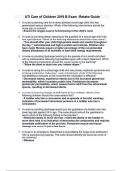
ATI Care of Children 2019 B Exam -Retake Guide
1. A nurse is planning care for a newly admitted school-age child who has generalized seizure disorder. Which of the following interventions should the nurse plan to include? - Ensure the oxygen source is functioning in the child’s room 2. A nurse is providing dietary teaching to the guardian of a school-age child who has cystic fibrosis. Which of the following statements should the nurse make? - "You should offer your child high-protein meals and snacks throughout the day."; well-balanced and high in protein and calories. Children who have cystic fibrosis require a higher percentage of the recommended dietary allowances of all nutrients to meet their energy requirements. 3. A nurse is providing discharge teaching to the parents of a 6-month-old infant who is postoperative following hypospadias repair with a stent placement. Which of the following instructions should the nurse include in the teaching? - "Allow the stent to drain into your infants diaper." 4. A nurse is caring for a school-age child who has primary nephrotic syndrome and is taking prednisone. Following 1 week of treatment, which of the following manifestations indicates to the nurse that the medication is effective? - Decreased edema; experience edema due to the increased glomerular permeability, which increases protein loss. Prednisone decreases glomerular permeability, which causes fluid to shift from the extracellular spaces, resulting in decreased edema. 5. A nurse is receiving change-of-shift report for four children. Which of the following children should the nurse assess first? - A toddler who has a concussion and an episode of forceful vomiting.; indication of increased intracranial pressure in a toddler who has a concussion. 6. A nurse is providing discharge teaching to the guardians of a toddler who had lower leg cast applied 24 hr ago. The nurse should instruct the guardians to report which of the following finding to the provider? - Restricted ability to move the toes.; restricted ability of the toddler to move their toes is an indication of neurovascular compromise and requires immediate notification of the provider. Permanent muscle and tissue damage can occur in just a few hours. 7. A nurse in an emergency department is auscultating the lungs of an adolescent who is experiencing dyspnea. The nurse should identify the sound as which of the following? - Wheezes 8. A nurse is caring for a preschooler who has congestive heart failure. The nurse observes wide QRS complexes and peaked T waves on the cardiac monitor. Which of the following prescriptions should the nurse clarify with the provider? - Potassium Chloride 9. A nurse is planning an educational program for school-age children and their parents about bicycle safety. Which of the following information should the nurse plan to include? - The child should be able to stand on the balls of their feet when sitting on the bike.; To decrease the risk for injury, parents should ensure that the bike is the correct size for the child 10. A nurse is monitoring the oxygen saturation level of an infant using pulse oximetry. The nurse should secure the sensor to which of the following areas on the infant? - Great Toe 11. A nurse is an emergency department is caring for a school-age child who has epiglottitis. Which of the following actions should the nurse take? - Monitor the child’s oxygen saturation 12. A nurse in an emergency department is caring for a school-age child who has sustained a minor superficial burn from fireworks on their forearm. Which of the following actions should the nurse take? - Apply an antimicrobial ointment to the affected area. 13. A nurse in a providers office is caring for a school-age child who has varicella. The parents asks the nurse when their child will no longer be contagious. Which of the following responses should the nurse make? - "When your child’s lesions are crusted, usually 6 days after they appear."; the child is contagious 1 day prior to lesion eruption and until the vesicles have crusted over, which usually takes about 6 days. 14. A nurse is providing discharge teaching to the parent of a school-age child who has moderate persistent asthma. Which of the following instructions should the nurse include? - "Pulmonary function tests will be performed every 12 to 24 months to evaluate how your child is responding to therapy." 15. A nurse is admitting an infant who has intussusception. Which of the following findings should the nurse expect? (Select all that apply.) - Vomiting; due to the obstruction that occurs when a segment of the bowel telescopes within another segment of the bowel. Lethargy; due to episodes of severe pain during which the infant cries inconsolably, leading to exhaustion and decreased nutritional intake.
Written for
- Institution
-
Chamberlain College Of Nursing
- Course
-
NURS 307
Document information
- Uploaded on
- April 24, 2025
- Number of pages
- 8
- Written in
- 2024/2025
- Type
- Exam (elaborations)
- Contains
- Questions & answers
Subjects
- ati care of children
- ati care of children exam
-
ati care of children 2019 b exam retake guide

Also available in package deal