

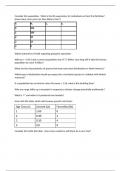
Consider this population. What is the life expectancy for individuals on their first birthday?
(How many more years are they likely to live?)
X Nx lm ex
0 200
1 100
2 50
3 25
4 0
Which statement is FALSE regarding peripatric speciation
With an r = 0.011 and a current population size of 7.5 billion, how long will it take the human
population to reach 9 billion?
What are the characteristics of species that have east-west distributions in North America?
Which type of distribution would you expect for a territorial species in a habitat with limited
resources?
If a population has an intrinsic rate of increase = 1.26, what is the doubling time?
Why are range shifts up a mountain in response to climate change potentially problematic?
What is "r" and when is it preferred over lambda?
Given this life table, which will increase growth rate faster:
Consider this static life table. How many newborns will there be in year two?
,A population's intrinsic rate of increase is primarily dependent on two variables. What are
they?
Selection for individuals with an intermediate phenotype is called:
Which of the following is FALSE regarding "r"?
Suppose you measure a population in Nov. 2020 and there are 135 individuals, and you come
back a year later and there are 270 individuals. If the population has a discrete breeding season,
what is lambda, the growth rate?
Which population would exhibit a clumped distribution?
1. 1.2
2. It occurs when a population is divided in half by a barrier of inhospitable habitat (river,
canyon, road, field, burned lands, etc.)
3. about 16 years
4. habitat generalists
5. regular
6. 0.55 years
7. the area of the habitat is probably smaller
8. "r" = is the per capita rate of instantaneous population growth, used in modeling
populations that change continuously, rather than those with discrete breeding seasons.
9. producing all six offspring in age class 2
10. 35
11. reproductive rate and generation time
12. stabilizing selection
13. populations with the same r will add the same number of individuals, regardless of size
14. 2.0
15. lions in prides on the Serengheti
, In general, which of the following will increase the growth rate of a population most?
In this equation, what does "m" represent?
dN/dt = rN [(K-N)/K] [(N-m)/K]
As a consequence of limited resources, population size may stabilize at a carrying capacity.
Which statement is necessarily true of a population at carrying capacity?
If a population has an intrinsic rate of increase = 1.26, what is the doubling time?
Which of the following will NOT limit the growth of a population?
What type of dynamic oscillation is produced when r < 1?
A population's intrinsic rate of increase is primarily dependent on two variables. What are
they?
Consider a metapopulation in which the patch occupancy has stabilized at 66%. What are the
extinction and colonization probabilities that could lead to this equilibrium?
Which of the following is the most unrealistic aspect of the logistic growth equation for sexually
reproducing species?
Which of the following cause the greatest oscillations in continuously growing populations?
Suppose you measure a population in Nov. 2020 and there are 135 individuals, and you come
back a year later and there are 270 individuals. If the population has a discrete breeding season,
what is lambda, the growth rate?
Which is the best scenario for maintaining populations on fragmented habitats?
How is the "net reproductive rate" calculated?
Which of the following will change the carrying capacity?
What is "r" and when is it preferred over lambda?
1. reproducing earlier (shorter generation time)
2. minimum population size that can persist in the environment
3. r=0
4. 0.55 years
5. decreased death rate and constant birth rate as population increases
(How many more years are they likely to live?)
X Nx lm ex
0 200
1 100
2 50
3 25
4 0
Which statement is FALSE regarding peripatric speciation
With an r = 0.011 and a current population size of 7.5 billion, how long will it take the human
population to reach 9 billion?
What are the characteristics of species that have east-west distributions in North America?
Which type of distribution would you expect for a territorial species in a habitat with limited
resources?
If a population has an intrinsic rate of increase = 1.26, what is the doubling time?
Why are range shifts up a mountain in response to climate change potentially problematic?
What is "r" and when is it preferred over lambda?
Given this life table, which will increase growth rate faster:
Consider this static life table. How many newborns will there be in year two?
,A population's intrinsic rate of increase is primarily dependent on two variables. What are
they?
Selection for individuals with an intermediate phenotype is called:
Which of the following is FALSE regarding "r"?
Suppose you measure a population in Nov. 2020 and there are 135 individuals, and you come
back a year later and there are 270 individuals. If the population has a discrete breeding season,
what is lambda, the growth rate?
Which population would exhibit a clumped distribution?
1. 1.2
2. It occurs when a population is divided in half by a barrier of inhospitable habitat (river,
canyon, road, field, burned lands, etc.)
3. about 16 years
4. habitat generalists
5. regular
6. 0.55 years
7. the area of the habitat is probably smaller
8. "r" = is the per capita rate of instantaneous population growth, used in modeling
populations that change continuously, rather than those with discrete breeding seasons.
9. producing all six offspring in age class 2
10. 35
11. reproductive rate and generation time
12. stabilizing selection
13. populations with the same r will add the same number of individuals, regardless of size
14. 2.0
15. lions in prides on the Serengheti
, In general, which of the following will increase the growth rate of a population most?
In this equation, what does "m" represent?
dN/dt = rN [(K-N)/K] [(N-m)/K]
As a consequence of limited resources, population size may stabilize at a carrying capacity.
Which statement is necessarily true of a population at carrying capacity?
If a population has an intrinsic rate of increase = 1.26, what is the doubling time?
Which of the following will NOT limit the growth of a population?
What type of dynamic oscillation is produced when r < 1?
A population's intrinsic rate of increase is primarily dependent on two variables. What are
they?
Consider a metapopulation in which the patch occupancy has stabilized at 66%. What are the
extinction and colonization probabilities that could lead to this equilibrium?
Which of the following is the most unrealistic aspect of the logistic growth equation for sexually
reproducing species?
Which of the following cause the greatest oscillations in continuously growing populations?
Suppose you measure a population in Nov. 2020 and there are 135 individuals, and you come
back a year later and there are 270 individuals. If the population has a discrete breeding season,
what is lambda, the growth rate?
Which is the best scenario for maintaining populations on fragmented habitats?
How is the "net reproductive rate" calculated?
Which of the following will change the carrying capacity?
What is "r" and when is it preferred over lambda?
1. reproducing earlier (shorter generation time)
2. minimum population size that can persist in the environment
3. r=0
4. 0.55 years
5. decreased death rate and constant birth rate as population increases


