

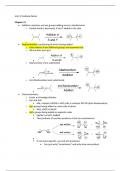
Unit 3 Textbook Notes
Chapter 11
• Addition reactions are two groups adding across a double bond
o Double bond is destroyed, X and Y added to the side
o
• Regiochemistry: positioning of what is being added
o Only matters if two different groups and asymmetrical
o Where does each go?
§
o Markovnikov more substituted
§
o Anti-Markovnikov least substituted
§
• Stereochemistry
o Easier w all wedges/dashes
o Syn and Anti
§ HBr, catalytic H2SO4 in H2O, HBr in catalytic RO-OR (Anti-Markovnikov)
o Syn: groups being added on same side of plane
§ BH3; H2O2 in NaOH
o Anti: groups being added on opposite sides
§ HgOAc2 in H2O, NaBH4
§ Two products of syn/two products of anti are enantiomers
§
§ If not stereospecific, syn and anti produced
• Can just write “enantiomer” and only draw one product
, • Cyclic Alkenes
o Look at regiochemistry then stereochemistry
o Draw wedges and dashes instead of rotating first
o If no stereocenters, stereochemistry is irrelevant so only one product
o If one stereocenter only, stereochemistry is still irrelevant because only two
possible products
§ R and S enantiomers in a racemic mixture
o Meso has only one product
• Hydrogenation
o Addition of H2
o Regiochemistry always irrelevant
o Syn addition
§ So only one pair of enantiomers (and look for meso)
• Hydration
o Adding water
o Can be both regiochemistry
§ Markovnikov if H3O+ used (acid protonates)
• Acid-catalyzed if H+ in brackets
• Pair of enantiomers (racemic) if one stereocenter
§ Anti Markovnikov if H2O used and no acid
• Syn addition
• Hydroboration oxidation because two step for converting alkene
to alcohol
o Use equilibrium arrows
o Le Chatelier’s principle
• Adding a hydrogen halide (HX)
o First, proton transfer to generate a carbocation
§ From alkene to proton
§
o Second, nucleophilic attack
§ From halide to carbocation
§
o Markovnikov
o Always place H on less substituted carbon, and halide on most substituted
• Carbocation intermediate
o More stable means Markovnikov (more stable preferred, so often Markovnikov)
o Regiochemistry determined by carbocation stability
Chapter 11
• Addition reactions are two groups adding across a double bond
o Double bond is destroyed, X and Y added to the side
o
• Regiochemistry: positioning of what is being added
o Only matters if two different groups and asymmetrical
o Where does each go?
§
o Markovnikov more substituted
§
o Anti-Markovnikov least substituted
§
• Stereochemistry
o Easier w all wedges/dashes
o Syn and Anti
§ HBr, catalytic H2SO4 in H2O, HBr in catalytic RO-OR (Anti-Markovnikov)
o Syn: groups being added on same side of plane
§ BH3; H2O2 in NaOH
o Anti: groups being added on opposite sides
§ HgOAc2 in H2O, NaBH4
§ Two products of syn/two products of anti are enantiomers
§
§ If not stereospecific, syn and anti produced
• Can just write “enantiomer” and only draw one product
, • Cyclic Alkenes
o Look at regiochemistry then stereochemistry
o Draw wedges and dashes instead of rotating first
o If no stereocenters, stereochemistry is irrelevant so only one product
o If one stereocenter only, stereochemistry is still irrelevant because only two
possible products
§ R and S enantiomers in a racemic mixture
o Meso has only one product
• Hydrogenation
o Addition of H2
o Regiochemistry always irrelevant
o Syn addition
§ So only one pair of enantiomers (and look for meso)
• Hydration
o Adding water
o Can be both regiochemistry
§ Markovnikov if H3O+ used (acid protonates)
• Acid-catalyzed if H+ in brackets
• Pair of enantiomers (racemic) if one stereocenter
§ Anti Markovnikov if H2O used and no acid
• Syn addition
• Hydroboration oxidation because two step for converting alkene
to alcohol
o Use equilibrium arrows
o Le Chatelier’s principle
• Adding a hydrogen halide (HX)
o First, proton transfer to generate a carbocation
§ From alkene to proton
§
o Second, nucleophilic attack
§ From halide to carbocation
§
o Markovnikov
o Always place H on less substituted carbon, and halide on most substituted
• Carbocation intermediate
o More stable means Markovnikov (more stable preferred, so often Markovnikov)
o Regiochemistry determined by carbocation stability


