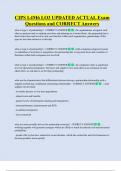
CIPS L4M6 LO3 UPDATED ACTUAL Exam
Questions and CORRECT Answers
what is type 1 of partnership? - CORRECT ANSWER - the organisations recognise each
other as partners and co-ordinate activities and planning on a limited basis. the partnership has a
short-term focus and involves only one function within each organisation. partnerships of this
type are less time intensive to develop
what is type 2 of partnership? - CORRECT ANSWER - both companies progress beyond
co-ordination of activities to integration. the partnership has a long-term focus and a number of
functions within both companies are involved
what is type 3 of partnership? - CORRECT ANSWER - the companies share a significant
level of operational integration. the buyer and supplier view each other as an extension of each
others firm. no end date is set for their partnership
what are the characteristics that differentiate between having a partnership relationship with a
supplier and having a traditional contracting relationship? - CORRECT ANSWER - - early
supplier involvement
- no tender process or win-lose negotiations
- shared costs and benefits
- greater levels of information sharing and transparency
- joint performance measurement and KPIs
- no defined end period
- less contractual
what are some possible drivers for partnership sourcing? - CORRECT ANSWER --
working together will generate synergies which are likely to result in reduced costs and increased
profitability
- product life cycles have reduced in recent decades, which has created the need for businesses to
develop products more quickly
, - changes in the marketplace or unstable markets may result in buyers and suppliers needing to
work together more closely in order to survive
- there may be a need to improve performance to satisfy the ultimate customer in the supply
chain
- the desire to reduce stock-holding and to move towards world-class standards of supply chain
management
what is a product life cycle? - CORRECT ANSWER - a period of time which involves
developing a product from scratch, bringing the product to the marketplace, sales in the market
and the eventual decline and removal of the product from the marketplace
what is vertical integration? - CORRECT ANSWER - when a buyer owns companies
within its supply chain. there could be forward vertical integration where a buyer owns a
distributor, or backward vertical integration where a buyer owns one of its suppliers of raw
materials
what are the joint advantages of partnership? - CORRECT ANSWER - - working together
and collaborating is likely to result in synergies which could bring reduced costs and increased
profitability for both partners
- investment costs, such as new machinery and research and development can be shared by both
partners
- partnership can lead to improved competitive advantage and/or increased market share. these
are both likely to generate increased profits
what are the partnership advantages for the buyer? - CORRECT ANSWER - - as
partnership relationships are generally long term, the buyer is likely to be able to gain price
stability from the supplier. this will aid in planning and financial management
- cost savings may be made as a result of supply base rationalisation and leveraging volume with
the supplier
- there may be greater continuity of supply. if there is a shortage of supplies in the marketplace a
supplier is likely to service its preferred customer first
Questions and CORRECT Answers
what is type 1 of partnership? - CORRECT ANSWER - the organisations recognise each
other as partners and co-ordinate activities and planning on a limited basis. the partnership has a
short-term focus and involves only one function within each organisation. partnerships of this
type are less time intensive to develop
what is type 2 of partnership? - CORRECT ANSWER - both companies progress beyond
co-ordination of activities to integration. the partnership has a long-term focus and a number of
functions within both companies are involved
what is type 3 of partnership? - CORRECT ANSWER - the companies share a significant
level of operational integration. the buyer and supplier view each other as an extension of each
others firm. no end date is set for their partnership
what are the characteristics that differentiate between having a partnership relationship with a
supplier and having a traditional contracting relationship? - CORRECT ANSWER - - early
supplier involvement
- no tender process or win-lose negotiations
- shared costs and benefits
- greater levels of information sharing and transparency
- joint performance measurement and KPIs
- no defined end period
- less contractual
what are some possible drivers for partnership sourcing? - CORRECT ANSWER --
working together will generate synergies which are likely to result in reduced costs and increased
profitability
- product life cycles have reduced in recent decades, which has created the need for businesses to
develop products more quickly
, - changes in the marketplace or unstable markets may result in buyers and suppliers needing to
work together more closely in order to survive
- there may be a need to improve performance to satisfy the ultimate customer in the supply
chain
- the desire to reduce stock-holding and to move towards world-class standards of supply chain
management
what is a product life cycle? - CORRECT ANSWER - a period of time which involves
developing a product from scratch, bringing the product to the marketplace, sales in the market
and the eventual decline and removal of the product from the marketplace
what is vertical integration? - CORRECT ANSWER - when a buyer owns companies
within its supply chain. there could be forward vertical integration where a buyer owns a
distributor, or backward vertical integration where a buyer owns one of its suppliers of raw
materials
what are the joint advantages of partnership? - CORRECT ANSWER - - working together
and collaborating is likely to result in synergies which could bring reduced costs and increased
profitability for both partners
- investment costs, such as new machinery and research and development can be shared by both
partners
- partnership can lead to improved competitive advantage and/or increased market share. these
are both likely to generate increased profits
what are the partnership advantages for the buyer? - CORRECT ANSWER - - as
partnership relationships are generally long term, the buyer is likely to be able to gain price
stability from the supplier. this will aid in planning and financial management
- cost savings may be made as a result of supply base rationalisation and leveraging volume with
the supplier
- there may be greater continuity of supply. if there is a shortage of supplies in the marketplace a
supplier is likely to service its preferred customer first