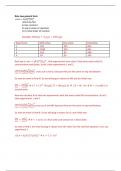
Rate Law general form
𝑟𝑎𝑡𝑒 = 𝑘[𝐴]! [𝐵]"
rate=how fast
k=rate constant
m and n=order of reactions
m+n=total order of reaction
Example: 2𝑁𝑂(𝑔) + 𝑂# (𝑔) → 2𝑁𝑂# (𝑔)
Experiment [NO] initial [O2] initial Initial Rate
1 .015 .015 .024
2 .0195 .015 .041
3 .015 .03 .048
4 .03 .03 .192
Rate law is 𝑟𝑎𝑡𝑒 = [𝑁𝑂]! [𝑂# ]" ; find experiments from chart 2 that have same initial O2
concentration and divide. So let’s take experiments 1 and 2.
$%&' #)*! [",]! " [,! ]! #
cross out k and O2 because they are the same on top and bottom.
$%&' .) *$ [",]$ " [,! ]$ #
So now we want to find M. So we will plug in values for NO and for initial rate.
.01. (.0.34)"
.0#1
= (.0.4)"
à 1.7 = 1.3! à log(1.7) = 𝑀𝑙𝑜𝑔(1.3) à . 23 = 𝑀. 114 à 𝑀 = 2 so NO is in
second order.
Now we calculate N so take two experiments with the same initial NO concentration. So let’s
take experiments 1 and 3.
$%&' 6)*% [",]% " [,! ]% #
cross out k and NO because they are the same on top and bottom.
$%&' .) *$ [",]$ " [,! ]$ #
So now we want to find N. So we will plug in values for O2 and initial rate.
.017 (.06)#
.0#1
= (.0.4)# à 𝑁 = 1 so O2 is in first order and overall rxn is third order.
So now to find k, we need to plug in values from the chart into the rate law equation. Let’s use
experiment 1.
. 024 = 𝑘(.015)# (.015). à 𝑘 = 7.1 ∗ 106
, Integrated Rate Equations
Zero order: [𝐴]& = −𝑘𝑡 + [𝐴]0
Slope is -k and rate does not depend on concentration
First order: 𝑙𝑛[𝐴]& = −𝑘𝑡 + 𝑙𝑛[𝐴]0
Slope is -k
. .
Second order:[8] = 𝑘𝑡 + [8]
& '
Slope is k
Find by making a graph which all three orders and whichever is linear means it’s in that order.
Example: Calculate the rate of decomposition of [H2O2] at 1400 seconds. Assume k=7.3 *
-4
10 and the initial concentration of H2O2 is 2.32 M. It is first order.
Note: if k were not given, you could find it by graphing in all three orders.
Plug values into the first order equation.
𝑙𝑛[𝐻# 𝑂# ].100 = −𝑘𝑡 + 𝑙𝑛(2.32) à 𝑙𝑛[𝐻# 𝑂# ].100 = −(7.3 ∗ 1091 )(1400) + (.842) à
[𝐻# 𝑂# ].100 = .835 𝑀
Now, we plug this value and k into the differential rate law to find the overall rate.
𝑟𝑎𝑡𝑒 = 𝑘[𝐻# 𝑂# ] à 𝑟𝑎𝑡𝑒 = (7.3 ∗ 1091 )(.835)à𝑟𝑎𝑡𝑒 = 6.1 ∗ 101 𝑀/𝑠
Half-Life Equation
.;36
𝑡./# = * only for first order equations, in seconds
Collision Theory
𝑘 = 𝑝𝑍0 𝑒 9<( /=>
P=steric factor
Z0 = collision frequency factor
e-Ea/RT= fraction of sufficiently energetic collisions
R= 8.314 J/Kmol
𝑟𝑎𝑡𝑒 = 𝑘[𝐴]! [𝐵]"
rate=how fast
k=rate constant
m and n=order of reactions
m+n=total order of reaction
Example: 2𝑁𝑂(𝑔) + 𝑂# (𝑔) → 2𝑁𝑂# (𝑔)
Experiment [NO] initial [O2] initial Initial Rate
1 .015 .015 .024
2 .0195 .015 .041
3 .015 .03 .048
4 .03 .03 .192
Rate law is 𝑟𝑎𝑡𝑒 = [𝑁𝑂]! [𝑂# ]" ; find experiments from chart 2 that have same initial O2
concentration and divide. So let’s take experiments 1 and 2.
$%&' #)*! [",]! " [,! ]! #
cross out k and O2 because they are the same on top and bottom.
$%&' .) *$ [",]$ " [,! ]$ #
So now we want to find M. So we will plug in values for NO and for initial rate.
.01. (.0.34)"
.0#1
= (.0.4)"
à 1.7 = 1.3! à log(1.7) = 𝑀𝑙𝑜𝑔(1.3) à . 23 = 𝑀. 114 à 𝑀 = 2 so NO is in
second order.
Now we calculate N so take two experiments with the same initial NO concentration. So let’s
take experiments 1 and 3.
$%&' 6)*% [",]% " [,! ]% #
cross out k and NO because they are the same on top and bottom.
$%&' .) *$ [",]$ " [,! ]$ #
So now we want to find N. So we will plug in values for O2 and initial rate.
.017 (.06)#
.0#1
= (.0.4)# à 𝑁 = 1 so O2 is in first order and overall rxn is third order.
So now to find k, we need to plug in values from the chart into the rate law equation. Let’s use
experiment 1.
. 024 = 𝑘(.015)# (.015). à 𝑘 = 7.1 ∗ 106
, Integrated Rate Equations
Zero order: [𝐴]& = −𝑘𝑡 + [𝐴]0
Slope is -k and rate does not depend on concentration
First order: 𝑙𝑛[𝐴]& = −𝑘𝑡 + 𝑙𝑛[𝐴]0
Slope is -k
. .
Second order:[8] = 𝑘𝑡 + [8]
& '
Slope is k
Find by making a graph which all three orders and whichever is linear means it’s in that order.
Example: Calculate the rate of decomposition of [H2O2] at 1400 seconds. Assume k=7.3 *
-4
10 and the initial concentration of H2O2 is 2.32 M. It is first order.
Note: if k were not given, you could find it by graphing in all three orders.
Plug values into the first order equation.
𝑙𝑛[𝐻# 𝑂# ].100 = −𝑘𝑡 + 𝑙𝑛(2.32) à 𝑙𝑛[𝐻# 𝑂# ].100 = −(7.3 ∗ 1091 )(1400) + (.842) à
[𝐻# 𝑂# ].100 = .835 𝑀
Now, we plug this value and k into the differential rate law to find the overall rate.
𝑟𝑎𝑡𝑒 = 𝑘[𝐻# 𝑂# ] à 𝑟𝑎𝑡𝑒 = (7.3 ∗ 1091 )(.835)à𝑟𝑎𝑡𝑒 = 6.1 ∗ 101 𝑀/𝑠
Half-Life Equation
.;36
𝑡./# = * only for first order equations, in seconds
Collision Theory
𝑘 = 𝑝𝑍0 𝑒 9<( /=>
P=steric factor
Z0 = collision frequency factor
e-Ea/RT= fraction of sufficiently energetic collisions
R= 8.314 J/Kmol