

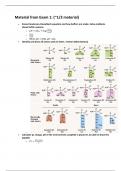
Material from Exam 1: (~1/3 material)
• Know Henderson-Hasselbach equation and how buffers are made. Solve problems
about buffer systems
[#! ]
o 𝑝𝐻 = 𝑝𝐾! + log ([%#])
&!'(
o
!)*+
o When [A-] = [HA], pH = pKa
• Identify and draw all amino acids (1 letter, 3 letter abbreviations)
o
• Calculate pI, charge, pH of the environment a peptide is placed in, be able to draw the
peptide
,-" .,-#
o 𝑃𝐼 =
/
,• Know protein structure, primary, secondary, tertiary, and Anfinson’s experiments.
o Primary
§ Peptide bonds
o Secondary
§ H bonds
§ a helix repetitive bonding, MALEK, 1 acid and 1 base within 4, no Pro/Gly
§ b sheet parallel = bent bonds; anti-parallel = linear bonds
o Tertiary
§ Disulfide, ionic, hydrophobic bonds
§ R group interactions
§ Hydrophobic between nonpolar AAs
§ Domains can be on their own, motifs cannot stand alone
§ Covalent bonds strengthen
o Anfinson
§ Added urea and b-mercaptoethanol to RNase
§ Disrupted protein function
§ Removed urea
§ Removed b-mercaptoethanol
§ Restored protein function
• Protein purification techniques—know how to solve problems with:
o Ion exchange (cation and anion) chromatography
§ Most opposite charge eluted first
§ Cation columns are negative and attract cations
§ Anion columns are positive and attract anions
o Isoelectric focusing
§ Proteins stop where PI=pH
§ Left à right, pH high à low
o Molecular weight separation
§ Larger protons eluted first
§ Small protons travel farthest
o Digestion of peptides using enzymes and re-organizing them to determine
peptide structure
§ Trypsin: R or K, unless followed by P
§ Chymotrypsin: F, W, or Y, unless followed by P
§ Cyanogen Bromide: M
, Material from Exam 2 ( ~1/3 material)
• Know how hemoglobin interacts with oxygen under different conditions (all
biochemical aspects of Hb structure and interactions with inhibitors)
o T state
§ Lower O2 affinity
§ Stabilized by ionic bonds, low pH, Bohr Effect, 2,3 BPG, high CO2, lactic
acid buildup, carbamate release
§ Low pH forms interactions between His+ and Asp- (Asp-146)
§ 2,3 BPG forms salt bridge because so negative
o R state
§ High O2 affinity
§ Few interactions
o Fetal Hb
§ Ser-143 instead of His-143
§ Gamma position instead of Beta
§ Higher O2 affinity
§ Does not bind to 2,3 BPG
• Compare and contrast Hemoglobin and Myoglobin
o Hemoglobin
§ Similar tertiary structure
§ Same heme group
§ Lower O2 affinity
§ In red blood cells
§ 4 subunits for 4 O2
§ Transports O2 between tissue and lungs
o Myoglobin
§ Similar tertiary structure
§ Same heme group
§ High O2 affinity
§ In skeletal/cardiac muscles
§ One subunit for 1 O2
§ Releases O2 to tissues when needed
• Compare and contrast globular and fibrous proteins in general
o Globular
§ Spherical
§ For transport
§ Soluble in water
§ Irregular AA sequence
§ Sensitive to heat/pH
o Fibrous
§ Linear
§ For structure
• Know Henderson-Hasselbach equation and how buffers are made. Solve problems
about buffer systems
[#! ]
o 𝑝𝐻 = 𝑝𝐾! + log ([%#])
&!'(
o
!)*+
o When [A-] = [HA], pH = pKa
• Identify and draw all amino acids (1 letter, 3 letter abbreviations)
o
• Calculate pI, charge, pH of the environment a peptide is placed in, be able to draw the
peptide
,-" .,-#
o 𝑃𝐼 =
/
,• Know protein structure, primary, secondary, tertiary, and Anfinson’s experiments.
o Primary
§ Peptide bonds
o Secondary
§ H bonds
§ a helix repetitive bonding, MALEK, 1 acid and 1 base within 4, no Pro/Gly
§ b sheet parallel = bent bonds; anti-parallel = linear bonds
o Tertiary
§ Disulfide, ionic, hydrophobic bonds
§ R group interactions
§ Hydrophobic between nonpolar AAs
§ Domains can be on their own, motifs cannot stand alone
§ Covalent bonds strengthen
o Anfinson
§ Added urea and b-mercaptoethanol to RNase
§ Disrupted protein function
§ Removed urea
§ Removed b-mercaptoethanol
§ Restored protein function
• Protein purification techniques—know how to solve problems with:
o Ion exchange (cation and anion) chromatography
§ Most opposite charge eluted first
§ Cation columns are negative and attract cations
§ Anion columns are positive and attract anions
o Isoelectric focusing
§ Proteins stop where PI=pH
§ Left à right, pH high à low
o Molecular weight separation
§ Larger protons eluted first
§ Small protons travel farthest
o Digestion of peptides using enzymes and re-organizing them to determine
peptide structure
§ Trypsin: R or K, unless followed by P
§ Chymotrypsin: F, W, or Y, unless followed by P
§ Cyanogen Bromide: M
, Material from Exam 2 ( ~1/3 material)
• Know how hemoglobin interacts with oxygen under different conditions (all
biochemical aspects of Hb structure and interactions with inhibitors)
o T state
§ Lower O2 affinity
§ Stabilized by ionic bonds, low pH, Bohr Effect, 2,3 BPG, high CO2, lactic
acid buildup, carbamate release
§ Low pH forms interactions between His+ and Asp- (Asp-146)
§ 2,3 BPG forms salt bridge because so negative
o R state
§ High O2 affinity
§ Few interactions
o Fetal Hb
§ Ser-143 instead of His-143
§ Gamma position instead of Beta
§ Higher O2 affinity
§ Does not bind to 2,3 BPG
• Compare and contrast Hemoglobin and Myoglobin
o Hemoglobin
§ Similar tertiary structure
§ Same heme group
§ Lower O2 affinity
§ In red blood cells
§ 4 subunits for 4 O2
§ Transports O2 between tissue and lungs
o Myoglobin
§ Similar tertiary structure
§ Same heme group
§ High O2 affinity
§ In skeletal/cardiac muscles
§ One subunit for 1 O2
§ Releases O2 to tissues when needed
• Compare and contrast globular and fibrous proteins in general
o Globular
§ Spherical
§ For transport
§ Soluble in water
§ Irregular AA sequence
§ Sensitive to heat/pH
o Fibrous
§ Linear
§ For structure


