100% satisfaction guarantee Immediately available after payment Both online and in PDF No strings attached 4.2 TrustPilot
logo-home
Exam (elaborations)

Power Engineering 4th Class - Unit A2 Review Exam Questions And Answers

Rating
-
Sold
-
Pages
5
Grade
A+
Uploaded on
20-04-2025
Written in
2024/2025

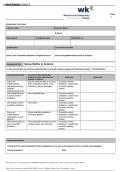
(4-096-1.1) Large areas, such as warehouses, are usually heated by: Select one: a. Unit heaters b. Radiators c. Convectors d. Open heaters e. Space heaters - ANS a (4-019-3.8) How much heat must be supplied to 200 kg of water at 20°C to make steam at 850 kPa abs and 87% dry? Select one: a. 2039.4 kJ b. 407 880 kJ c. 1774.28 kJ d. 424 627.98 kJ e. 484 507.6 kJ - ANS e (4-018-2.6) Convert -6°C to °F. Select one: a. 30.4°F b. 28.5°F c. 21.2°F d. 18.6°F e. 16.7°F - ANS c (4-020-3.2) A substance that cannot be decomposed into other substances by chemical means is: Select one: a. a Mixture b. a Compound c. a Solution d. an Atom e. an Element - ANS e (4-019-3.4) A boiler furnace releases 10 400 kJ of heat for each kg of fuel burned and produces dry saturated steam at 14 000 kPa abs. from feedwater at 200°C. How many kg of steam will be produced for each kg of fuel burned if the boiler has an efficiency of 66%? Select one: a. 3.546 b. 3.845 c. 4.875 d. 5.754 e. 6.854 - ANS b (4-019-1.6) Steam containing water particles in suspension is defined as: Select one: a. Dry steam b. Theoretical steam c. Wet steam d. Sub-cooled steam e. Superheated steam - ANS c (4-019-1.3) How much heat must be absorbed by 63 kg of ice at 0°C to convert it to saturated steam at 100°C. Specific heat of water is 4.2 kJ/kg K. Latent heat of fusion of ice is 335 kJ/kg. Latent heat of evaporation of steam is 2257 kJ/kg. Select one: a. 35 490 kJ b. 21 775 kJ c. 53 107 kJ d. 189 756 kJ e. 273 097 kJ - ANS d When is hot oil an ideal heat transfer fluid? Select one: a. when high temperature, high pressure process fluids are needed b. when low temperature process fluids are needed at high pressure c. when glycol is too expensive d. when high temperature process fluids are needed at low pressure - ANS d (4-018-4.5) When the temperature of an object is increased, its change in length is proportional to its: Select one: a. Initial length and initial temperature. b. Cross-sectional area and temperature. c. Volume and temperature increase. d. Initial length and temperature increase. e. Initial temperature, but inversely proportional to its length. - ANS d (4-018-2.2) In the First Law of Thermodynamics, heat supplied = increase in internal energy + ____________: Select one: a. Energy supplied. b. Energy absorbed. c. Work input. d. Work done. e. Power output. - ANS d (4-020-3.4) Any material made up of distinct elements, compounds, or both, that are not chemically combined with one another, is a: Select one: a. Solid b. Mixture c. Molecule d. Crystal e. Compound - ANS b (4-018-4.1) Which of the following statements is TRUE? Select one: a. In general, coefficients of expansion of solids are greater than those of liquids. b. Liquids do not contract when cooled. c. The Coefficient of Expansion for a liquid changes if the liquid temperature changes d. Solids contract when heated. e. Water will only expand when its temperature is increased. - ANS c (4-018-5.5) _____ refers to the transfer of heat via electromagnetic waves. Select one: a. Convection b. Transmission c. Conduction d. Induction e. Radiation - ANS e (4-019-3.6) Calculate the boiler efficiency if the heat supplied to the steam is 26 880 kJ per kg of fuel burned and the heating value of 1 kg of fuel is 32 000 kJ. Select one: a. 72% b. 78% c. 84% d. 87.7% e. 89.35% - ANS c (4-018-1.1) ________ is the temperature at which all molecular movement ceases. Select one: a. 0o Celsius b. 0o Fahrenheit c. Absolute zero d. -273 Kelvin e. -460o Rankine - ANS c (4-020-2.8) If a substance goes through a process that changes its composition so that it is no longer the same substance, then the substance has undergone a: Select one: a. Physical change b. Heterogeneous change c. Homogeneous change d. Chemical change e. Mechanical change - ANS d An example of a two-phase heat transfer fluid is Select one: a. petroleum b. glycol/water c. anhydrous ammonia d. heat transfer oil - ANS c (4-018-5.4) The transfer of heat involving the movement of a fluid is defined as: Select one: a. Conduction b. Convection c. Radiation d. Flux e. Thermo-circulation - ANS b (4-018-4.2) When the temperature of an object is raised, its increase in surface area is proportional to its: Select one: a. Initial length and final temperature. b. Initial area and temperature rise. c. Volume and initial temperature. d. Initial length and temperature rise. e. Shape. - ANS b

Show more Read less
Institution
Power Engineering
Course
Power Engineering


Whoops! We can’t load your doc right now. Try again or contact support.

Written for

Institution
Power Engineering
Course
Power Engineering

Document information

Uploaded on
April 20, 2025
Number of pages
5
Written in
2024/2025
Type
Exam (elaborations)
Contains
Questions & answers

Subjects

Content preview

Power Engineering 4th Class unit B 7
chapter 1 Exam Questions And Answers


A
R
U
LA
C
O
D

, The reciprocating motion of a steam engine is converted to rotary motion:
Choose one answer.
a. At the end of the piston stroke
b. In the steam cylinder
c. By the camshaft


A
d. At the crankshaft
e. By the valve gear - ANS d


R
Which of the following is a prime mover ?
Choose one answer.
a. An electric generator
b. A gas turbine


U
c. A centrifugal pump
d. An air compressor
e. A boiler - ANS b
LA
The term "prime mover" refers to:
Choose one answer.
a. All heat engines
b. A device that uses a source of energy to produce mechanical motion
c. Electric motors only
C

d. Steam and gas turbines only
e. thermal generating stations - ANS b

A "heat engine" is an operating cycle that uses a working fluid to convert:
O


Choose one answer.
a. Thermal energy to chemical energy
b. Chemical energy to mechanical energy
D


c. Thermal energy to electrical energy
d. Mechanical energy to electrical energy
e. Thermal energy to mechanical energy - ANS e

A steam engine piston:
Choose one answer.
a. Moves fastest at the end of its stroke
b. Produces the most force at the end of its stroke
c. Is lubricated with crankcase oil by the splash method
d. Moves fastest at the mid point of its stroke


Get to know the seller

Seller avatar
Reputation scores are based on the amount of documents a seller has sold for a fee and the reviews they have received for those documents. There are three levels: Bronze, Silver and Gold. The better the reputation, the more your can rely on the quality of the sellers work.
DocLaura Galen College Of Nursing
View profile
Follow You need to be logged in order to follow users or courses
Sold
143
Member since
2 year
Number of followers
38
Documents
6488
Last sold
3 days ago

4.2

43 reviews

5
26
4
4
3
10
2
2
1
1

Recently viewed by you

Why students choose Stuvia

Created by fellow students, verified by reviews

Quality you can trust: written by students who passed their tests and reviewed by others who've used these notes.

Didn't get what you expected? Choose another document

No worries! You can instantly pick a different document that better fits what you're looking for.

Pay as you like, start learning right away

No subscription, no commitments. Pay the way you're used to via credit card and download your PDF document instantly.

Student with book image

“Bought, downloaded, and aced it. It really can be that simple.”

Alisha Student

Frequently asked questions