Week 1
Allan
(Allan, 2011)
https://www.sagepub.com/sites/default/files/upm-binaries/36028_1.pdf
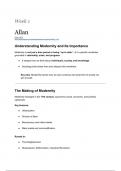
Understanding Modernity and Its Importance
Modernity is not just a time period or being “up to date”—it’s a specific worldview
grounded in rationality, order, and progress.
● It shapes how we think about individuals, society, and knowledge.
● Sociology both arises from and critiques this worldview.
Key idea: Modernity frames how we see ourselves and what kind of society we
aim to build.
The Making of Modernity
Modernity emerged in the 17th century, spurred by social, economic, and political
upheavals.
Key features:
● Urbanization
● Division of labor
● Bureaucracy and nation-states
● Mass media and commodification
Rooted in:
● The Enlightenment
● Renaissance, Reformation, Industrial Revolution
, At its core, modernity replaced religious authority with reason and empirical
knowledge.
Enlightenment and the Rise of Positivism
The Enlightenment redefined knowledge through empiricism and rational thought.
● Progress: Society can improve.
● Empiricism: Knowledge comes from observation.
● Positivism: Valid knowledge is based on testable facts.
Science became the model for knowing and shaping the world.
Modernity’s Two Projects: Technical and Social
Modernity had a dual mission:
● Technical Project (science): Control nature through rational knowledge and
technology.
● Social Project (democracy): Organize society through rational individuals and
equality.
Democracy rests on natural rights and governance through consent.
From Subject to Citizen
In pre-modern feudal societies, people were subjects loyal to monarchs.
● Modernity introduced the citizen: rational, self-governing, and politically responsible.
● Enlightenment ideals made democracy possible—and necessary.
The shift empowered individuals to shape both governance and knowledge.
,Early Sociologists and the American Experiment
The U.S. became a living lab for Enlightenment ideals and democratic theory.
Key figures:
● Alexis de Tocqueville – Explored U.S. democracy's moral and political foundations.
● Harriet Martineau – Developed early sociological methods, emphasized ethics.
● Jane Addams – Tied democracy to social ethics and community responsibility.
These thinkers saw sociology as a tool to critique democracy's failures.
Martineau’s Ethical Method
Martineau insisted that studying society required rigorous ethical observation.
● Compare morals (ideals) with manners (practices).
● Avoid bias; be disciplined and humble.
Sociology must examine whether democratic ideals match reality.
Addams and the Ethical Foundations of Democracy
Jane Addams saw democracy as more than politics—it was a way of living ethically.
● Ethics arise from interaction and diversity, not individual codes.
● Democracy is a test of faith in human dignity.
She championed emergent ethics, grounded in community engagement.
The Collective Moral Project
Democracy, for Tocqueville and Addams, is a public, moral practice.
, ● Morality is emergent, not fixed.
● Created through dialogue and difference.
● Free speech and a free press are ethical imperatives.
Real democracy demands engagement with others, especially those unlike
ourselves.
Democratic Institutions in Modernity
Modernity separates religion from state, unlike theocracy where authority is divine.
● In democracy, power flows from the people.
● Religion no longer legitimizes political rule.
This separation was crucial for modern democratic governance.
Capitalism and New Economic Assumptions
Modern capitalism broke from feudal inheritance by promoting mobility based on talent.
● Social and economic status became tied to individual effort.
Modernity replaced fixed hierarchies with market-based meritocracy.
Education: The Keystone of Modern Knowledge
Education is central to both technical and democratic projects.
Martineau’s criteria:
● Extent of free education indicates societal commitment to equality.
● Strength of universities signals democratic responsibility.
Allan
(Allan, 2011)
https://www.sagepub.com/sites/default/files/upm-binaries/36028_1.pdf
Understanding Modernity and Its Importance
Modernity is not just a time period or being “up to date”—it’s a specific worldview
grounded in rationality, order, and progress.
● It shapes how we think about individuals, society, and knowledge.
● Sociology both arises from and critiques this worldview.
Key idea: Modernity frames how we see ourselves and what kind of society we
aim to build.
The Making of Modernity
Modernity emerged in the 17th century, spurred by social, economic, and political
upheavals.
Key features:
● Urbanization
● Division of labor
● Bureaucracy and nation-states
● Mass media and commodification
Rooted in:
● The Enlightenment
● Renaissance, Reformation, Industrial Revolution
, At its core, modernity replaced religious authority with reason and empirical
knowledge.
Enlightenment and the Rise of Positivism
The Enlightenment redefined knowledge through empiricism and rational thought.
● Progress: Society can improve.
● Empiricism: Knowledge comes from observation.
● Positivism: Valid knowledge is based on testable facts.
Science became the model for knowing and shaping the world.
Modernity’s Two Projects: Technical and Social
Modernity had a dual mission:
● Technical Project (science): Control nature through rational knowledge and
technology.
● Social Project (democracy): Organize society through rational individuals and
equality.
Democracy rests on natural rights and governance through consent.
From Subject to Citizen
In pre-modern feudal societies, people were subjects loyal to monarchs.
● Modernity introduced the citizen: rational, self-governing, and politically responsible.
● Enlightenment ideals made democracy possible—and necessary.
The shift empowered individuals to shape both governance and knowledge.
,Early Sociologists and the American Experiment
The U.S. became a living lab for Enlightenment ideals and democratic theory.
Key figures:
● Alexis de Tocqueville – Explored U.S. democracy's moral and political foundations.
● Harriet Martineau – Developed early sociological methods, emphasized ethics.
● Jane Addams – Tied democracy to social ethics and community responsibility.
These thinkers saw sociology as a tool to critique democracy's failures.
Martineau’s Ethical Method
Martineau insisted that studying society required rigorous ethical observation.
● Compare morals (ideals) with manners (practices).
● Avoid bias; be disciplined and humble.
Sociology must examine whether democratic ideals match reality.
Addams and the Ethical Foundations of Democracy
Jane Addams saw democracy as more than politics—it was a way of living ethically.
● Ethics arise from interaction and diversity, not individual codes.
● Democracy is a test of faith in human dignity.
She championed emergent ethics, grounded in community engagement.
The Collective Moral Project
Democracy, for Tocqueville and Addams, is a public, moral practice.
, ● Morality is emergent, not fixed.
● Created through dialogue and difference.
● Free speech and a free press are ethical imperatives.
Real democracy demands engagement with others, especially those unlike
ourselves.
Democratic Institutions in Modernity
Modernity separates religion from state, unlike theocracy where authority is divine.
● In democracy, power flows from the people.
● Religion no longer legitimizes political rule.
This separation was crucial for modern democratic governance.
Capitalism and New Economic Assumptions
Modern capitalism broke from feudal inheritance by promoting mobility based on talent.
● Social and economic status became tied to individual effort.
Modernity replaced fixed hierarchies with market-based meritocracy.
Education: The Keystone of Modern Knowledge
Education is central to both technical and democratic projects.
Martineau’s criteria:
● Extent of free education indicates societal commitment to equality.
● Strength of universities signals democratic responsibility.