ASVAB Arithmetic Reasoning/
Mathematics Knowledge Exam |
Questions & Answers (100% Verified)
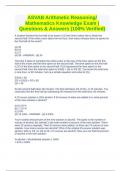
A student finishes the first half of an exam in 2/3 the time it takes him to finish the
second half. If the entire exam takes him an hour, how many minutes does he spend on
the first half of the exam?
(a) 20
(b) s4
(c) 27
(d) 36 - ANSWER - (b) 24
The time it takes to complete the entire exam is the sum of the time spent on the first
half of the exam and the time spent on the second half. The time spent on the first half
is 2/3 of the time spent on he second half. If (S) represents the time spent on the
second half, then the total time spent is 2/3(S) + (S) or 5/3 (S). You know this total time
is one hour, or 60 minutes. Set up a simple equation and solve for (S).
5/3(S) = 60
3/5 x 5/3(S) = 3/5 x 60
(S) = 36
So the second half takes 36 minutes. The first half takes 2/3 of this, or 24 minutes. You
could also find the first half by subtracting 36 minutes from the total time, 60 minutes.
A 25 ounce solution is 20% alcohol. If 50 ounces of water are added to it, what percent
of the new solution is alcohol?
(a) 6 2/3 %
(b) 7 1/2 %
(c) 10%
(d) 13 1/3% - ANSWER - (a) 6 2/3%
You're asked what percent of the new solution is alcohol. The (part) is the number of
ounces of alcohol; the (whole) is the total number of ounces of the new solution. There
were 25 ounces originally. Then 50 ounces were added, so there are 75 ounces of new
solution. How many ounces are alcohol? 20% of the original 25-ounces solution was
alcohol. 20% is 1/5, so 1/5 of 25, or 5 ounces are alcohol. Now you can find the percent
of alcohol in the new solution:
% alcohol = alcohol/total solution x 100%
= 5/75 x 100%
,= 20/3% = 6 2/3%
Marty has exactly 5 blue pens, 6 black pens, and 4 red pens in his backpack. If he pulls
out one pen at random from his backpack, what is the probability that the pen is either
red or black?
(a) 2/3
(b) 3/5
(c) 2/5
(d) 1/3 - ANSWER - (a) 2/3
To find probability, determine the number of desired outcomes and divide that by the
number of possible outcomes. The probability formula looks like this:
Probability = # of desired outcomes/# of possible outcomes
In this case, Marty is pulling one pen at random from his knapsack, and you want to
determine the probability that the pen is either red or black. There are 5 blue pens, 6
black pens, and 4 red pens in the knapsack. Let's return to the probability formula:
Probability = # of desired outcomes/ # of possible outcomes
= number of red + black pens/number of red+ black + blue pens
= 4 + 6/ 4+6+5 = 10/15=2/3
From 1980 through 1990, the population of Country X increased by 100%. From 1990 to
2000, he population increased by 50%. What was the continued increase for the period
1980-2000?
(a) 150%
(b) 166 2/3%
(c) 175%
(d) 200% - ANSWER - (d) 200%
Be careful with combined percent increase. You cannot just add the two percents,
because they're percents of different bases. In this instance, the 100% increase is
based on the 1980 population, but the 50% increase is based on the larger 1990
population. If you just added 100% and 50% to get 150%, you would have chosen the
wrong answer.
The best way to do a problem like this one is to pick a number for the original whole and
just see what happens. The best number to pick here is 100. (That may be a small
number for the population of a country, but reality is not important - all that matters is
the math.)
If the 1990 population was 100, then a 100% increase would put the 1990 population at
200. And a 50% increase over 200 would be 200 + 100 = 300.
,Since the population went from 100 to 300, that's a percent increase of 200%.
300 - 100/100 x 100% = 200/100 X 100% = 200%
If a man earns $200 for his first 40 hours of work in a week and then is paid one-and-
one-half times his regular rate for any additional hours, how many hours must be work
to make $230 in a week?
(a) 43
(b) 44
(c) 45
(d)46 - ANSWER - (b) 44
To learn the man's overtime rate of pay, first figure out his regular rate of pay. Divide the
amount of money made, $200, by the time it took to make it, 40 hours.
$ hours = $5 per hour. That is the normal rate. The man is paid 1 1/2 times his
regular rate during overtime, so when working more than 40 hours he makes 3/2 x $5
per hour = $7.50 per hour. Now figure out how long it takes the man to make $230. It
takes him 40 hours to make the first $200. The last $30 are made at the overtime rate.
Since it takes the man one hour to make $7.50 at this rate, you can figure out the
number of extra hours by dividing $30 by $7.50 per hour. $30 / $7.50 per hour = 4
hours. The total time needed is 40 hours plus 4 hours, or 44 hours.
If 50% of (x) is 150, what is 75% of (x)?
(a) 225
(b) 250
(c) 275
(d) 300 - ANSWER - (a) 225
The calculations aren't too bad on this one. The most important thing to keep in mind is
that you're solving for 75% of (x) and not for (x) itself. First, you are told that 50% of (x)
is 150. That means that half of (x) is 150, and that (x) is 300. So 75% of (x) = 0.75 x 300
= 225.
The total fare for two adults and three children on an excursion boat is $14. If each
child's fare is one half of each adult's fare, what is the adult fare?
(a) $2.00
(b) $3.00
(c) $3.50
(d) $4.00 - ANSWER - (d) $4.00
This question where Backsolving (plugging in an answer choice to see if it's correct) can
save you a lot of time. Let's start with choice (b) and see if it works. If (b) is correct, an
, adult's ticket would cost $3.00, and a child's ticket would cost $1.50. The total fare
you're asked for is for two adults and three children. If an adult's fare was $3.00, that
total fare would be 2($3.00) + 3($1.50) = $6.00 + $4.50 = $10.50. That's too low since
the question states that the total fare is $14.00.
Now see what happens if an adult fare was more expensive. If (d) was correct, an
adult's ticket would cost $4.00 and a child's ticket would cost $2.00. The total fare would
equal
2($4.00) + 3($2.00) = $8.00 + $6.00 = $14.00.
That's the total fare you're looking for, so (d) is correct.
What is the prime factorization of 140?
(a) 2 x 70
(b) 2 x 3 x 5 x 7
(c) 2 x 2 x 5 x 7
(d) 2 x 2 x 2 x 5 x 7 - ANSWER - (c) 2 x 2 x 5 x 7
To find the prime factorization of a number, find one prime that will go into the number
(here 2 is a good place to start). Express the number as that prime multiplied by some
other number.
140 = 2 x 70
Then keep breaking down the larger factor until you are left with only prime numbers.
140 = 2 x 2 x 35
140 = 2 x 2 x 5 x 7
A painter charges $12 an hour while his son charges $6 an hour. If the father and son
worked the same amount of time together on a job, how many hours did each of them
work if their combined charge for their labor was $108?
(a) 6
(b) 9
(c) 12
(d) 18 - ANSWER - (a) 6
When the painter and his son work together, they charge the sum of their hourly rates,
$12 + $6, or $18 per hour. Their bill equals the product of this combined rate and the
number of hours they worked, Therefore $108 must equal $18 per hour times the
number of hours they worked. Divide $108 by $18 per hour to find the number of hours.
$108 / $18 = 6.
4! = __.
Mathematics Knowledge Exam |
Questions & Answers (100% Verified)
A student finishes the first half of an exam in 2/3 the time it takes him to finish the
second half. If the entire exam takes him an hour, how many minutes does he spend on
the first half of the exam?
(a) 20
(b) s4
(c) 27
(d) 36 - ANSWER - (b) 24
The time it takes to complete the entire exam is the sum of the time spent on the first
half of the exam and the time spent on the second half. The time spent on the first half
is 2/3 of the time spent on he second half. If (S) represents the time spent on the
second half, then the total time spent is 2/3(S) + (S) or 5/3 (S). You know this total time
is one hour, or 60 minutes. Set up a simple equation and solve for (S).
5/3(S) = 60
3/5 x 5/3(S) = 3/5 x 60
(S) = 36
So the second half takes 36 minutes. The first half takes 2/3 of this, or 24 minutes. You
could also find the first half by subtracting 36 minutes from the total time, 60 minutes.
A 25 ounce solution is 20% alcohol. If 50 ounces of water are added to it, what percent
of the new solution is alcohol?
(a) 6 2/3 %
(b) 7 1/2 %
(c) 10%
(d) 13 1/3% - ANSWER - (a) 6 2/3%
You're asked what percent of the new solution is alcohol. The (part) is the number of
ounces of alcohol; the (whole) is the total number of ounces of the new solution. There
were 25 ounces originally. Then 50 ounces were added, so there are 75 ounces of new
solution. How many ounces are alcohol? 20% of the original 25-ounces solution was
alcohol. 20% is 1/5, so 1/5 of 25, or 5 ounces are alcohol. Now you can find the percent
of alcohol in the new solution:
% alcohol = alcohol/total solution x 100%
= 5/75 x 100%
,= 20/3% = 6 2/3%
Marty has exactly 5 blue pens, 6 black pens, and 4 red pens in his backpack. If he pulls
out one pen at random from his backpack, what is the probability that the pen is either
red or black?
(a) 2/3
(b) 3/5
(c) 2/5
(d) 1/3 - ANSWER - (a) 2/3
To find probability, determine the number of desired outcomes and divide that by the
number of possible outcomes. The probability formula looks like this:
Probability = # of desired outcomes/# of possible outcomes
In this case, Marty is pulling one pen at random from his knapsack, and you want to
determine the probability that the pen is either red or black. There are 5 blue pens, 6
black pens, and 4 red pens in the knapsack. Let's return to the probability formula:
Probability = # of desired outcomes/ # of possible outcomes
= number of red + black pens/number of red+ black + blue pens
= 4 + 6/ 4+6+5 = 10/15=2/3
From 1980 through 1990, the population of Country X increased by 100%. From 1990 to
2000, he population increased by 50%. What was the continued increase for the period
1980-2000?
(a) 150%
(b) 166 2/3%
(c) 175%
(d) 200% - ANSWER - (d) 200%
Be careful with combined percent increase. You cannot just add the two percents,
because they're percents of different bases. In this instance, the 100% increase is
based on the 1980 population, but the 50% increase is based on the larger 1990
population. If you just added 100% and 50% to get 150%, you would have chosen the
wrong answer.
The best way to do a problem like this one is to pick a number for the original whole and
just see what happens. The best number to pick here is 100. (That may be a small
number for the population of a country, but reality is not important - all that matters is
the math.)
If the 1990 population was 100, then a 100% increase would put the 1990 population at
200. And a 50% increase over 200 would be 200 + 100 = 300.
,Since the population went from 100 to 300, that's a percent increase of 200%.
300 - 100/100 x 100% = 200/100 X 100% = 200%
If a man earns $200 for his first 40 hours of work in a week and then is paid one-and-
one-half times his regular rate for any additional hours, how many hours must be work
to make $230 in a week?
(a) 43
(b) 44
(c) 45
(d)46 - ANSWER - (b) 44
To learn the man's overtime rate of pay, first figure out his regular rate of pay. Divide the
amount of money made, $200, by the time it took to make it, 40 hours.
$ hours = $5 per hour. That is the normal rate. The man is paid 1 1/2 times his
regular rate during overtime, so when working more than 40 hours he makes 3/2 x $5
per hour = $7.50 per hour. Now figure out how long it takes the man to make $230. It
takes him 40 hours to make the first $200. The last $30 are made at the overtime rate.
Since it takes the man one hour to make $7.50 at this rate, you can figure out the
number of extra hours by dividing $30 by $7.50 per hour. $30 / $7.50 per hour = 4
hours. The total time needed is 40 hours plus 4 hours, or 44 hours.
If 50% of (x) is 150, what is 75% of (x)?
(a) 225
(b) 250
(c) 275
(d) 300 - ANSWER - (a) 225
The calculations aren't too bad on this one. The most important thing to keep in mind is
that you're solving for 75% of (x) and not for (x) itself. First, you are told that 50% of (x)
is 150. That means that half of (x) is 150, and that (x) is 300. So 75% of (x) = 0.75 x 300
= 225.
The total fare for two adults and three children on an excursion boat is $14. If each
child's fare is one half of each adult's fare, what is the adult fare?
(a) $2.00
(b) $3.00
(c) $3.50
(d) $4.00 - ANSWER - (d) $4.00
This question where Backsolving (plugging in an answer choice to see if it's correct) can
save you a lot of time. Let's start with choice (b) and see if it works. If (b) is correct, an
, adult's ticket would cost $3.00, and a child's ticket would cost $1.50. The total fare
you're asked for is for two adults and three children. If an adult's fare was $3.00, that
total fare would be 2($3.00) + 3($1.50) = $6.00 + $4.50 = $10.50. That's too low since
the question states that the total fare is $14.00.
Now see what happens if an adult fare was more expensive. If (d) was correct, an
adult's ticket would cost $4.00 and a child's ticket would cost $2.00. The total fare would
equal
2($4.00) + 3($2.00) = $8.00 + $6.00 = $14.00.
That's the total fare you're looking for, so (d) is correct.
What is the prime factorization of 140?
(a) 2 x 70
(b) 2 x 3 x 5 x 7
(c) 2 x 2 x 5 x 7
(d) 2 x 2 x 2 x 5 x 7 - ANSWER - (c) 2 x 2 x 5 x 7
To find the prime factorization of a number, find one prime that will go into the number
(here 2 is a good place to start). Express the number as that prime multiplied by some
other number.
140 = 2 x 70
Then keep breaking down the larger factor until you are left with only prime numbers.
140 = 2 x 2 x 35
140 = 2 x 2 x 5 x 7
A painter charges $12 an hour while his son charges $6 an hour. If the father and son
worked the same amount of time together on a job, how many hours did each of them
work if their combined charge for their labor was $108?
(a) 6
(b) 9
(c) 12
(d) 18 - ANSWER - (a) 6
When the painter and his son work together, they charge the sum of their hourly rates,
$12 + $6, or $18 per hour. Their bill equals the product of this combined rate and the
number of hours they worked, Therefore $108 must equal $18 per hour times the
number of hours they worked. Divide $108 by $18 per hour to find the number of hours.
$108 / $18 = 6.
4! = __.