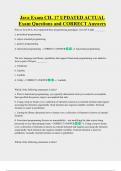
Java Exam CH. 17 UPDATED ACTUAL
Exam Questions and CORRECT Answers
Prior to Java SE 8, Java supported three programming paradigms. Java SE 8 adds ________.
a. procedural programming
b. object-oriented programming
c. generic programming
d. functional programming. - CORRECT ANSWER - d. functional programming
The new language and library capabilities that support functional programming were added to
Java as part of Project ________.
a. Utilitarian
b. Upsilon
c. Lambda
d. Utility - CORRECT ANSWER - c. Lambda
Which of the following statements is false?
a. Prior to functional programming, you typically determined what you wanted to accomplish,
then specified the precise steps to accomplish that task.
b. Using a loop to iterate over a collection of elements is known as external iteration and requires
accessing the elements sequentially. Such iteration also requires mutable variables. External
iteration is easier to parallelize.
c. Letting the library determine how to iterate over a collection of elements is known as internal
iteration.
d. Functional programming focuses on immutability—not modifying the data source being
processed or any other program state - CORRECT ANSWER - b. Using a loop to iterate
over a collection of elements is known as external iteration and requires accessing the elements
sequentially. Such iteration also requires mutable variables. External iteration is easier to
parallelize. Actually, internal iteration is easier to parallelize.
Which of the following statements is false?
,a. Functional interfaces are also known as single abstract method (SAM) interfaces.
b. Package java.util.function contains six basic functional interfaces BinaryOperator, Consumer,
Function, Predicate, Supplier and UnaryOperator.
c. There are many specialized versions of the six basic functional interfaces for use with int, long
and double primitive values. There are also generic customizations of Consumer, Function and
Predicate for binary operations—that is, methods that take two arguments.
d. All of these statements are true - CORRECT ANSWER - All of these statements are true
The basic generic functional interface ________ in package java.util.function contains method
apply that takes two T arguments, performs an operation on them (such as a calculation) and
returns a value of type T.
a. Consumer<T>
b. Function<T,R>
c. Supplier<T>
d. BinaryOperator<T> - CORRECT ANSWER - d. BinaryOperator<T>
The basic generic functional interface ________ in package java.util.function contains method
accept that takes a T argument and returns void. Performs a task with its T argument, such as
outputting the object, invoking a method of the object, etc.
a. Consumer<T>
b. Function<T,R>
c. Supplier<T>
d. BinaryOperator<T> - CORRECT ANSWER - a. Consumer<T>
The basic generic functional interface ________ in package java.util.function contains method
apply that takes a T argument and returns a value of type R. Calls a method on the T argument
and returns that method's result.
a. Consumer<T>
b. Function<T,R>
c. Supplier<T>
d. BinaryOperator<T> - CORRECT ANSWER - b. Function<T,R>
, The basic generic functional interface ________ in package java.util.function contains method
test that takes a T argument and returns a boolean. Tests whether the T argument satisfies a
condition.
a. Consumer<T>
b. Function<T,R>
c. Supplier<T>
d. Predicate<T> - CORRECT ANSWER - d. Predicate<T>
The basic generic functional interface ________ in package java.util.function contains method
get that takes no arguments and produces a value of type T. Often used to create a collection
object in which a stream operation's results are placed.
a. Consumer<T>
b. Function<T,R>
c. Supplier<T>
d. BinaryOperator<T> - CORRECT ANSWER - c. Supplier<T>
The basic generic functional interface ________ in package java.util.function contains method
get that takes no arguments and returns a value of type T.
a. UnaryOperator<T>
b. Function<T,R>
c. Supplier<T>
d. BinaryOperator<T> - CORRECT ANSWER - a. UnaryOperator<T>
A lambda expression represents a(n) ________ method—a shorthand notation for implementing
a functional interface.
a. functional
b. unnamed
c. undesignated
d. anonymous - CORRECT ANSWER - d. anonymous
Exam Questions and CORRECT Answers
Prior to Java SE 8, Java supported three programming paradigms. Java SE 8 adds ________.
a. procedural programming
b. object-oriented programming
c. generic programming
d. functional programming. - CORRECT ANSWER - d. functional programming
The new language and library capabilities that support functional programming were added to
Java as part of Project ________.
a. Utilitarian
b. Upsilon
c. Lambda
d. Utility - CORRECT ANSWER - c. Lambda
Which of the following statements is false?
a. Prior to functional programming, you typically determined what you wanted to accomplish,
then specified the precise steps to accomplish that task.
b. Using a loop to iterate over a collection of elements is known as external iteration and requires
accessing the elements sequentially. Such iteration also requires mutable variables. External
iteration is easier to parallelize.
c. Letting the library determine how to iterate over a collection of elements is known as internal
iteration.
d. Functional programming focuses on immutability—not modifying the data source being
processed or any other program state - CORRECT ANSWER - b. Using a loop to iterate
over a collection of elements is known as external iteration and requires accessing the elements
sequentially. Such iteration also requires mutable variables. External iteration is easier to
parallelize. Actually, internal iteration is easier to parallelize.
Which of the following statements is false?
,a. Functional interfaces are also known as single abstract method (SAM) interfaces.
b. Package java.util.function contains six basic functional interfaces BinaryOperator, Consumer,
Function, Predicate, Supplier and UnaryOperator.
c. There are many specialized versions of the six basic functional interfaces for use with int, long
and double primitive values. There are also generic customizations of Consumer, Function and
Predicate for binary operations—that is, methods that take two arguments.
d. All of these statements are true - CORRECT ANSWER - All of these statements are true
The basic generic functional interface ________ in package java.util.function contains method
apply that takes two T arguments, performs an operation on them (such as a calculation) and
returns a value of type T.
a. Consumer<T>
b. Function<T,R>
c. Supplier<T>
d. BinaryOperator<T> - CORRECT ANSWER - d. BinaryOperator<T>
The basic generic functional interface ________ in package java.util.function contains method
accept that takes a T argument and returns void. Performs a task with its T argument, such as
outputting the object, invoking a method of the object, etc.
a. Consumer<T>
b. Function<T,R>
c. Supplier<T>
d. BinaryOperator<T> - CORRECT ANSWER - a. Consumer<T>
The basic generic functional interface ________ in package java.util.function contains method
apply that takes a T argument and returns a value of type R. Calls a method on the T argument
and returns that method's result.
a. Consumer<T>
b. Function<T,R>
c. Supplier<T>
d. BinaryOperator<T> - CORRECT ANSWER - b. Function<T,R>
, The basic generic functional interface ________ in package java.util.function contains method
test that takes a T argument and returns a boolean. Tests whether the T argument satisfies a
condition.
a. Consumer<T>
b. Function<T,R>
c. Supplier<T>
d. Predicate<T> - CORRECT ANSWER - d. Predicate<T>
The basic generic functional interface ________ in package java.util.function contains method
get that takes no arguments and produces a value of type T. Often used to create a collection
object in which a stream operation's results are placed.
a. Consumer<T>
b. Function<T,R>
c. Supplier<T>
d. BinaryOperator<T> - CORRECT ANSWER - c. Supplier<T>
The basic generic functional interface ________ in package java.util.function contains method
get that takes no arguments and returns a value of type T.
a. UnaryOperator<T>
b. Function<T,R>
c. Supplier<T>
d. BinaryOperator<T> - CORRECT ANSWER - a. UnaryOperator<T>
A lambda expression represents a(n) ________ method—a shorthand notation for implementing
a functional interface.
a. functional
b. unnamed
c. undesignated
d. anonymous - CORRECT ANSWER - d. anonymous