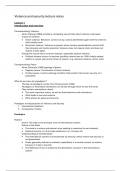
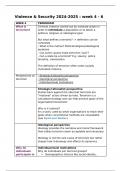
Violence & Security 2024-2025 : week 1 - 3
WEEK 1 - I CONCEPTS & APPROACHES
What is political Direct violence (behaviours carried out by a clearly identifiable
violence? agent with the intent to inflict bodily harm) vs. structural
violence (when humans systematically cannot fulfil their
physical and mental needs ⇒ e.g. not having clean water).
Political violence: occurs in wartime (1000+ battle-related
deaths) and in times of "peace" (electoral violence, ethnic riots).
Types of peace? - Negative peace: when direct violence is absent.
- Positive peace: attitudes, institutions and structures that
sustain peaceful societies.
Through what Actors (behaviours/motivations) / what leads to violence / what
lenses/paradigms allows peace?
can we analyse - Realism
political - Liberalism
violence? - Constructivism
- Instrumentalism
- Institutionalism
Realism
> Actor: the state is the main actor.
> Nature of the state: It's a unitary/rational actor, seeking to
maximise own interest. Overarching goal: national security.
> Understanding conflict:
International system: characterised by anarchy -> you can never
be sure of your security. Power (material capabilities) is the
means that can ensure security.
> How likely is war? Depends on the distribution of power in the
international system.
Liberalism
> Actor: both state and non-state actors important.
, > Nature of the state: aggregate of preferences of wide-ranging
actors.
> Understanding conflict:
Cooperation is possible ⇒ through mutual gains.
> How can we achieve order?
1) Economic interdependence and free trade; 2) International
institutions; 3) Democratic institutions.
Constructivism
> Actor: all socially constructed, both the actor and the interests
that drive them. Identity also determined by
Because preferences are also socially constructed, they can
change.
> Understanding conflict/peace:
Appropriate action is determined by the content of identities
and interests (of political actors), which is why norms are very
important.
Instrumentalism
> Actor: elites determine whether there's conflict or not, in
favour of their interests (maximising political power and material
gains).
> Understanding conflict/peace: if elites believe something can
be gained from violence, they will orchestrate the masses into
carrying out violence.
Institutionalism
- How do institutional settings mediate political struggle?
Davies, Petersson Findings
& Oburg (2023)
(Organized • Number of fatalities in organised violence increased
Violence 1989- sharply in 2022.
2022, and the • Increase in one-sided violence compared to 2021 was
return of conflict minor, but highest number of fatalities in this type of
between states) violence since 2014.
, • Number of fatalities in non-state conflict decreased
slightly in 2022, the number of active conflicts increased.
WEEK 1 - II VIOLENCE & STATE FORMATION
What is state The long-term processes leading to the centralisation of political
formation? power within a sovereign territory.
What is state The ability of states to accomplish their goals.
capacity? How can it be measured?
- State's military power
- Bureaucratic/administrative capacity (extractive capacity)
> The ability to collect taxes is a good way to measure the
strength of the state, since people don't want to pay this.
Is war necessary
for the building of
strong states?
Are war and state
formation linked?
What is state War making ( ---- requires ---> ) extraction.
formation Extraction (------->) protection.
according to Tilly? Extraction (------->) state building (------->) protection.
// The Bellicist
Approach // Because extraction is so dibicult, state's need to find a way to do
it better, thus they build institutions.
This increases bureaucratic capacity (knowing who is in the
territory, and how many resources are available) and this builds
a stronger state.
Tilly (1985) Monopolisation of the concentrated means of violence/coercion
(War Making and by governments. Leading from illegitimate violence to legitimate
State Making as violence. Under the guise of providing protection.
Organized Crime)
Noble act to protect? Not really: still comes from the logic of
expanding power.
WEEK 1 - I CONCEPTS & APPROACHES
What is political Direct violence (behaviours carried out by a clearly identifiable
violence? agent with the intent to inflict bodily harm) vs. structural
violence (when humans systematically cannot fulfil their
physical and mental needs ⇒ e.g. not having clean water).
Political violence: occurs in wartime (1000+ battle-related
deaths) and in times of "peace" (electoral violence, ethnic riots).
Types of peace? - Negative peace: when direct violence is absent.
- Positive peace: attitudes, institutions and structures that
sustain peaceful societies.
Through what Actors (behaviours/motivations) / what leads to violence / what
lenses/paradigms allows peace?
can we analyse - Realism
political - Liberalism
violence? - Constructivism
- Instrumentalism
- Institutionalism
Realism
> Actor: the state is the main actor.
> Nature of the state: It's a unitary/rational actor, seeking to
maximise own interest. Overarching goal: national security.
> Understanding conflict:
International system: characterised by anarchy -> you can never
be sure of your security. Power (material capabilities) is the
means that can ensure security.
> How likely is war? Depends on the distribution of power in the
international system.
Liberalism
> Actor: both state and non-state actors important.
, > Nature of the state: aggregate of preferences of wide-ranging
actors.
> Understanding conflict:
Cooperation is possible ⇒ through mutual gains.
> How can we achieve order?
1) Economic interdependence and free trade; 2) International
institutions; 3) Democratic institutions.
Constructivism
> Actor: all socially constructed, both the actor and the interests
that drive them. Identity also determined by
Because preferences are also socially constructed, they can
change.
> Understanding conflict/peace:
Appropriate action is determined by the content of identities
and interests (of political actors), which is why norms are very
important.
Instrumentalism
> Actor: elites determine whether there's conflict or not, in
favour of their interests (maximising political power and material
gains).
> Understanding conflict/peace: if elites believe something can
be gained from violence, they will orchestrate the masses into
carrying out violence.
Institutionalism
- How do institutional settings mediate political struggle?
Davies, Petersson Findings
& Oburg (2023)
(Organized • Number of fatalities in organised violence increased
Violence 1989- sharply in 2022.
2022, and the • Increase in one-sided violence compared to 2021 was
return of conflict minor, but highest number of fatalities in this type of
between states) violence since 2014.
, • Number of fatalities in non-state conflict decreased
slightly in 2022, the number of active conflicts increased.
WEEK 1 - II VIOLENCE & STATE FORMATION
What is state The long-term processes leading to the centralisation of political
formation? power within a sovereign territory.
What is state The ability of states to accomplish their goals.
capacity? How can it be measured?
- State's military power
- Bureaucratic/administrative capacity (extractive capacity)
> The ability to collect taxes is a good way to measure the
strength of the state, since people don't want to pay this.
Is war necessary
for the building of
strong states?
Are war and state
formation linked?
What is state War making ( ---- requires ---> ) extraction.
formation Extraction (------->) protection.
according to Tilly? Extraction (------->) state building (------->) protection.
// The Bellicist
Approach // Because extraction is so dibicult, state's need to find a way to do
it better, thus they build institutions.
This increases bureaucratic capacity (knowing who is in the
territory, and how many resources are available) and this builds
a stronger state.
Tilly (1985) Monopolisation of the concentrated means of violence/coercion
(War Making and by governments. Leading from illegitimate violence to legitimate
State Making as violence. Under the guise of providing protection.
Organized Crime)
Noble act to protect? Not really: still comes from the logic of
expanding power.