Real Options
Call Options - It is the right to buy shares for a specified price in the future. But you are not
obligated.
Put Options - It is the right to sell shares for a specified price in the future. But you are not
obligated.
European options can only be exercised only on a particular day whereas American option
can be exercised at any time before that day.
The higher the volatility of the asset in this case a share price, the higher the price of call or
put.
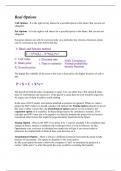
The payoff of both the sides of equation is equal. You can either buy a Put option & share
price or Call Options and exercise it. If the payoff is same then the cost would be equal too.
At expiry one of them would be worth nothing.
In the case of DCF model, real options attached to projects are ignored. When we value a
project by DCF model we should consider real options like Timing option (should we invest
this year or delay it and why), the abandonment option (option to exit in future), the
expansion option (is it scalable). So these things need to be considered. Scrutiny. If we
calculate and NPV turns out to be negative we directly abandon the project but we haven't
considered other factors that might be proportionately beneficial in the future.
Timing Option - What is the NPV if we delay it by 1 year for example. Like conditions may
change in future, interest or inflation rate would get lower. Covid would pass. Its like
Opportunity cost, you have to calculate how much you will get if you invest today or
tomorrow & compare both of them & base your decision on it.
Abandonment Option - There is always a difference between forecasted & actual results
because of uncertainty. The option to abandon is like a put option.
Its like a put option because it allows the company to "sell" or terminate the project at a
certain "strike price" as after this point the costs would be exceeding the benefits.
Call Options - It is the right to buy shares for a specified price in the future. But you are not
obligated.
Put Options - It is the right to sell shares for a specified price in the future. But you are not
obligated.
European options can only be exercised only on a particular day whereas American option
can be exercised at any time before that day.
The higher the volatility of the asset in this case a share price, the higher the price of call or
put.
The payoff of both the sides of equation is equal. You can either buy a Put option & share
price or Call Options and exercise it. If the payoff is same then the cost would be equal too.
At expiry one of them would be worth nothing.
In the case of DCF model, real options attached to projects are ignored. When we value a
project by DCF model we should consider real options like Timing option (should we invest
this year or delay it and why), the abandonment option (option to exit in future), the
expansion option (is it scalable). So these things need to be considered. Scrutiny. If we
calculate and NPV turns out to be negative we directly abandon the project but we haven't
considered other factors that might be proportionately beneficial in the future.
Timing Option - What is the NPV if we delay it by 1 year for example. Like conditions may
change in future, interest or inflation rate would get lower. Covid would pass. Its like
Opportunity cost, you have to calculate how much you will get if you invest today or
tomorrow & compare both of them & base your decision on it.
Abandonment Option - There is always a difference between forecasted & actual results
because of uncertainty. The option to abandon is like a put option.
Its like a put option because it allows the company to "sell" or terminate the project at a
certain "strike price" as after this point the costs would be exceeding the benefits.