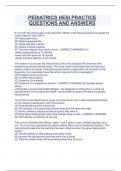
PHARM 2 EXAM 1 ATI Questions with
correct answers
A provider prescribes phenobarbital for a client who has a seizure disorder. The medication
has a long half-life of 4 days. How many times per day should the nurse expect to administer
this medication?
A. one
B. two
C. three
D. four - verified answers; A. one
A nurse educator is reviewing medication metabolism at an in-service presentation. Which of
the following factors should the educator include as a reason to administer lower medication
dosages? (SATA)
A. increased renal excretion
B. increased medication-metabolizing enzymes
C. liver failure
D. peripheral vascular disease
E. concurrent use of medication the same pathway metabolizes - verified answers; C. liver
failure
E. concurrent use of medication the same pathway metabolizes
A nurse is preparing to administer eye drops to a client. Which of the following actions should
the nurse take? (SATA)
,A. Have the client lie on one side
B. Ask the client to look up at the ceiling
C. Tell the client to blink when the drops enter the eye
D. Drop the medication into the client's conjunctival sac
E. Instruct the client to close the eye gently after instillation - verified answers; B. Ask the
client to look up at the ceiling
D. Drop the medication into the client's conjunctival sac
E. Instruct the client to close the eye gently after instillation
A nurse is teaching a client about transdermal patches. Which of the following statements
should the nurse identify as an indication that the client understands?
A. I will clean the site with an alcohol swab before I apply the patch.
B. I will rotate the application sites weekly.
C. I will apply the patch to an area of skin with no hair.
D. I will place the new patch on the site of the old patch. - verified answers; C. I will apply the
patch to an area of skin with no hair
A nurse reviewing a clients medical record notes a new prescription for verifying the trough
level of the medication. Which of the following actions should the nurse take?
A. Obtain a blood specimen immediately prior to administering the next dose of medication.
B. Verify that the client has been taking the medication for 24 hr before obtaining a blood
specimen
C. Ask the client to provide a urine specimen after the next dose of medication.
D. Administer the medication, and obtain a blood specimen 30 min later. - verified answers; A.
Obtain a blood specimen immediately prior to administering the next dose of medication
, A nurse is preparing a client's medications. Which of the following actions should the nurse
take in following legal practice guidelines? (SATA)
A. Teach the client about the medication
B. Determine the dosage
C. Monitor the adverse effects
D. Lock compartments for controlled substances
E. Determine the client's insurance status - verified answers; A. Teach the client about the
medication
C. Monitor the adverse effects
D. Lock compartments for controlled substances
A nurse is preparing to administer digoxin to a client who states, " I don't want to take that
medication. I do not want one more pill." Which of the following responses should the nurse
make?
A. Your physician prescribed it for you, so you really should take it.
B. Well, let's just get it over quickly then.
C. Okay I will just give you your other medications.
D. Tell me your concerns about taking this medication - verified answers; D. Tell me your
concerns about taking this medication
A nurse is reviewing a client's prescribed medications. Which of the following situations
represents a contraindication to medication administration?
A. The client drank grapefruit juice, which could reduce a medication's effectiveness
B. The medication has orthostatic hypotension as an adverse affect
correct answers
A provider prescribes phenobarbital for a client who has a seizure disorder. The medication
has a long half-life of 4 days. How many times per day should the nurse expect to administer
this medication?
A. one
B. two
C. three
D. four - verified answers; A. one
A nurse educator is reviewing medication metabolism at an in-service presentation. Which of
the following factors should the educator include as a reason to administer lower medication
dosages? (SATA)
A. increased renal excretion
B. increased medication-metabolizing enzymes
C. liver failure
D. peripheral vascular disease
E. concurrent use of medication the same pathway metabolizes - verified answers; C. liver
failure
E. concurrent use of medication the same pathway metabolizes
A nurse is preparing to administer eye drops to a client. Which of the following actions should
the nurse take? (SATA)
,A. Have the client lie on one side
B. Ask the client to look up at the ceiling
C. Tell the client to blink when the drops enter the eye
D. Drop the medication into the client's conjunctival sac
E. Instruct the client to close the eye gently after instillation - verified answers; B. Ask the
client to look up at the ceiling
D. Drop the medication into the client's conjunctival sac
E. Instruct the client to close the eye gently after instillation
A nurse is teaching a client about transdermal patches. Which of the following statements
should the nurse identify as an indication that the client understands?
A. I will clean the site with an alcohol swab before I apply the patch.
B. I will rotate the application sites weekly.
C. I will apply the patch to an area of skin with no hair.
D. I will place the new patch on the site of the old patch. - verified answers; C. I will apply the
patch to an area of skin with no hair
A nurse reviewing a clients medical record notes a new prescription for verifying the trough
level of the medication. Which of the following actions should the nurse take?
A. Obtain a blood specimen immediately prior to administering the next dose of medication.
B. Verify that the client has been taking the medication for 24 hr before obtaining a blood
specimen
C. Ask the client to provide a urine specimen after the next dose of medication.
D. Administer the medication, and obtain a blood specimen 30 min later. - verified answers; A.
Obtain a blood specimen immediately prior to administering the next dose of medication
, A nurse is preparing a client's medications. Which of the following actions should the nurse
take in following legal practice guidelines? (SATA)
A. Teach the client about the medication
B. Determine the dosage
C. Monitor the adverse effects
D. Lock compartments for controlled substances
E. Determine the client's insurance status - verified answers; A. Teach the client about the
medication
C. Monitor the adverse effects
D. Lock compartments for controlled substances
A nurse is preparing to administer digoxin to a client who states, " I don't want to take that
medication. I do not want one more pill." Which of the following responses should the nurse
make?
A. Your physician prescribed it for you, so you really should take it.
B. Well, let's just get it over quickly then.
C. Okay I will just give you your other medications.
D. Tell me your concerns about taking this medication - verified answers; D. Tell me your
concerns about taking this medication
A nurse is reviewing a client's prescribed medications. Which of the following situations
represents a contraindication to medication administration?
A. The client drank grapefruit juice, which could reduce a medication's effectiveness
B. The medication has orthostatic hypotension as an adverse affect