Stats, Chapter 5 Review Exam
Questions and Answers
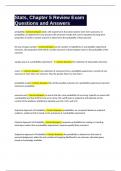
probability - Correct Answers: deals with experiments that yield random short-term outcomes; in
probability, an experiment is any process with uncertain results that can be repeated; the long-term
proportion in which a certain outcome is observed is the probability of that outcome
the law of large numbers - Correct Answers: as the number of repetitions of a probability experiment
increases, the proportion with which a certain outcome is observed gets closer to the probability of the
outcome
sample space of a probability experiment - S - Correct Answers: the collection of all possible outcomes
event - E - Correct Answers: any collection of outcomes from a probability experiment; consists of one
outcome or more than one outcome. Must be greater than 0 or less than 1.
probability model - Correct Answers: lists all the possible outcomes of a probability experiment and each
outcome's probability
unusual event - Correct Answers: an event that has a low probability of occurring; typically an event with
a probability less than 0.05 but not set in stone; the cutoff point is subjective and depends on the
context of the problem; statisticians typically use 0.01, 0.05, and 0.10
Empirical Approach of Probability - Correct Answers: probabilities are computed based on empirical
evidence, evidence that is based on the outcomes of a probability experiment
Classical Approach of Probability - Correct Answers: computes probabilities by relying on counting
techniques rather than a probability experiment; requires equally likely outcomes
Subjective Approach of Probability - Correct Answers: the probability is obtained on the basis of
personal judgement; often the only method of assigning likelihood to an outcome; educated guess
based on knowledge available
Questions and Answers
probability - Correct Answers: deals with experiments that yield random short-term outcomes; in
probability, an experiment is any process with uncertain results that can be repeated; the long-term
proportion in which a certain outcome is observed is the probability of that outcome
the law of large numbers - Correct Answers: as the number of repetitions of a probability experiment
increases, the proportion with which a certain outcome is observed gets closer to the probability of the
outcome
sample space of a probability experiment - S - Correct Answers: the collection of all possible outcomes
event - E - Correct Answers: any collection of outcomes from a probability experiment; consists of one
outcome or more than one outcome. Must be greater than 0 or less than 1.
probability model - Correct Answers: lists all the possible outcomes of a probability experiment and each
outcome's probability
unusual event - Correct Answers: an event that has a low probability of occurring; typically an event with
a probability less than 0.05 but not set in stone; the cutoff point is subjective and depends on the
context of the problem; statisticians typically use 0.01, 0.05, and 0.10
Empirical Approach of Probability - Correct Answers: probabilities are computed based on empirical
evidence, evidence that is based on the outcomes of a probability experiment
Classical Approach of Probability - Correct Answers: computes probabilities by relying on counting
techniques rather than a probability experiment; requires equally likely outcomes
Subjective Approach of Probability - Correct Answers: the probability is obtained on the basis of
personal judgement; often the only method of assigning likelihood to an outcome; educated guess
based on knowledge available