

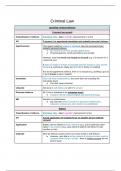
Criminal Law
Specified criminal offences
Common law assault
Classification of offence Summary only - max 6 months imprisonment or a fine
AR D causes V to apprehend immediate and unlawful personal violence
Apprehension This means making V expect or anticipate (but not necessarily fear)
unlawful personal violence
● No need for D to have actually applied force
● Physical gestures, words and silence are enough
However, note that words can negate an assault (e.g. if it weren’t for X
I would hit you)
It does not matter if D does not actually have the means to carry out the
threat (e.g. pointing an empty gun at V, but V thinks it is loaded)
If D did not apprehend violence, there is no assault (e.g. pointing a gun at
V but V knows it wasn’t loaded)
Immediate Does not mean instantaneous, but some time not excluding the
immediate future
● Can also mean imminent
Unlawful Not done in self-defence or with V’s consent
Personal violence All V has to anticipate is an unwanted touch
● Includes a threat of psychological and physical damage
MR Intention or recklessness
● But note that where conviction is based on recklessness,
subjective recklessness also needs to be established
Battery
Classification of offence Summary only - max 6 months’ imprisonment or fine
AR Actual application of unlawful force on another person without
consent
Application Battery can be inflicted directly, indirectly (e.g. acid in bathroom dryer
case) or by omission (e.g. case where D failed to tell officer he had
needles on him)
Unlawful Must be without consent and D can’t have acted in self defence
● However, note that a certain amount of physical contact must be
accepted when living in society - there is implied consent for this
kind of touch
,Force The merest of touches can constitute battery - this does not have to
be rude, hostile or aggressive
● Touching someone’s clothes is enough
MR Intention or recklessness
Examples of injuries that Mere touch, unwanted kiss or a slap
amount to battery
S47 - assault occasioning ABH
Classification of offence Either-way offence - max 5 years imprisonment
AR ABH requires a base offence of assault or battery - the AR of either of
these must be established
‘Occasioning’ Normal rules of factual and legal causation apply
● Can also be committed by omission
ABH Any hurt that interferes with the health or comfort of V
● Need not be serious or permanent
● Must be more than transient and trifling
MR Same as battery/assault - intention or recklessness
● Prosecution does not need to prove that D intended or was
reckless to ABH - intention/recklessness of causing some harm
is sufficient
Examples of injuries ● Temporary loss of sensory function like sight or hearing
amounting to ABH ● Temporary loss of consciousness
● Extensive bruising
● Cutting someone’s hair
● Minor fractures
● Psychiatric injury that is more than trivial - beyond fear, distress
or panic
S20 - malicious wounding or inflicting GBH
Classification of offence Either way offence - max 5 years imprisonment
AR Creates 2 offences
● Malicious wounding
● Maliciously inflicting GBH
Wound There must be a break in both layers of the skin
● The injury does not need to be severe, any breaking of the skin
is enough (e.g. piercing the skin with a needle is enough)
Infliction Essentially means ‘cause’ - normal rules apply
● There can be an infliction of GBH without an assault being
committed
GBH Means a ‘really serious’ harm, but serious harm will also be enough
The courts will consider the following factors when assessing GBH:
● The effect of the injuries on V, considering age and health
, ● The totality of injuries
E.g. if a baby has multiple cuts which on their own would not constitute
GBH, but taken together they would constitute GBH
MR D must intend or be reckless as to the causing of some harm
● It is enough that D foresaw some physical harm, albeit of a minor
character
● Note that in the case where HIV is transmitted from sex and the
risk is not consented to, this will amount to recklessness and
therefore the defendant will be found guilty
S18 - wounding or causing GBH with intent
Classification of offence Either-way offence - max 5 years imprisonment
AR Same as a S20 offence
● Malicious wounding with intent to cause GBH
● Maliciously inflicting GBH with intent to cause GBH
MR This is the key difference between S18 and S20 - recklessness is not
enough (intention only)
D must intend to cause harm which amounts to GBH (not just some
harm)
Where the AR is a wound, the MR is still intention to cause GBH
● Intention to wound is not enough
Examples of injury ● Permanent loss of sensory function
● Permanent disability
● Broken bones
● Fractured skull
● Substantial blood loss
● Wounds
Basic criminal damage
Classification of offence Either-way offence (max 10 years imprisonment) unless the damage is
£5000 or less (then it is treated as summary only)
AR D damages or destroys property belonging to another without
lawful excuse
‘Destroy’ Following D’s actions, the property ceases to exist
‘Damage’ This is a question of fact and a matter of degree
● Includes mischief, injury or harm done to the property
● No need to establish that the property is useless or cannot serve
its normal function
● Damage does not need to be permanent - it is enough that
time, effort and money has been spent restoring the property to
its natural state
● Includes temporary impairment of value or usefulness
‘Property’ Property of a tangible nature (both real and personal property, and
Specified criminal offences
Common law assault
Classification of offence Summary only - max 6 months imprisonment or a fine
AR D causes V to apprehend immediate and unlawful personal violence
Apprehension This means making V expect or anticipate (but not necessarily fear)
unlawful personal violence
● No need for D to have actually applied force
● Physical gestures, words and silence are enough
However, note that words can negate an assault (e.g. if it weren’t for X
I would hit you)
It does not matter if D does not actually have the means to carry out the
threat (e.g. pointing an empty gun at V, but V thinks it is loaded)
If D did not apprehend violence, there is no assault (e.g. pointing a gun at
V but V knows it wasn’t loaded)
Immediate Does not mean instantaneous, but some time not excluding the
immediate future
● Can also mean imminent
Unlawful Not done in self-defence or with V’s consent
Personal violence All V has to anticipate is an unwanted touch
● Includes a threat of psychological and physical damage
MR Intention or recklessness
● But note that where conviction is based on recklessness,
subjective recklessness also needs to be established
Battery
Classification of offence Summary only - max 6 months’ imprisonment or fine
AR Actual application of unlawful force on another person without
consent
Application Battery can be inflicted directly, indirectly (e.g. acid in bathroom dryer
case) or by omission (e.g. case where D failed to tell officer he had
needles on him)
Unlawful Must be without consent and D can’t have acted in self defence
● However, note that a certain amount of physical contact must be
accepted when living in society - there is implied consent for this
kind of touch
,Force The merest of touches can constitute battery - this does not have to
be rude, hostile or aggressive
● Touching someone’s clothes is enough
MR Intention or recklessness
Examples of injuries that Mere touch, unwanted kiss or a slap
amount to battery
S47 - assault occasioning ABH
Classification of offence Either-way offence - max 5 years imprisonment
AR ABH requires a base offence of assault or battery - the AR of either of
these must be established
‘Occasioning’ Normal rules of factual and legal causation apply
● Can also be committed by omission
ABH Any hurt that interferes with the health or comfort of V
● Need not be serious or permanent
● Must be more than transient and trifling
MR Same as battery/assault - intention or recklessness
● Prosecution does not need to prove that D intended or was
reckless to ABH - intention/recklessness of causing some harm
is sufficient
Examples of injuries ● Temporary loss of sensory function like sight or hearing
amounting to ABH ● Temporary loss of consciousness
● Extensive bruising
● Cutting someone’s hair
● Minor fractures
● Psychiatric injury that is more than trivial - beyond fear, distress
or panic
S20 - malicious wounding or inflicting GBH
Classification of offence Either way offence - max 5 years imprisonment
AR Creates 2 offences
● Malicious wounding
● Maliciously inflicting GBH
Wound There must be a break in both layers of the skin
● The injury does not need to be severe, any breaking of the skin
is enough (e.g. piercing the skin with a needle is enough)
Infliction Essentially means ‘cause’ - normal rules apply
● There can be an infliction of GBH without an assault being
committed
GBH Means a ‘really serious’ harm, but serious harm will also be enough
The courts will consider the following factors when assessing GBH:
● The effect of the injuries on V, considering age and health
, ● The totality of injuries
E.g. if a baby has multiple cuts which on their own would not constitute
GBH, but taken together they would constitute GBH
MR D must intend or be reckless as to the causing of some harm
● It is enough that D foresaw some physical harm, albeit of a minor
character
● Note that in the case where HIV is transmitted from sex and the
risk is not consented to, this will amount to recklessness and
therefore the defendant will be found guilty
S18 - wounding or causing GBH with intent
Classification of offence Either-way offence - max 5 years imprisonment
AR Same as a S20 offence
● Malicious wounding with intent to cause GBH
● Maliciously inflicting GBH with intent to cause GBH
MR This is the key difference between S18 and S20 - recklessness is not
enough (intention only)
D must intend to cause harm which amounts to GBH (not just some
harm)
Where the AR is a wound, the MR is still intention to cause GBH
● Intention to wound is not enough
Examples of injury ● Permanent loss of sensory function
● Permanent disability
● Broken bones
● Fractured skull
● Substantial blood loss
● Wounds
Basic criminal damage
Classification of offence Either-way offence (max 10 years imprisonment) unless the damage is
£5000 or less (then it is treated as summary only)
AR D damages or destroys property belonging to another without
lawful excuse
‘Destroy’ Following D’s actions, the property ceases to exist
‘Damage’ This is a question of fact and a matter of degree
● Includes mischief, injury or harm done to the property
● No need to establish that the property is useless or cannot serve
its normal function
● Damage does not need to be permanent - it is enough that
time, effort and money has been spent restoring the property to
its natural state
● Includes temporary impairment of value or usefulness
‘Property’ Property of a tangible nature (both real and personal property, and


