BIOD 171 Essential Microbiology Portage Learning
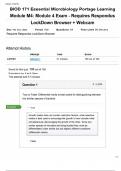
Due No due date Points 100 Questions 24 Time Limit 60 Minutes Requires Respondus LockDown Browser Attempt History Attempt Time Score LATEST Attempt 1 51 minutes 100 out of 100 Score for this quiz: 100 out of 100 Submitted Jun 6 at 8:10pm This attempt took 51 minutes. 6/20/22, 10:00 PM 2/13 Question 3 10 / 10 pts What are the requirements of a fastidious microbe? Your Answer: They are organisms with abstract growth requirements and without these requirements, they are not able to grow. Medias that are rich however, contain these specific nutrients, which are essential and necessary for the growth of a certain subset of microorganisms. A fastidious microbe is an organism with complex growth requirements such that if absent it will not grow. Enriched medias thus contain these specific and essential nutrients required for the growth of a particular subset of microorganisms. Correctt! Selective media Non-selective and non-differential media Growth media Differential media A researcher is asked to determine which of two vials contains E coli and which contains salmonella. Knowing both are Gram-negative while only one of them is capable of fermenting lactose, which type of media would be best suited? Question 2 2 / 2 pts 6/20/22, 10:00 PM 3/13 Agar is used to create a solid, smooth surface on which microbes can grow. Your Answer: It is generally used to create a smooth and solid surface, to allow microbes to grow on it What is agar used for in microbiology? Question 5 5 / 5 pts Blood agar is which type of medium? Select all that apply. Correctt! Enriched Question 6 2 / 2 pts Correctt! LB agar is the most basic type of agar and like LB media supports the growth of virtually all microbes without restriction. False True True or False: LB agar is classified as a selective, non-differential media. Question 4 2 / 2 pts 6/20/22, 10:00 PM 4/13 Match the following hemolytic class with its description of activity. 1. Alpha hemolysis 2. Beta hemolysis color 3. Gamma hemolysis clearing A. No change. B. Greenish-brown C. Distinct zone of Correctt! 1 Correctt! 2 Correctt! 3 Question 7 5 / 5 pts A C B Question 8 2 / 2 pts Correctt! Differential Blood agar can be used to differential between species based on its hemolytic activity. Selective Selective and Differential 6/20/22, 10:00 PM 5/13 Correctt! Chocolate (cocoa) is never added to the media. The name is derived simply based on the color that actually comes from the presence of ‘cooked’ (lysed) red blood cells in the media. False True True or False: Chocolate agar gets its brown color from cocoa to produce an enriched media. Question 9 2 / 2 pts An unknown microbe is streaked onto a MacConkey agar plate. After an overnight incubation at 37°C, growth is observed. Would a Gram stain be Question 10 5 / 5 pts Columbia CNA agar is most closely related to which media: MacConkey Agar Trypticase Soy Agar Correctt! Blood agar CNA agar is similar to BAP as it is also enriched with blood and allows for differentiation based on hemolytic patterns. EMB agar 6/20/22, 10:00 PM 6/13 Question 11 10 / 10 pts In an attempt to detect the presence of the pathogenic strain of E. coli O157:H7, a researcher spread a culture onto a MacConkey agar with failed results. What type of agar should they (correctly) try next? Why? Your Answer: First, this strain of E. Coli is different from other strains of E-Coli, because it is unable to ferment sarbitol. And since the MacConkey plates contain sarbitol, the researcher should try an EMB plate next, because of it's similiarities to the SMAC plate, as lactose fermenting microbes will produce colonies on the surface of the agar. Which if present, would show up as a metallic green color on the EMB agar plate The microbe should be plated on SMAC (Sorbitol-MacConkey agar) as it is specifically formulated to detect O157:H7. Pathogenic E. coli (O157:H7) cannot ferment sorbitol while non-pathogenic E. coli can ferment both soribitol and lactose. Therefore, colonies that ferment (acidic conditions; nonpathogenic) can be differentiated from non-fermenters (neutral to basic conditions; pathogenic).
Written for
- Institution
-
Portage Learning
Document information
- Uploaded on
- April 12, 2025
- Number of pages
- 13
- Written in
- 2024/2025
- Type
- Exam (elaborations)
- Contains
- Questions & answers
Subjects
- biod 171
- essential microbiology
-
biod 171 essential microbiology
-
biod 171 essential microbiology portage learning

Also available in package deal