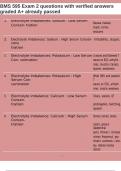
BMS 595 Exam 2 questions with verified answers
graded A+ already passed
1. Electrolyte Imbalances: Sodium : Low Serum
Nausea, malaise,
Concen- tration
stupor, coma,
seizures
2. Electrolyte Imbalances: Sodium : High Serum Concen- Irritability, stupor,
coma
tration
3. Electrolyte Imbalances: Potassium : Low Serum U waves and flattened T
Con- centration waves on ECG. arrhythi-
mas, muscle cramps,
spasm, weakness
4. Electrolyte Imbalances: Potassium : High Wide QRS and peaked
Serum Con- T
centration waves on ECG, arrhyth-
mias, muscle weakness
5. Electrolyte imbalance: Calcium : Low Serum Tetany, seizures, QT
Concen-
tration prolongation, twitching,
spasm
6. Electrolyte imbalance: Calcium : High Serum Stones (renal), bones
Concen-
tration (pain), groans
(abdominal
pain), thrones ( increase
urinary frequency), psy-
chiatric overtones ( anxi-
ety, altered mental
status)
,BMS 595 Exam 2 questions with verified answers
graded A+ already passed
7. The ECG is a graphic record of the atria, ventricles
direction and magnitude of the
electrical activity generated by the
depolarization and repolarization of the and
of the heart.
8. electrodes
,BMS 595 Exam 2 questions with verified answers
graded A+ already passed
It gives a tracing from 12
different "electrical positions"
of the heart by
attached to the skin.
Einthoven
9. Dutch physiologist Willem
developed techniques to record the
electrical activity of the heart in the late
1800's. 1800's
10. Dutch physiologist Willem
Einthoven developed
techniques to record the Electro Kardio
electrical activity of the heart in the late 's. Gramm
11. The physiologist called this recording an
(acronym EKC).
12. Normal Heart Rate for an Infant (1-12months) 100-160
13. Normal Heart Rate for a Toddler (1 to 3 years) 90-150
14. Normal Heart Rate for a PreSchooler ( 4 to 5 years)80-140
15. Normal Heart Rate for School Age ( 6 to 12 years)70-120
16. Normal Heart Rate for an Adolescent ( 13 to 18 years) 60-100
17. Normal Heart Rate for an Adult 60-100
18. Each lead records the average flow at a specific electrical
time in a specific location of the heart.
,BMS 595 Exam 2 questions with verified answers
graded A+ already passed
19. The ECG records views of the heart on both
and a frontal, transverse
plane.
20. The frontal leads include , , , , and, I, II, III, aVR, aVL
and aVF
graded A+ already passed
1. Electrolyte Imbalances: Sodium : Low Serum
Nausea, malaise,
Concen- tration
stupor, coma,
seizures
2. Electrolyte Imbalances: Sodium : High Serum Concen- Irritability, stupor,
coma
tration
3. Electrolyte Imbalances: Potassium : Low Serum U waves and flattened T
Con- centration waves on ECG. arrhythi-
mas, muscle cramps,
spasm, weakness
4. Electrolyte Imbalances: Potassium : High Wide QRS and peaked
Serum Con- T
centration waves on ECG, arrhyth-
mias, muscle weakness
5. Electrolyte imbalance: Calcium : Low Serum Tetany, seizures, QT
Concen-
tration prolongation, twitching,
spasm
6. Electrolyte imbalance: Calcium : High Serum Stones (renal), bones
Concen-
tration (pain), groans
(abdominal
pain), thrones ( increase
urinary frequency), psy-
chiatric overtones ( anxi-
ety, altered mental
status)
,BMS 595 Exam 2 questions with verified answers
graded A+ already passed
7. The ECG is a graphic record of the atria, ventricles
direction and magnitude of the
electrical activity generated by the
depolarization and repolarization of the and
of the heart.
8. electrodes
,BMS 595 Exam 2 questions with verified answers
graded A+ already passed
It gives a tracing from 12
different "electrical positions"
of the heart by
attached to the skin.
Einthoven
9. Dutch physiologist Willem
developed techniques to record the
electrical activity of the heart in the late
1800's. 1800's
10. Dutch physiologist Willem
Einthoven developed
techniques to record the Electro Kardio
electrical activity of the heart in the late 's. Gramm
11. The physiologist called this recording an
(acronym EKC).
12. Normal Heart Rate for an Infant (1-12months) 100-160
13. Normal Heart Rate for a Toddler (1 to 3 years) 90-150
14. Normal Heart Rate for a PreSchooler ( 4 to 5 years)80-140
15. Normal Heart Rate for School Age ( 6 to 12 years)70-120
16. Normal Heart Rate for an Adolescent ( 13 to 18 years) 60-100
17. Normal Heart Rate for an Adult 60-100
18. Each lead records the average flow at a specific electrical
time in a specific location of the heart.
,BMS 595 Exam 2 questions with verified answers
graded A+ already passed
19. The ECG records views of the heart on both
and a frontal, transverse
plane.
20. The frontal leads include , , , , and, I, II, III, aVR, aVL
and aVF