100% satisfaction guarantee Immediately available after payment Both online and in PDF No strings attached 4.2 TrustPilot
logo-home
Exam (elaborations)

Medical Microbiology Final Exam Questions and Answers.

Rating
-
Sold
-
Pages
41
Grade
A+
Uploaded on
11-04-2025
Written in
2024/2025

Medical Microbiology Final Exam Questions and Answers All microorganisms are best defined as organisms that: A. cause human disease B. lack a cell nucleus C. are infectious particles D. are too small to be seen with the unaided eye E. can only be found growing in laboratories - Correct Answers: D. are too small to be seen with the unaided eye Which of the following is a difference between prokaryotic and eukaryotic cells? A. prokaryotes have a cell wall, while eukaryotes do not B. prokaryotes have multiple linear chromosomes while eukaryotes have a single, circle chromosome C. eukaryotes have no membrane bound organelles, while prokaryotes do contain them D. prokaryotes have a nucleus while eukaryotes do not E. prokaryotes contain the bacteria and archea, while eukaryotes include all other living organisms - Correct Answers: E. prokaryotes contain the bacteria and archea, while eukaryotes include all other living organisms Which of the following is found in ALL bacterial cells? A. flagella B. cell wall C. pili D. spore E. none of the above - Correct Answers: E. none of the above Microbes are beneficial in that they have been used to: A. treat waste water B. clean up toxic spills C. decompose organic material D. all of the above E. none of the above - Correct Answers: D. all of the above Scientists use microbes to produce drugs, hormones, and enzymes. This type of biotechnology involves the transfer of foreign genetic material into a microbe, a process called: A. recombinant DNA technology B. gene therapy C. bioremediation D. polymerase chain reaction - Correct Answers: A. recombinant DNA technology Which of the following is the smallest cause of infectious disease? A. protozoans B. bacteria C. helminths D. viruses E. none of the above - Correct Answers: D. viruses Gram negative bacteria differ from gram positive in that they: A. are non-pathogenic B. do not have a cell wall C. have flagella D. have an outer membrane surrounding the cell wall E. none of the above - Correct Answers: D. have an outer membrane surrounding the cell wall Which of the following is mismatched? A. ribosomes - protein synthesis B. inclusions - excess cell nutrients and materials C. plasmids - genes essential for growth and metabolism D. nucleoid - hereditary material E. cytoplasm - dense, gelatinous solution - Correct Answers: C. plasmids - genes essential for growth and metabolism Bacterial endospores are not produced by: A. staphylococcus B. bacillus C. clostridium D. all of the choices produce endospores - Correct Answers: A. staphylococcus Which of the following is a unique characteristic of viruses that distinguishes them from other major groups of microorganisms? A. cause human disease B. lack a nucleus C. cannot be seen without a microscope D. contain genetic material E. lack cell structure - Correct Answers: E. lack cell structure Koch's postulates are criteria used to establish that: A. microbes are found on dust particles B. a specific microbe is the cause of a specified disease C. life forms can only arise from preexisting life forms D. a specific microbe should be classified in a specific kingdom E. microbes can be used to clean up toxic spills - Correct Answers: B. a specific microbe is the cause of a specified disease Which scientific field is involved in the identification, classification, and naming or organisms? A. nomenclature B. taxonomy C. phylogeny D. woesean classification E. none of the choices is correct - Correct Answers: B. taxonomy Select the correct descending taxonomic hierarchy (left to right): A. family, order, class B. family, genus, species C. genus, species, family D. class, phylum, order E. kingdom, domain, phylum - Correct Answers: B. family, genus, species Which of the following is a scientific name? A. gram-positive streptococcus B. staphylococcus C. staphylococcus pyogenes D. anthrax E. streptobacilli - Correct Answers: C. staphylococcus pyogenes Aseptic technique aims to reduce the number of microbes in medical settings, thus preventing wound infection and disease. These techniques were first introduced in a surgical setting by: A. Joseph Lister B. Robert Hooke C. Louis Pasteur D. Antonie van Leeuwenhoek - Correct Answers: A. Joseph Lister The difference in cell wall structure of Mycobacterium and Norcardia compared to the typical gram-positive bacterial cell wall structure is: A. more peptidoglycan B. predominance of unique, waxy lipids C. easily decolorized D. presence of lipopolysaccharide E. all of the choices are correct - Correct Answers: B. predominance of unique, waxy lipids A capsule surrounding a bacterium may allow: A. transfer of plasmids carrying drug resistance genes B. evasion of the human immune response C. adhesion to host cells D. increased phagocytosis - Correct Answers: B. evasion of the human immune response Which of the following allows bacteria to survive under extremely harsh conditions? A. pili B. flagella C. capsules D. plasmids E. endospores - Correct Answers: E. endospores The term that refers to the purposeful addition of microorganisms into a laboratory nutrient medium is: A. isolation B. inoculation C. immunization D. infection E. contamination - Correct Answers: B. inoculation A pure culture contains: A. only one species of microorganisms B. only bacteria C. a variety of microbes from one source D. a variety of species from the same genus E. none of the choices are correct - Correct Answers: A. only one species of microorganisms What type of isolation technique is most effective for the majority of applications? A. pour plate B. streak plate C. spread plate D. loop dilution E. culture plate - Correct Answers: B. streak plate Agar is an important component of media because: A. bacteria require agar to grow B. agar inhibits mold growth C. agar provides a solid surface for bacterial growth D. agar prevents contamination E. all of the choices are correct - Correct Answers: C. agar provides a solid surface for bacterial growth A bacterial cell exhibiting chemotaxis probably has: A. fimbriae B. a capsule C. thylakoids D. flagella E. metachromatic granules Chemotaxis; the movement of an organism in response to a chemical stimulus. - Correct Answers: D. flagella The three physical forms of laboratory media are: A. solid, liquid, and gas B. solid, semisolid, and liquid C. streak plate, pour plate, and broth D. aerobic, anaerobic, and micro aerobic E. none of the choices are correct - Correct Answers: B. solid, semisolid, and liquid If bacteria living in salty seawater were displaced to a freshwater environment, the cell structure that would prevent the cells from rupturing is: A. endospore B. cell wall C. cell membrane D. capsule E. slime layer - Correct Answers: B. cell wall A nutrient medium that has all of its chemical components identified, and their precise concentrations known and reproducible, would be termed: A. complex B. reducing C. enriched D. chemically defined E. none of the choices are correct - Correct Answers: D. chemically defined Which type of medium is able to distinguish different species or types of microorganisms based on an observable change in the colonies or in the medium? A. differential B. selective C. enumeration D. enriched E. reducing - Correct Answers: A. differential A microbiologist inoculates Staphylococcus aureus into a culture medium. Following incubation, both Staphylococcus aureus and Staphylococcus epidermidis are determined to be growing in this culture. What is the most likely explanation? A. the microbiologist used too much inoculum B. the culture is contaminated C. the incubation temperature was incorrect D. the culture medium must be selective E. the culture medium must be differential - Correct Answers: B. the culture is contaminated If a microbiologist is studying at a total magnification of 950x, what is the magnifying power of the objective lens if the ocular lens is at 10x? A. 100x B. 950x C. 85x D. 850x E. 95x - Correct Answers: E. 95x Which of the following characteristics refers to the microscope's ability to show two separate entities as separate and distinct? A. resolving power B. magnification C. refraction D. all of the choices are correct E. none of the choices are correct - Correct Answers: A. resolving power Which type of microscope is the most widely used and shows cells against a light background? A. bright field B. dark field C. phase contrast D. fluorescence E. electron - Correct Answers: A. bright field The specimen preparation that is best for viewing cell motility is: A. hanging drop B. fixed stained smear C. gram stain D. negative stain E. flagellar stain - Correct Answers: A. hanging drop A microbiologist makes a fixed smear of bacterial cells and stains them with Loeffler's methylene blue. All the cells appear blue under the oil lens. This is an example of: A. negative staining B. using an acidic dye C. simple staining D. using the acid-fast stain E. capsule staining - Correct Answers: C. simple staining Which type of microscope does not use light in forming the specimen image? A. bright field B. dark field C. phase contrast D. fluorescence E. electron - Correct Answers: E. electron Bacterial cells could have any of the following appendages except: A. flagella B. cilia C. fimbriae D. periplasmic flagella E. sex pili - Correct Answers: B. cilia The cell ____ can be composed of three layers: the cytoplasmic membrane, the cell wall, and the outer membrane. A. glycocalyx B. envelope C. pathogenic package D. slime coat E. none of the choices are correct - Correct Answers: B. envelope The term that refers to the presence of flagella over the cell surface is: A. amphitrichous B. atrichous C. lophotrichous D. monotrichous E. peritrichous - Correct Answers: E. peritrichous Which of the following is not a division of bacteria and archaea according to Bergey's Manual of Bacteriology? A. gracilicutes B. scotobacteria C. firmicutes D. tenericutes E. mendosicutes - Correct Answers: B. scotobacteria The transfer of genes during bacterial conjugation involves rigid, tubular appendages called: A. flagella B. cilia C. fimbriae D. periplasmic flagella (axial filaments) E. sex pili - Correct Answers: E. sex pili A client has a serious case of the flu. A random sample of sputum was taken from the patient coughing up blood. The lab tech said they had isolated a bacterium that did not have any peptiglycan. You hypothesize that the identity of this microbe could possibly be: A. Mycobacterium tuberculosis B. Borrelia burghdorferi C. Streptococcus pneumoniae D. Mycoplasma pneumoniae E. Staphylococcus aureus - Correct Answers: D. Mycoplasma pneumoniae Microscopic analysis revealed the presence of gram-negative bacilli in the patient's stool. Based upon this information, you picture in your mind which of the following images? A. red spheres in chains B. purple rods C. purple spheres in clusters D. red rods - Correct Answers: D. red rods The report shows that a motility test was also performed on the sample, and the microbe produced positive results. Thinking about bacterial movement, you realize that this bacterium could possess which structure(s) for motility? A. endospores B. a pilus C. one or more flagella D. pseudopodia - Correct Answers: C. one or more flagella The report concludes that the diagnosis is salmonella infection. Remembering resources available for prokaryotic identification, you assume that the laboratory technicians may have used: A. Bergey's Manual of Systematic Bacteriology because its five volumes of information were necessary to create a phylogenetic tree for identification of this pathogen B. Bergey's Manual of Systematic Bacteriology because rRNA analysis was required in the identification of this pathogen C. Bergey's Manual of Determinative Bacteriology because they needed to fully understand the evolutionary background of the pathogen D. Bergey's Manual of Determinative Bacteriology because it classifies prokaryotes on phenotypic traits typically tested for in clinical settings - Correct Answers: D. Bergey's Manual of Determinative Bacteriology because it classifies prokaryotes on phenotypic traits typically tested for in clinical settings (T/F) If during the gram stain procedure, the bacterial cells were viewed immediately after crystal violet was applied, gram-positive cells would be purple but gram-negative cells would be colorless. - Correct Answers: False (T/F) Flagella move in a whiplike motion. - Correct Answers: False (T/F) Bacterial cultures are easily identified from their microscopic appearance. - Correct Answers: False (T/F) If you observe rod-shaped, pink cells on a slide that had just been gram-stained, you can assume that their cell walls contain endotoxin. - Correct Answers: True (T/F) Complacency is a factor in reemerging diseases due to decreased vaccination rates because they assume that it is no longer necessary for certain diseases. - Correct Answers: True (T/F) Louis Pasteur originally developed the process of pasteurization for preventing the spoilage of wine. - Correct Answers: True (T/F) Only a minority of microbes are pathogenic. - Correct Answers: True (T/F) A scientist studying helminths is working with bacteria. - Correct Answers: False (T/F) The term sterile means free of all life forms. - Correct Answers: True Which of the following would describe single curved rods? A. streptococcus B. staphylococcus C. vibrio D. bacillus E. spirochete - Correct Answers: C. vibrio Which of the following would describe clusters of round cells? A. streptococcus B. vibrio C. staphylococcus D. spirochete E. bacillus - Correct Answers: C. staphylococcus Cells form a ___ arrangement when cells in a chain snap back upon each other forming a row of cells oriented side by side. A. tetrad B. strep C. staph D. sarcina E. palisade - Correct Answers: E. palisade Which of the following is found in eukaryotic cells but not in the cells of bacteria? A. Mitochondria B. Cytoplasm C. Ribosomes D. Cell membrane E. DNA - Correct Answers: A. Mitochondria Cell walls are not usually found in: A. protozoa B. algae C. fungi D. bacteria E. all of the choices are correct - Correct Answers: A. protozoa The size of eukaryotic cell ribosome is: A. 30S B. 40S C. 50S D. 70S E. 80S - Correct Answers: E. 80S Filamentous fungi are called: A. pseudohyphae B. septa C. molds D. dimorphic E. mycelium - Correct Answers: C. molds Which is not a characteristic of fungi? A. have cell walls B. photosynthetic C. include single-celled and filamentous forms D. heterotrophic nutrition E. can use a wide variety of nutrients - Correct Answers: B. photosynthetic Fungal infections are known as ___ and can be acquired from environmental or clinical sources. A. secondary infections B. vegetative infections C. mycoses D. saprobic infections E. parasitoses - Correct Answers: C. mycoses During unfavorable growth conditions, many protozoa can convert to a resistant, dormant stage called: A. endospore B. cyst C. seed D. saprobic infections E. parasitoses - Correct Answers: B. cyst Larvae and eggs are developmental forms of: A. protozoa B. algae C. helminths D. fungi E. none of the choices are correct - Correct Answers: C. helminths Which of the following is not a method of locomotion utilized by protozoa: A. pseudopodia B. cilia C. gliding motility D. flagella E. pili - Correct Answers: E. pili Which is mismatched? A. Giardia - causes intestinal distress; transmitted by feces in drinking water B. Histoplasma - fungus that causes Ohio Valley fever C. Trichomonas - sexually transmitted vaginal infection D. Plasmodium - protozoan that causes Chagas disease E. Naegleria - amoeba that causes brain infection - Correct Answers: D. Plasmodium - protozoan that causes Chagas disease All of the following are helminths except: A. pinkworms B. flukes C. trypanosomes D. roundworms E. tapeworms - Correct Answers: C. trypanosomes Parasitic worms have a highly developed ___ system. A. digestive B. nervous C. respiratory D. muscular E. reproductive - Correct Answers: E. reproductive After staining, you visualize the specimen. You identify single-celled organisms that possess a nucleus, and many of them are undergoing the process of budding. You believe this patient is suffering from an infection cause by a: A. helminth B. protozoan C. fungus D. bacterium - Correct Answers: C. fungus You look closely and see that some of the cells are producing filamentous structures called hyphae. A term referring to a yeast able to exist in a yeast or hyphal form is: A. dioecious B. dimorphic C. dichotomous D. diurnal - Correct Answers: B. dimorphic You suspect that your patient is suffering from oral candidiasis, caused by candida albicans, and know the treatment may require drugs that produce toxic side effects. Which of the following statetments explains why drugs used to treat this type of infection can be toxic to humans? A. They target viruses only seen in humans B. They target eukaryotic structures seen in both Candida albicans and human cells C. They target peptidoglycan which is seen both Candida albicans and human cells D. They target the process of sporulation exhibited by both Candida albicans and human cells - Correct Answers: B. They target eukaryotic structures seen in both Candida albicans and human cells The school nurse noticed a second grader scratching and pulling at the back of her pants, she complained that her bottom itched mostly in the morning hours, what is the most likely cause of the child's problems? A. a helminth B. a fungus C. bacteria D. protozoa E. a virus - Correct Answers: A. a helminth Viruses have all the following except: A. definite shape B. metabolism C. genes D. the ability to infect host cells E. ultramicroscopic size - Correct Answers: B. metabolism Host cells of viruses include: A. humans and other animals B. plants and fungi C. bacteria D. protozoa and algae E. all of the choices are correct - Correct Answers: E. all of the choices are correct One of the principal capsid shapes is 20-sided figure with 12 evenly spaced corners referred to as a ___ capsid. A. spiked B. complex C. icosahedral D. helical E. buckeyball - Correct Answers: C. icosahedral A naked virus only has a: A. capsid B. capsomere C. nucleocapsid D. envelope E. antigenic surface - Correct Answers: C. nucleocapsid The core of every virus particle always contains: A. DNA B. capsomeres C. enzymes D. DNA and RNA E. either DNA or RNA - Correct Answers: E. either DNA or RNA In general, most DNA viruses multiply in the host cell's ___, while most RNA viruses multiply in the host cell's ___. A. nucleus, cytoplasm B. cytoplasm, cell membrane C. cell membrane, cytoplasm D. cytoplasm, nucleus E. nucleus, endoplasmic reticulum - Correct Answers: A. nucleus, cytoplasm Which of the following is not a major element of a microbial cell? A. copper B. carbon C. hydrogen D. nitrogen E. oxygen - Correct Answers: A. copper Viral tissue specificites are called: A. ranges B. virions C. receptacles D. tropisms E. uncoating - Correct Answers: D. tropisms Mammalian viruses capable of starting tumors are: A. chronic latent viruses B. oncoviruses C. syncytia D. inclusion bodies E. cytiopathic - Correct Answers: B. oncoviruses; virus that can cause cancer New, nonenveloped virus release occurs by: A. lysis B. budding C. exocytosis D. both lysis and budding E. both budding and exocytosis - Correct Answers: A. lysis; disintegration of a cell by rupture of the cell wall or membrane The event that occurs in bacteriophage multiplication that does not occur in animal virus replication is: A. adsorption to the host cells B. injection of only the viral nucleic acid into the host cell C. host cell synthesis of viral enzymes and capsid proteins D. assembly of nucleocapsids E. replication of viral nucleic acid - Correct Answers: B. injection of only the viral nucleic acid into the host cell Viruses that cause infection resulting in alternating periods of activity with symptoms and inactivity without symptoms are called: A. latent B. oncogenic C. prions D. viroids E. delta agents - Correct Answers: A. latent; lying dormant or hidden until circumstances are suitable for development or manifestation When a bacterium acquires a trait from its temperate phage, it is called: A. transformation B. lysogenic conversion C. viral persistence D. transcription E. translation - Correct Answers: B. lysogenic conversion; when a temperate phage induces a change in the phenotype of the infected bacteria that is not part of a usual phage cycle Which of the following will NOT support viral cultivation? A. live lab animals B. embryonated bird eggs C. cell cultures D. nutrient broth - Correct Answers: D. nutrient broth The development of antiviral drug therapy is difficult because: A. viruses are obligate intracellular parasites so the host cell can be harmed by the drug B. viruses do not have specific replication cycles that can be targeted C. viruses do not contain genetic material D. their life cycles do not have distinctive stages - Correct Answers: A. viruses are obligate intracellular parasites so the host cell can be harmed by the drug Infectious protein particles are called: A. viroids B. phages C. prions D. oncogenic viruses E. spikes - Correct Answers: C. prions Satellite viruses are: A. also called viroids B. dependent on other viruses for replication C. the cause of spongiform encephalopathies D. significant pathogens of plants E. all of the choices are correct - Correct Answers: B. dependent on other viruses for replication Viruses contain the necessary tools to invade and control a host cell. These tools may consist of a: A. nucleus, nucleic acid, and enzymes B. viral cell membrane, nucleic acid, and enzyme C. nucleus, nucleic acid, capsid, and enzymes D. capsid, nucleic acid, envelope, and enzyme - Correct Answers: D. capsid, nucleic acid, envelope, and enzyme Which of the following is not a characteristic of a transformed cell? A. decreased growth rate B. alterations in chromosomes C. viral nucleic acid integrated into host DNA D. changes in cell surface molecules E. capacity to divide indefinitely - Correct Answers: A. decreased growth rate The term photoautotroph refers to an organism that: A. is a decomposer B. must obtain organic compounds for its carbon needs C. gets energy from sunlight D. gets energy by oxidizing chemical compounds E. does not need a carbon source - Correct Answers: C. gets energy from sunlight Organisms that feed on dead organisms for nutrients are called: A. saprobes B. parasites C. autotrophs D. lithoautotrophs E. phototrophs - Correct Answers: A. saprobes The movement of substances from higher to lower concentration across a semipermeable membrane that must have a specific protein carrier but no energy expenditure is called: A. facilitated diffusion B. diffusion C. active transport D. osmosis E. endocytosis - Correct Answers: A. facilitated diffusion Bacteria living in a freshwater stream that are moved to salty seawater would: A. be in a hypotonic solution B. gain water C. be in an isotonic solution D. undergo plasmolyis E. none of the choices are correct - Correct Answers: D. undergo plasmolyis Cultures of a bacterial species were incubated on the incubator shelf, in an anerobic jar, and in a candle jar. After incubation, there was moderate growth of cultures in the candle and anaerobic jars, but heavy growth of the culture on the incubator shelf this species is a: A. aerobe B. anaerobe C. facultative anaerobe D. microaerophile E. capnophile - Correct Answers: C. facultative anaerobe; organism that makes ATP by aerobic respiration if oxygen is present, but is capable of switching to fermentation or anaerobic respiration if oxygen is absent Human pathogens fall into the group: A. psychrophiles B. thermophiles C. halophiles D. mesophiles E. acidophiles - Correct Answers: D. mesophiles; organism that grows best in moderate temperature, neither too hot nor too cold, typically between 20 and 45 °C The E. coli that normally live in the human large intestines and produce vitamin K for the body to use would best be termed a ___ relationship. A. parasitic B. saprobic C. commensal D. mutualistic E. none of the choices are correct - Correct Answers: D. mutualistic The phase of the bacterial growth curve in which newly inoculated cells are adjusting to their new environment, metabolizing but not growing, is the: A. lag phase B. log phase C. stationary phase D. death phase E. prophase - Correct Answers: A. lag phase You start a culture of Streptococcus lactis from 3 bacterial cells. You know that the generation time is 45 minutes for this species. How many bacterial cells would you expect to obtain after 6 hours? A. 8 B. 192 C. 256 D. 768 E. 6561 - Correct Answers: D. 768 (T/F) Sterols (typically waxy solids) are not present in eukaryotic cell membranes. - Correct Answers: False (T/F) All fungi cause some kind of disease in plants and animals. - Correct Answers: False (T/F) Viruses are used to produce vaccines for prevention of certain viral infections. - Correct Answers: True (T/F) A specific animal virus has the ability to attach to and enter almost any animal host cell. - Correct Answers: False (T/F) After binary fission, daughter cells will differ genetically. - Correct Answers: False (T/F) Bacteria in a biofilm express different genes and behave differently than free (planktonic) bacteria. - Correct Answers: False All of the chemical reactions of the cell are called: A. catabolism B. redox reactions C. phosphorylation D. metabolism E. cellular respiration - Correct Answers: D. metabolism Enzymes are: A. broken down in reactions that require energy input B. proteins that function as catalysts C. used up in chemical reactions D. not needed for catabolic reactions E. none of the choices are correct - Correct Answers: B. proteins that function as catalysts Formation of peptide bonds between amino acids to build up a polypeptide would be called: A. anabolism B. phosphorylation C. fermentation D. catabolic E. glycolysis - Correct Answers: A. anabolism During aerobic cellular respiration, the final electron acceptor is: A. pyruvic acid B. oxygen C. nitrate D. cytochrome c E. alcohol - Correct Answers: B. oxygen When glucose is broken down during bacterial fermentation, how many ATP are generated? A. 2 ATP B. 3 ATP C. 24 ATP D. 36 ATP E. 38 ATP - Correct Answers: A. 2 ATP The property of organisms to integrate catabolic and anabolic pathways to improve cell efficiency is best termed: A. metabolism B. amphibolism C. anabolism D. catabolism E. biosynthesis - Correct Answers: B. amphibolism; a biochemical pathway that involves both catabolism and anabolism Which of the following processes is common to fermentation, anaerobic respiration and aerobic respiration? A. glycolysis B. the Krebs cycle C. the electron transport system D. glycosylation - Correct Answers: A. glycolysis; the breakdown of glucose by enzymes, releasing energy and pyruvic acid Which of the following statements about anaerobic respiration is false? A. it lowers amount of ATP when compared to aerobic respiration B. The Krebs cycle is utilized C. it involves the reduction of an organic final electron acceptor D. it generates ATP E. it utilizes the electron transport chain - Correct Answers: C. it involves the reduction of an organic final electron acceptor Which of the following statements regarding metabolism is false? A. heat may be released in both anabolic and catabolic reactions B. ATP if formed in catabolic reactions C. ADP is formed in anabolic reactions D. anabolic reactions are degradative - Correct Answers: D. anabolic reactions are degradative You look in the refrigerator and find some orange drink you had forgotten was there. The drink now has an "off" taste and bubbles. What is the most likely explanation for the changes in the drink? A. Bacterial cells are growing in the drink and performing aerobic respiration to produce energy B. Bacterial cells are growing in the drink and performing fermentation to produce energy C. Bacterial cells are growing in the drink and performing anaerobic respiration to produce energy D. Bacterial cells are dying and breaking down E. The drink is degrading - Correct Answers: B. Bacterial cells are growing in the drink and performing fermentation to produce energy Each ___ is a specific segment of DNA with the code for the production of one functional product. A. intron B. exon C. gene D. operator E. triplet - Correct Answers: C. gene The structure of DNA determines the product it produces, this is determined by: A. The specific amino acid sequence of the DNA determined by the variable group B. The specific nucleotide sequence of the DNA determined by the bases A,T, G, and C C. The specific nucleotide sequence of the DNA determined by the bases A, U, G, and C D. The random amino acid sequence of the DNA determined by the amino group E. The random molecular structure of DNA - Correct Answers: B. The specific nucleotide sequence of the DNA determined by the bases A,T, G, and C A permanent inheritable change in the genetic information is called: A. translation B. transcription C. mutation D. alteration E. regeneration - Correct Answers: C. mutation Which is incorrect about inducible operons? A. have genes turned off by a buildup of end product B. are often for catabolic pathways C. are noramlly turned off D. are turned on by the substrate of the enzyme (molecule acted upon by the gene product) E. include the lac operon - Correct Answers: A. have genes turned off by a buildup of end product The lactose repressor: A. is transcribed with the structural lac genes B. is activated by binding lactose C. is inactivated by binding lactose D. requires lactose for its transcription E. none of the choices are correct - Correct Answers: C. is inactivated by binding lactose A mutation that changes a normal codon to a stop codon is called a: A. point mutation B. silent mutation C. back mutation D. missense mutation E. nonsense mutation - Correct Answers: E. nonsense mutation If the wild-type DNA sequence reads THE CAT ATE THE BIG RAT, what type of mutation would change the sequence to THE CAT ATE THE BAG RAT? A. missense B. nonsense C. insertion D. deletion E. silent - Correct Answers: A. missense; a single nucleotide change results in a codon that codes for a different amino acid Which of the following is not a type of bacterial DNA recombination? A. transformation B. conjugation C. mitosis D. transduction - Correct Answers: C. mitosis The transfer of DNA fragments of a dead cell to a live, competent recipient cell that results in a changed recipient cell is: A. transduction B. conjugation C. transformation D. transmission E. mitosis - Correct Answers: C. transformation The jumping of a gene from one location to another is done by: A. conjugation B. transposons C. transformation D. transduction E. transmission - Correct Answers: B. transposons DNA strands can be clipped crosswise at selected positions by using enzymes produced by bacterial cells called: A. palindromes B. reverse transcriptase C. restriction endonucleases D. ligases E. DNA polymerase - Correct Answers: C. restriction endonucleases; an enzyme from bacteria that can recognize specific base sequences in DNA and cut (restrict) the DNA at that site The transfer of genetic material can involve contact between two bacterial cells. DNA can pass from one cell to the other through a pilus during this process, which is called: A. transformation B. conjugation C. specialized transduction D. generalized transduction - Correct Answers: B. conjugation Which of the following microbial forms have the lowest resistance to physical and chemical controls? A. enveloped viruses B. protozoan cysts C. fungal spores D. bacterial endospores E. gram negative bacteria - Correct Answers: A. enveloped viruses The process that destroys or removes all microorganisms and microbial forms including bacterial endospores on inanimate objects is: A. disinfection B. sterilization C. antisepsis D. sanitization E. degermation - Correct Answers: B. sterilization Scrubbing or immersing the skin in chemicals to reduce the number of microbes on the skin is? A. disinfection B. sterilization C. antisepsis D. sanitization E. ionization - Correct Answers: C. antisepsis The method of removing vegetative microbial life forms from inanimate objects is termed? A. antisepsis B. disinfection C. sterilization D. decontamination E. degerming - Correct Answers: B. disinfection Which is correct regarding the rate of microbial death? A. cells die at increasingly greater rates B. only older cells die in a culture C. Cells in a culture die at a constant rate D. upon contact with the control agent, all cells die at one time E. cells become metabolically inactive, but are never killed - Correct Answers: C. Cells in a culture die at a constant rate Microbial death occurs when there is: A. no movement B. permanent loss of reproduction C. a change in appearance D. a decrease in size E. a decrease in metabolism - Correct Answers: B. permanent loss of reproduction Each of the following is the target of antimicrobial agents except: A. cell walls B. cell membranes C. nucleus D. cellular proteins E. cellular metabolism - Correct Answers: C. nucleus Physical agents for controlling microbial growth include all of the following except: A. ultraviolet radiation B. boiling water C. HEPA filters D. pasteurization E. hydrogen peroxide - Correct Answers: E. hydrogen peroxide The lowest temperature needed to kill all microbes in 10 minutes is the: A. thermal death point (TDP) B. thermal death time (TDT) C. sporicidal time D. death phase point E. none of the choices are correct - Correct Answers: A. thermal death point (TDP) Placing organisms at 4 degrees Celsius is: A. bacteriocidal B. bacteriostatic C. decontamination D. sterilization E. none of the above - Correct Answers: B. bacteriostatic; a biological or chemical agent that stops bacteria from reproducing, while not necessarily killing them otherwise What instrument is most effective pressure-temperature sterilization? A. oven B. autoclave C. water bath D. bunsen burner E. incubator - Correct Answers: B. autoclave Vials of microorganisms that undergo the freez-drying process called ___ will remain preserved and viable for years. A. desiccation B. flash freeze C. lyophilization D. pasteurization E. sterilization - Correct Answers: C. lyophilization; freeze drying ___ is a control method that removes microorganisms rather than inhibiting or killing them. A. boiling B. sterilization C. radiation D. filtration E. disinfection - Correct Answers: D. filtration Which of the following is not a factor that affects germicidal activity? A. the material being treated B. the length of exposure C. the strength of germicide D. the microorganism being treated E. all of these are factors - Correct Answers: E. all of these are factors Alcohols: A. dissolve membrane lipids at concentrations of greater than 50% B. can be used for disinfection or antisepsis C. are skin degerming agents D. are limited in effectiveness due to rapid evaporation E. all the choices are correct - Correct Answers: E. all the choices are correct Heavy metals work by: A. rupturing the cell membrane B. inactivating proteins C. binding to the DNA D. dissolving the cell wall E. mutating DNA - Correct Answers: B. inactivating proteins (T/F) Building block molecules for biosynthetic pathways come from the cell's catabolic pathways and from the environment. - Correct Answers: True (T/F) Microbes can utilize only carbohydrates for energy. - Correct Answers: False (T/F) The smallest unit of heredity is a chromosome. - Correct Answers: False (T/F Spontaneous mutations result from errors in DNA replication. - Correct Answers: True (T/F) Repressible operons are normally turned on in the cell. - Correct Answers: True (T/F) All mutations are detrimental to the cell. - Correct Answers: False (T/F) Cell-to-cell contact is required for transduction to occur. - Correct Answers: False; transduction is the transfer of genetic material from one organism (as a bacterium) to another by a genetic vector and especially a bacteriophage (T/F) Sexual reproduction is the only mechanism for genetic change. - Correct Answers: False (T/F) The term biotechnology refers exclusively to the use of genetically modified organisms for the production of desired products. - Correct Answers: False; biotechnology is the manipulation (as through genetic engineering) of living organisms or their components to produce useful usually commercial products (T/F) When a control agent targets the metabolic processes of microbial cells, active younger cells typically die more rapidly than older cells. - Correct Answers: True (T/F) Isoproply alcohol wiped across the skin site can sterilize it. - Correct Answers: False Which of the following types of microorganisms does not contain members known to cause disease? A. bacteria B. protozoa C. virus D. fungi E. Archaea - Correct Answers: E. Archaea Place in order from smallest to largest: virus, helmnith, bacteria, protozoan - Correct Answers: virus bacteria protozoan helminth Order the following based on level of resistance from MOST to LEAST resistant: fungi, prions, protozoan cysts, bacterial endospores, enveloped viruses, most gram-negative bacteria, most gram-positive bacteria - Correct Answers: prions bacterial endospores protozoan cysts gram-negative bacteria fungi gram-positive bacteria enveloped viruses (T/F) Bacteria are eukaryotic. - Correct Answers: False Which of the five I's of microbiology may involve the streak plate method? A. inspection B. isolation C. incubation D. inoculation E. identification - Correct Answers: B. isolation What does Streptococcus pyogenes look like under a microscope? A. chains of rods B. single spheres C. single rods D. cluster of rods E. cluster of spheres F. chains of spheres - Correct Answers: F. chains of spheres (T/F) Gram-negative bacteria appear pink following the gram staining protocol. - Correct Answers: True Metallic green colonies have formed in a culture where no other bacterial species have formed this color of colony. What type of media is this best described as? A. chemically defined media B. complex media C. selective media D. differential media - Correct Answers: D. differential media The major difference between gram+ and gram- cells would be found in their: A. nucleus B. ribosomes C. cell walls D. folic acid biosynthesis pathway - Correct Answers: C. cell walls Based on temperature requirements, most pathogenic bacteria would be classified as: - Correct Answers: Mesophiles What happens if you place a normal bacterial cell in a hypotonic solution? A. plasmolysis and cell growth will be inhibited B. the cell will burst open if it has a weak cell wall C. nothing, the cell will continue to grow normally D. the DNA will mutate and the cell will die - Correct Answers: A. plasmolysis and cell growth will be inhibited Which of the following is NOT an essential nutrient for microbial growth? A. hydrogen B. carbon C. silver D. oxygen - Correct Answers: C. silver What mechanism is most often used for bacterial growth? - Correct Answers: binary fission Which of the following is typically involved in the net breakdown of ATP? A. catabolism B. anabolism C. anaerobic respiration D. fermentation - Correct Answers: B. anabolism (constructive metabolism); the synthesis in living organisms of more complex substances from simpler ones [opposed to catabolism (destructive metabolism); the breaking down in living organisms of more complex substances into simpler ones, with the release of energy] Which chemotherapeutic drugs are purified and used unmodified from bacterial or fungal cells? - Correct Answers: Antibiotics Which of the following is normally used to treat a fungal infection? A. pyrantel B. fluconazole C. ampicillin D. oseltamivir - Correct Answers: B. fluconazole Which of the following is not a possible effect on the host of a chemotherapeutic agent? A. kill normal microbiota B. allergic reaction C. remove human cell walls D. toxicity - Correct Answers: C. remove human cell walls Pathogenic microbes that cause disease in healthy people are called? - Correct Answers: True pathogens (T/F) The infectious dose is always a single cell. - Correct Answers: False Substances that are naturally produced by certain microorganisms that can inhibit or destroy other microorganisms are called? A. narrow-spectrum drugs B. synthetic drugs C. antibiotics D. broad-spectrum drugs E. semisynthetic drugs - Correct Answers: C. antibiotics Important characteristics of antimicrobial drugs include: A. low toxicity for human tissues B. high toxicity against microbial cells C. do not cause serious side effects in humans D. stable and soluble in body tissues and fluids E. all of the choices are correct - Correct Answers: E. all of the choices are correct The use of a drug to prevent a person at risk of an imminent infection is called? A. prophylaxis B. synergism C. competitive inhibition D. lantibiotics E. prebiotics - Correct Answers: A. prophylaxis Which therapeutic index value would be the drug of choice (safest)? A. 10 B. 20 C. 0.1 D. 1 - Correct Answers: B. 20 A superinfection results from: A. buildup of a drug to toxic levels in the patient B. the wrong drug administered to the patient C. an immune system reaction to the drug D. decrease in most normal flora with overgrowth of an unaffected species E. all of the choices are correct - Correct Answers: D. decrease in most normal flora with overgrowth of an unaffected species Nutrients that encourage the growth of beneficial microbes in the intestines are known as: A. prebiotics B. lantibiotics C. probiotics D. riboswitches E. phytobiotics - Correct Answers: A. prebiotics Rabies is an example of this type of infection, which is indigenous to animals but naturally transmissible to humans: A. latent infection B. zoonotic infection C. focal infection D. mixed infection - Correct Answers: B. zoonotic infection If the patient develops rabies infection, the time from the bite to the appearance of symptoms is referred to as the: A. period of invasion B. prodromal stage C. convalescent period D. incubation period - Correct Answers: D. incubation period Which of the following terms most appropriately describes the role of the raccoon in the patient's exposure to infection? A. nonliving reservoir B. fomite C. carrier D. living reservoir - Correct Answers: D. living reservoir

Show more Read less
Institution
Microbiology
Course
Microbiology


Whoops! We can’t load your doc right now. Try again or contact support.

Written for

Institution
Microbiology
Course
Microbiology

Document information

Uploaded on
April 11, 2025
Number of pages
41
Written in
2024/2025
Type
Exam (elaborations)
Contains
Questions & answers

Subjects

Content preview

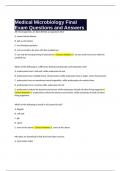
Medical Microbiology Final
Exam Questions and Answers
All microorganisms are best defined as organisms that:

A. cause human disease

B. lack a cell nucleus

C. are infectious particles

D. are too small to be seen with the unaided eye

E. can only be found growing in laboratories - Correct Answers: D. are too small to be seen with the
unaided eye


Which of the following is a difference between prokaryotic and eukaryotic cells?

A. prokaryotes have a cell wall, while eukaryotes do not

B. prokaryotes have multiple linear chromosomes while eukaryotes have a single, circle chromosome

C. eukaryotes have no membrane bound organelles, while prokaryotes do contain them

D. prokaryotes have a nucleus while eukaryotes do not

E. prokaryotes contain the bacteria and archea, while eukaryotes include all other living organisms -
Correct Answers: E. prokaryotes contain the bacteria and archea, while eukaryotes include all other
living organisms


Which of the following is found in ALL bacterial cells?

A. flagella

B. cell wall

C. pili

D. spore

E. none of the above - Correct Answers: E. none of the above


Microbes are beneficial in that they have been used to:

A. treat waste water

,B. clean up toxic spills

C. decompose organic material

D. all of the above

E. none of the above - Correct Answers: D. all of the above


Scientists use microbes to produce drugs, hormones, and enzymes. This type of biotechnology involves
the transfer of foreign genetic material into a microbe, a process called:

A. recombinant DNA technology

B. gene therapy

C. bioremediation

D. polymerase chain reaction - Correct Answers: A. recombinant DNA technology


Which of the following is the smallest cause of infectious disease?

A. protozoans

B. bacteria

C. helminths

D. viruses

E. none of the above - Correct Answers: D. viruses


Gram negative bacteria differ from gram positive in that they:

A. are non-pathogenic

B. do not have a cell wall

C. have flagella

D. have an outer membrane surrounding the cell wall

E. none of the above - Correct Answers: D. have an outer membrane surrounding the cell wall


Which of the following is mismatched?

A. ribosomes - protein synthesis

B. inclusions - excess cell nutrients and materials

,C. plasmids - genes essential for growth and metabolism

D. nucleoid - hereditary material

E. cytoplasm - dense, gelatinous solution - Correct Answers: C. plasmids - genes essential for growth and
metabolism


Bacterial endospores are not produced by:

A. staphylococcus

B. bacillus

C. clostridium

D. all of the choices produce endospores - Correct Answers: A. staphylococcus


Which of the following is a unique characteristic of viruses that distinguishes them from other major
groups of microorganisms?

A. cause human disease

B. lack a nucleus

C. cannot be seen without a microscope

D. contain genetic material

E. lack cell structure - Correct Answers: E. lack cell structure


Koch's postulates are criteria used to establish that:

A. microbes are found on dust particles

B. a specific microbe is the cause of a specified disease

C. life forms can only arise from preexisting life forms

D. a specific microbe should be classified in a specific kingdom

E. microbes can be used to clean up toxic spills - Correct Answers: B. a specific microbe is the cause of a
specified disease


Which scientific field is involved in the identification, classification, and naming or organisms?

A. nomenclature

B. taxonomy

, C. phylogeny

D. woesean classification

E. none of the choices is correct - Correct Answers: B. taxonomy


Select the correct descending taxonomic hierarchy (left to right):

A. family, order, class

B. family, genus, species

C. genus, species, family

D. class, phylum, order

E. kingdom, domain, phylum - Correct Answers: B. family, genus, species


Which of the following is a scientific name?

A. gram-positive streptococcus

B. staphylococcus

C. staphylococcus pyogenes

D. anthrax

E. streptobacilli - Correct Answers: C. staphylococcus pyogenes


Aseptic technique aims to reduce the number of microbes in medical settings, thus preventing wound
infection and disease. These techniques were first introduced in a surgical setting by:

A. Joseph Lister

B. Robert Hooke

C. Louis Pasteur

D. Antonie van Leeuwenhoek - Correct Answers: A. Joseph Lister


The difference in cell wall structure of Mycobacterium and Norcardia compared to the typical gram-
positive bacterial cell wall structure is:

A. more peptidoglycan

B. predominance of unique, waxy lipids
$17.99
Get access to the full document:

100% satisfaction guarantee
Immediately available after payment
Both online and in PDF
No strings attached

Get to know the seller
Seller avatar
EXAMSTUVIA

Also available in package deal

Thumbnail
Package deal
Test Bank for Microbiology Test I Study Guide 1
-
14 2025
$ 251.16 More info

Get to know the seller

Seller avatar
EXAMSTUVIA stuvia
View profile
Follow You need to be logged in order to follow users or courses
Sold
2
Member since
1 year
Number of followers
2
Documents
1114
Last sold
3 months ago
Stuvia Exam

Assignments, Case Studies, Research, Essay writing service, Questions and Answers, Discussions etc. for students who want to see results twice as fast. I have done papers of various topics and complexities. I am punctual and always submit work on-deadline. I write engaging and informative content on all subjects. Send me your research papers, case studies, psychology papers, etc, and I’ll do them to the best of my abilities. Writing is my passion when it comes to academic work. I’ve got a good sense of structure and enjoy finding interesting ways to deliver information in any given paper. I love impressing clients with my work, and I am very punctual about deadlines. Send me your assignment and I’ll take it to the next level. I strive for my content to be of the highest quality. Your wishes come first— send me your requirements and I’ll make a piece of work with fresh ideas, consistent structure, and following the academic formatting rules. For every student you refer to me with an order that is completed and paid transparently, I will do one assignment for you, free of charge!!!!!!!!!!!!

Read more Read less
0.0

0 reviews

5
0
4
0
3
0
2
0
1
0

Recently viewed by you

Why students choose Stuvia

Created by fellow students, verified by reviews

Quality you can trust: written by students who passed their tests and reviewed by others who've used these notes.

Didn't get what you expected? Choose another document

No worries! You can instantly pick a different document that better fits what you're looking for.

Pay as you like, start learning right away

No subscription, no commitments. Pay the way you're used to via credit card and download your PDF document instantly.

Student with book image

“Bought, downloaded, and aced it. It really can be that simple.”

Alisha Student

Frequently asked questions