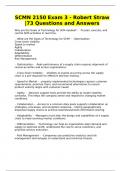
SCMN 2150 Exam 3 - Robert Straw
|73 Questions and Answers
Why are the Goals of Technology for SCM needed? - -To plan, execute, and
control SCM activities in real time.
- What are the Goals of Technology for SCM? - -Optimization
Cross-chain visibility
Speed to market
Agility
Collaboration
Adaptability
Differentiation
Risk Management
- Optimization - -Peak performance of a supply chain requires alignment of
resources within and across organizations.
- Cross-Chain Visibility - -Visibility to events occurring across the supply
chain is a pre-requisite for effective decision making.
- Speed to Market - -properly implemented technologies capture customer
requirements, prioritize them, and recommend alternatives to ensure
product velocity aligns with customer needs
- Agility - -Decision support tools provide the ability to model volatility
scenarios. This helps the company sense and respond to changing market
conditions.
- Collaboration - -Access to a common data pools supports collaboration on
strategies, processes, and exception response... linking geographically
dispersed supply chains to achieve seamless/smooth information sharing.
- Adaptability - -Managers must alter the design and capabilities of a supply
chain to meet evolving market conditions.
- Differentiation - -Technology can help an organization align demand and
supply to optimize profit, understand the cost to serve customers, and
prioritize service execution.
- Risk Management - -Companies use predictive analytics and risk
management technologies to understand and minimize threats.
, - Characteristics of High-Quality Data & Useful Supply Chain Information - -
Accurate
Accessible
Relevant
Timely
Transferable
Reliable
Usable
- What does supply chain planning software do? - -Strategic network design
Capacity planning
Demand planning & forecasting
Procurement planning
Production planning & scheduling
Distribution planning
- What do supply chain execution applications do and what are some
examples? - -- Supply chain execution applications facilitate the efficient use
of resources to control supply chain costs and achieve the quality and
service requirements.
Examples:
-Warehouse Management Systems (WMS)
-Transportation Management Systems (TMS)
-Manufacturing Execution Systems (MES)
-Global Trade Management Tools (GTM)
-Distributed Order Management Tools (OM)
- What do supply chain event management systems do? - --Provides
visibility of critical flows and help provide early warning signals of deviations
from plans.
-Triggers corrective actions or recovery recommendations based on
predefined work-flow rules.
-Help decision-makers implement the best alternative in terms of cost, time,
and customer service requirements.
- Business Intelligence (BI) Tools - -Tools that extract data from execution
systems across the supply chain and provide summaries and data
visualization that enable timely identification of anomalies, opportunities and
solutions.
- Business Analytics - -The combination of skills, technologies, applications
and processes used by organizations to gain insight in to their business
based on data and statistics to drive business planning.
- What does ERP stand for and what does it do? - -Enterprise Resource
Planning (ERP)
|73 Questions and Answers
Why are the Goals of Technology for SCM needed? - -To plan, execute, and
control SCM activities in real time.
- What are the Goals of Technology for SCM? - -Optimization
Cross-chain visibility
Speed to market
Agility
Collaboration
Adaptability
Differentiation
Risk Management
- Optimization - -Peak performance of a supply chain requires alignment of
resources within and across organizations.
- Cross-Chain Visibility - -Visibility to events occurring across the supply
chain is a pre-requisite for effective decision making.
- Speed to Market - -properly implemented technologies capture customer
requirements, prioritize them, and recommend alternatives to ensure
product velocity aligns with customer needs
- Agility - -Decision support tools provide the ability to model volatility
scenarios. This helps the company sense and respond to changing market
conditions.
- Collaboration - -Access to a common data pools supports collaboration on
strategies, processes, and exception response... linking geographically
dispersed supply chains to achieve seamless/smooth information sharing.
- Adaptability - -Managers must alter the design and capabilities of a supply
chain to meet evolving market conditions.
- Differentiation - -Technology can help an organization align demand and
supply to optimize profit, understand the cost to serve customers, and
prioritize service execution.
- Risk Management - -Companies use predictive analytics and risk
management technologies to understand and minimize threats.
, - Characteristics of High-Quality Data & Useful Supply Chain Information - -
Accurate
Accessible
Relevant
Timely
Transferable
Reliable
Usable
- What does supply chain planning software do? - -Strategic network design
Capacity planning
Demand planning & forecasting
Procurement planning
Production planning & scheduling
Distribution planning
- What do supply chain execution applications do and what are some
examples? - -- Supply chain execution applications facilitate the efficient use
of resources to control supply chain costs and achieve the quality and
service requirements.
Examples:
-Warehouse Management Systems (WMS)
-Transportation Management Systems (TMS)
-Manufacturing Execution Systems (MES)
-Global Trade Management Tools (GTM)
-Distributed Order Management Tools (OM)
- What do supply chain event management systems do? - --Provides
visibility of critical flows and help provide early warning signals of deviations
from plans.
-Triggers corrective actions or recovery recommendations based on
predefined work-flow rules.
-Help decision-makers implement the best alternative in terms of cost, time,
and customer service requirements.
- Business Intelligence (BI) Tools - -Tools that extract data from execution
systems across the supply chain and provide summaries and data
visualization that enable timely identification of anomalies, opportunities and
solutions.
- Business Analytics - -The combination of skills, technologies, applications
and processes used by organizations to gain insight in to their business
based on data and statistics to drive business planning.
- What does ERP stand for and what does it do? - -Enterprise Resource
Planning (ERP)