MNT - UPPER GI QUIZ QUESTIONS WITH CORRECT ANSWERS |LATEST UPDATE
100% SOLVED| GRADED A+
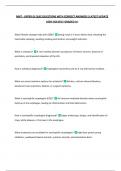
What lifestyle changes help with GERD? Eating meals 2-3 hours before bed, elevating the
head while sleeping, avoiding smoking and alcohol, and weight reduction.
What is achalasia? A rare motility disorder causing loss of enteric neurons, absence of
peristalsis, and impaired relaxation of the LES.
How is achalasia diagnosed? Esophageal manometry and an X-ray with barium swallow.
What are some treatment options for achalasia? Nitrates, calcium channel blockers,
botulinum toxin injections, dilation, or surgical myotomy.
What is eosinophilic esophagitis (EOE)? An immune-mediated disorder where eosinophils
build up in the esophagus, leading to inflammation and food obstruction.
How is eosinophilic esophagitis diagnosed? Upper endoscopy, biopsy, and identification of
rings, white plaques, or furrows in the esophagus.
What treatments are available for eosinophilic esophagitis? High-dose proton pump
inhibitors, swallowed topical steroids, systemic steroids, and elimination diets.
, What is gastroparesis? A condition characterized by delayed gastric emptying without
mechanical obstruction.
What is the IDDSI framework? The International Dysphagia Diet Standardisation Initiative
(IDDSI) is a standardized system for classifying food textures and drink thickness.
How many levels are in the IDDSI framework? Eight levels, ranging from 0 (thin liquids) to 7
(regular foods).
What is IDDSI Level 0? Thin liquids that flow like water and require no modification.
What is IDDSI Level 1? Slightly thick liquids, similar to anti-regurgitation infant formulas.
What is IDDSI Level 2? Mildly thick liquids that flow slower than thin liquids but can still be
sipped.
What is IDDSI Level 3? Moderately thick or liquidized foods that can be eaten with a spoon
but not with a fork.
What is IDDSI Level 4? Extremely thick or pureed foods that hold their shape on a spoon but
do not require chewing.
What is IDDSI Level 5? Minced and moist foods that are soft, requiring minimal chewing.
100% SOLVED| GRADED A+
What lifestyle changes help with GERD? Eating meals 2-3 hours before bed, elevating the
head while sleeping, avoiding smoking and alcohol, and weight reduction.
What is achalasia? A rare motility disorder causing loss of enteric neurons, absence of
peristalsis, and impaired relaxation of the LES.
How is achalasia diagnosed? Esophageal manometry and an X-ray with barium swallow.
What are some treatment options for achalasia? Nitrates, calcium channel blockers,
botulinum toxin injections, dilation, or surgical myotomy.
What is eosinophilic esophagitis (EOE)? An immune-mediated disorder where eosinophils
build up in the esophagus, leading to inflammation and food obstruction.
How is eosinophilic esophagitis diagnosed? Upper endoscopy, biopsy, and identification of
rings, white plaques, or furrows in the esophagus.
What treatments are available for eosinophilic esophagitis? High-dose proton pump
inhibitors, swallowed topical steroids, systemic steroids, and elimination diets.
, What is gastroparesis? A condition characterized by delayed gastric emptying without
mechanical obstruction.
What is the IDDSI framework? The International Dysphagia Diet Standardisation Initiative
(IDDSI) is a standardized system for classifying food textures and drink thickness.
How many levels are in the IDDSI framework? Eight levels, ranging from 0 (thin liquids) to 7
(regular foods).
What is IDDSI Level 0? Thin liquids that flow like water and require no modification.
What is IDDSI Level 1? Slightly thick liquids, similar to anti-regurgitation infant formulas.
What is IDDSI Level 2? Mildly thick liquids that flow slower than thin liquids but can still be
sipped.
What is IDDSI Level 3? Moderately thick or liquidized foods that can be eaten with a spoon
but not with a fork.
What is IDDSI Level 4? Extremely thick or pureed foods that hold their shape on a spoon but
do not require chewing.
What is IDDSI Level 5? Minced and moist foods that are soft, requiring minimal chewing.