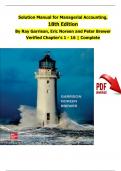
Solution Manual for Managerial Accounting,
18th Edition
By Ray Garrison, Eric Noreen and Peter Brewer
Verified Chapter's 1 - 16 | Complete
,Table of Contents
Chapter One: Managerial Accounting and Cost Concepts
Chapter Two: Job-Order Costing: Calculating Unit Product Costs
Chapter Three: Job-Order Costing: Cost Flows and External Reporting
Chapter Four: Process Costing
Chapter Five: Cost-Volume-Profit Relationships
Chapter Six: Variable Costing and Segment Reporting: Tools for Management
Chapter Seven: Activity-Based Costing: A Tool to Aid Decision Making
Chapter Eight: Master Budgeting
Chapter Nine: Flexible Budgets and Performance Analysis
Chapter Ten: Standard Costs and Variances
Chapter Eleven: Responsibility Accounting Systems
Chapter Twelve: Strategic Performance Measurement
Chapter Thirteen: Differential Analysis: The Key to Decision Making
Chapter Fourteen: Capital Budgeting Decisions
Chapter Fifteen: Statement of Cash Flows
Chapter Sixteen: Financial Statement Analysis
,Chapter 1
Managerial Accounting and Cost Concepts
Questions
1-1 The three major types of product costs 1-4
in a manufacturing company are direct a. Variable cost: The variable cost per unit is
materials, direct labor, and manufacturing constant, but total variable cost changes in
overhead. direct proportion to changes in volume.
b. Fixed cost: The total fixed cost is constant
1-2 within the relevant range. The average fixed
a. Direct materials are an integral part of a cost per unit varies inversely with changes
finished product and their costs can be in volume.
conveniently traced to it. c. Mixed cost: A mixed cost contains both
b. Indirect materials are generally small variable and fixed cost elements.
items of material such as glue and nails. They
may be an integral part of a finished product but 1-5
their costs can be traced to the product only at a. Unit fixed costs decrease as the activity level
great cost or inconvenience. increases.
c. Direct labor consists of labor costs that b. Unit variable costs remain constant as the
can be easily traced to particular products. activity level increases.
Direct labor is also called ―touch labor.‖ c. Total fixed costs remain constant as the
d. Indirect labor consists of the labor costs activity level increases.
of janitors, supervisors, materials handlers, and d. Total variable costs increase as the activity
other factory workers that cannot be level increases.
conveniently traced to particular products.
These labor costs are incurred to support 1-6
production, but the workers involved do not a. Cost behavior: Cost behavior refers to the
directly work on the product. way in which costs change in response to
e. Manufacturing overhead includes all changes in a measure of activity such as
manufacturing costs except direct materials and sales volume, production volume, or orders
direct labor. Consequently, manufacturing processed.
overhead includes indirect materials and indirect b. Relevant range: The relevant range is the
labor as well as other manufacturing costs. range of activity within which assumptions
about variable and fixed cost behavior are
1-3 A product cost is any cost involved in valid.
purchasing or manufacturing goods. In the case
of manufactured goods, these costs consist of 1-7 An activity base is a measure of
direct materials, direct labor, and manufacturing whatever causes the incurrence of a variable
overhead. A period cost is a cost that is taken cost. Examples of activity bases include units
directly to the income statement as an expense produced, units sold, letters typed, beds in a
in the period in which it is incurred. hospital, meals served in a cafe, service calls
made, etc.
1-8 The linear assumption is reasonably
, valid providing that the cost formula is used
only within the relevant range.
18th Edition
By Ray Garrison, Eric Noreen and Peter Brewer
Verified Chapter's 1 - 16 | Complete
,Table of Contents
Chapter One: Managerial Accounting and Cost Concepts
Chapter Two: Job-Order Costing: Calculating Unit Product Costs
Chapter Three: Job-Order Costing: Cost Flows and External Reporting
Chapter Four: Process Costing
Chapter Five: Cost-Volume-Profit Relationships
Chapter Six: Variable Costing and Segment Reporting: Tools for Management
Chapter Seven: Activity-Based Costing: A Tool to Aid Decision Making
Chapter Eight: Master Budgeting
Chapter Nine: Flexible Budgets and Performance Analysis
Chapter Ten: Standard Costs and Variances
Chapter Eleven: Responsibility Accounting Systems
Chapter Twelve: Strategic Performance Measurement
Chapter Thirteen: Differential Analysis: The Key to Decision Making
Chapter Fourteen: Capital Budgeting Decisions
Chapter Fifteen: Statement of Cash Flows
Chapter Sixteen: Financial Statement Analysis
,Chapter 1
Managerial Accounting and Cost Concepts
Questions
1-1 The three major types of product costs 1-4
in a manufacturing company are direct a. Variable cost: The variable cost per unit is
materials, direct labor, and manufacturing constant, but total variable cost changes in
overhead. direct proportion to changes in volume.
b. Fixed cost: The total fixed cost is constant
1-2 within the relevant range. The average fixed
a. Direct materials are an integral part of a cost per unit varies inversely with changes
finished product and their costs can be in volume.
conveniently traced to it. c. Mixed cost: A mixed cost contains both
b. Indirect materials are generally small variable and fixed cost elements.
items of material such as glue and nails. They
may be an integral part of a finished product but 1-5
their costs can be traced to the product only at a. Unit fixed costs decrease as the activity level
great cost or inconvenience. increases.
c. Direct labor consists of labor costs that b. Unit variable costs remain constant as the
can be easily traced to particular products. activity level increases.
Direct labor is also called ―touch labor.‖ c. Total fixed costs remain constant as the
d. Indirect labor consists of the labor costs activity level increases.
of janitors, supervisors, materials handlers, and d. Total variable costs increase as the activity
other factory workers that cannot be level increases.
conveniently traced to particular products.
These labor costs are incurred to support 1-6
production, but the workers involved do not a. Cost behavior: Cost behavior refers to the
directly work on the product. way in which costs change in response to
e. Manufacturing overhead includes all changes in a measure of activity such as
manufacturing costs except direct materials and sales volume, production volume, or orders
direct labor. Consequently, manufacturing processed.
overhead includes indirect materials and indirect b. Relevant range: The relevant range is the
labor as well as other manufacturing costs. range of activity within which assumptions
about variable and fixed cost behavior are
1-3 A product cost is any cost involved in valid.
purchasing or manufacturing goods. In the case
of manufactured goods, these costs consist of 1-7 An activity base is a measure of
direct materials, direct labor, and manufacturing whatever causes the incurrence of a variable
overhead. A period cost is a cost that is taken cost. Examples of activity bases include units
directly to the income statement as an expense produced, units sold, letters typed, beds in a
in the period in which it is incurred. hospital, meals served in a cafe, service calls
made, etc.
1-8 The linear assumption is reasonably
, valid providing that the cost formula is used
only within the relevant range.