Supply Chain Lab
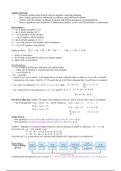
• Formulate optimization models using an algebraic modeling language
• Solve integer and network optimization problems using dedicated software
• Analyze real-life industry problems, formulate and defend managerial recommendations
• Assess capabilities and limitations of optimization models to solve real-life problems in distribution
Hoorcollege 1
N = set of natural numbers 1,2,3
Z = set of whole numbers 0,1,2
Z+ = set of positive whole numbers
Z− = set of negative whole numbers
R = set of all real numbers 0, 0.1, 1
R+ = set of all positive real numbers (heel of komma)
R− = set of all negative real numbers
Sigma notation =
i = index of summation
1= lower limit of summation, can be any integer number
n= upper limit of summation
Set Operations:
S = set of“objects”(elements), indicated with capital letters
{} = whole set of elements is reported between curly brackets
∈ ... is an element of …
: (or | ) such that
∪ union of two sets A and B ; A∪B equals the set of those elements that are either in A, or in B, or in both
∩ intersection of two sets A and B; A ∩ B equals the set of all those elements that A and B have in common
• Let A be a set defined as A={ x ∈ N : 1.5 ≤ x ≤ 4.5}, then
• Let A and B be two sets defined as A ={2, 3, 4} and B= {3, 4, 7}
Forall (∀) Operator; means “for each of the elements of the set” and is used to write a set of constraints
• Set of inequalities can be written as
Ordered Sets
- Sets reported in curly brackets are unordered, so {1, 2, 3, 4} = {3, 1, 4, 2}
- Sets reported in round brackets are ordered, so (1, 2, 3, 4) ≠ (3, 1, 4, 2)
Symbol × indicates Cartesian product between 2 sets of elements A and B is a third set; C (C = A × B)
Given the sets A= {1,2} and B= {a,b}
C = A × B = {(1, a), (1, b), (2, a), (2, b)}
C = B × A = {(a, 1), (a, 2), (b, 1), (b, 2)}
Note that set C is an unordered set, whereas each element of C (each pair) is an ordered set.
Hoorcollege 2
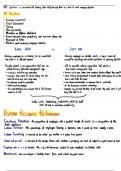
7 Step modeling
process
Communication throughout process is crucial. The complete model is not the end of the process: it is a starting point!
,Linear programming (LP) is concerned with objective; maximizing/minimizing quantity subject to restrictions
(constraints) that limit degree to which the objective can be pursued.
Three assumptions for LP:
1. Proportionality: contribution to objective and resources used in constraint are proportional to decision variable.
2. Additivity: value of objective function & total resources is sum of objective function contribution and resources used
3. Divisibility: the decision variables are continuous
Graphical Solution; Draw graph, determine feasible region that satisfies all constraints, see intersections (extreme
points) and find furthest point. Optimal LP solution is found at an extreme point of the feasible region.
Graphical solution allows to solve LP with two decision variables.
Integer Linear Programming (ILP); LP modeled problem where all variables are required to be integer.
MILP= If some, but not all, variables must be integer, we have a Mixed ILP, these are harder to solve.
e.g. ILP e.g. MILP
Graphical solution must be changed to solve ILPs.
First, graph feasible region exactly as in LP. Then integer feasible solutions must be identified. Finally, move objective
function line the furthest until reaching a feasible integer point with the best value for objective.
No efficient solution method exists for ILP, in general the solution for ILP is based on LP solution.
• For maximization ILPs, value of LP optimal solution provides an upper bound for the value for the optimal
integer solution.
• For minimization ILPs, value of LP optimal solution provides an lower bound for the value for the optimal
integer solution.
• If a rounded LP solution is feasible and provides a value that is close to the value of the LP objective function,
the rounded solution is a near-optimal integer solution.
, Hoorcollege 3 +4; Formulate network optimization models (e.g. transportation, assignment, shortest path models)
Optimization models have a graphical network representation
Node = indicated by a circle; represents a geographical location.
Arc = indicated by an arrow, represents a route for getting a product from one node to another
Transportation problem: company produces products at locations (origins) and ships these products to customer
locations (destinations). Each origin has a limited amount that it can ship directly, and each customer destination must
receive a (minimum) required quantity of the product.
Requires 3 sets of input - Capacities (supplies) at each plant
- Customer demands (requirements)
- Unit shipping costs (and possibly production costs)
Shipping Cars from Plants to Regions
- Shipping costs are placed on the arcs
- Decision variables are called flows
Objective; minimize shipping costs
Constraint; Don’t exceed supply
Constraint; Satisfy customer demand
Integrality constraint
dat file mod file
Optimal solution; – Plant 1⇒ Region 1:150 – Plant 1⇒ Region 4:300 – Plant 2⇒ Region 1:100
– Plant 2 ⇒ Region 2: 200 – Plant 3 ⇒ Region 1: 200 – Plant 3 ⇒ Region 3: 300
If all supplies(si) and demands(dj) are integers, the optimal solution has integer-valued flow; thus variables can be Real
• Formulate optimization models using an algebraic modeling language
• Solve integer and network optimization problems using dedicated software
• Analyze real-life industry problems, formulate and defend managerial recommendations
• Assess capabilities and limitations of optimization models to solve real-life problems in distribution
Hoorcollege 1
N = set of natural numbers 1,2,3
Z = set of whole numbers 0,1,2
Z+ = set of positive whole numbers
Z− = set of negative whole numbers
R = set of all real numbers 0, 0.1, 1
R+ = set of all positive real numbers (heel of komma)
R− = set of all negative real numbers
Sigma notation =
i = index of summation
1= lower limit of summation, can be any integer number
n= upper limit of summation
Set Operations:
S = set of“objects”(elements), indicated with capital letters
{} = whole set of elements is reported between curly brackets
∈ ... is an element of …
: (or | ) such that
∪ union of two sets A and B ; A∪B equals the set of those elements that are either in A, or in B, or in both
∩ intersection of two sets A and B; A ∩ B equals the set of all those elements that A and B have in common
• Let A be a set defined as A={ x ∈ N : 1.5 ≤ x ≤ 4.5}, then
• Let A and B be two sets defined as A ={2, 3, 4} and B= {3, 4, 7}
Forall (∀) Operator; means “for each of the elements of the set” and is used to write a set of constraints
• Set of inequalities can be written as
Ordered Sets
- Sets reported in curly brackets are unordered, so {1, 2, 3, 4} = {3, 1, 4, 2}
- Sets reported in round brackets are ordered, so (1, 2, 3, 4) ≠ (3, 1, 4, 2)
Symbol × indicates Cartesian product between 2 sets of elements A and B is a third set; C (C = A × B)
Given the sets A= {1,2} and B= {a,b}
C = A × B = {(1, a), (1, b), (2, a), (2, b)}
C = B × A = {(a, 1), (a, 2), (b, 1), (b, 2)}
Note that set C is an unordered set, whereas each element of C (each pair) is an ordered set.
Hoorcollege 2
7 Step modeling
process
Communication throughout process is crucial. The complete model is not the end of the process: it is a starting point!
,Linear programming (LP) is concerned with objective; maximizing/minimizing quantity subject to restrictions
(constraints) that limit degree to which the objective can be pursued.
Three assumptions for LP:
1. Proportionality: contribution to objective and resources used in constraint are proportional to decision variable.
2. Additivity: value of objective function & total resources is sum of objective function contribution and resources used
3. Divisibility: the decision variables are continuous
Graphical Solution; Draw graph, determine feasible region that satisfies all constraints, see intersections (extreme
points) and find furthest point. Optimal LP solution is found at an extreme point of the feasible region.
Graphical solution allows to solve LP with two decision variables.
Integer Linear Programming (ILP); LP modeled problem where all variables are required to be integer.
MILP= If some, but not all, variables must be integer, we have a Mixed ILP, these are harder to solve.
e.g. ILP e.g. MILP
Graphical solution must be changed to solve ILPs.
First, graph feasible region exactly as in LP. Then integer feasible solutions must be identified. Finally, move objective
function line the furthest until reaching a feasible integer point with the best value for objective.
No efficient solution method exists for ILP, in general the solution for ILP is based on LP solution.
• For maximization ILPs, value of LP optimal solution provides an upper bound for the value for the optimal
integer solution.
• For minimization ILPs, value of LP optimal solution provides an lower bound for the value for the optimal
integer solution.
• If a rounded LP solution is feasible and provides a value that is close to the value of the LP objective function,
the rounded solution is a near-optimal integer solution.
, Hoorcollege 3 +4; Formulate network optimization models (e.g. transportation, assignment, shortest path models)
Optimization models have a graphical network representation
Node = indicated by a circle; represents a geographical location.
Arc = indicated by an arrow, represents a route for getting a product from one node to another
Transportation problem: company produces products at locations (origins) and ships these products to customer
locations (destinations). Each origin has a limited amount that it can ship directly, and each customer destination must
receive a (minimum) required quantity of the product.
Requires 3 sets of input - Capacities (supplies) at each plant
- Customer demands (requirements)
- Unit shipping costs (and possibly production costs)
Shipping Cars from Plants to Regions
- Shipping costs are placed on the arcs
- Decision variables are called flows
Objective; minimize shipping costs
Constraint; Don’t exceed supply
Constraint; Satisfy customer demand
Integrality constraint
dat file mod file
Optimal solution; – Plant 1⇒ Region 1:150 – Plant 1⇒ Region 4:300 – Plant 2⇒ Region 1:100
– Plant 2 ⇒ Region 2: 200 – Plant 3 ⇒ Region 1: 200 – Plant 3 ⇒ Region 3: 300
If all supplies(si) and demands(dj) are integers, the optimal solution has integer-valued flow; thus variables can be Real