

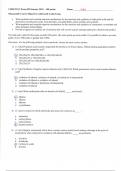
CHM 2211C Exam III Summer 2024 — 100 points Name: K €y
Measurable Course Objectives Addressed in this Exam
e Write products and complete stepwise mechanisms for the reactions and synthesis of carboxylic acids and the
derivatives of carboxylic acids: acid chlorides, acid anhydrides, esters, amides, and cyanides.
e Write products and complete stepwise mechanisms for the reactions and synthesis of compounds via enolates and
other carbanion intermediates.
* Provide a logical and realistic set of reactions that will convert a given starting material to a desired end product.
The total point value for this exam exceeds 100 points. The extra points are extra credit. It is possible to achieve an exam
grade of over 100 points or greater than 100%.
Directions: For the following multiple choice questions, choose the most correct answer.
1) (1.5 pts) Propanoic acid is partly responsible for the flavor of Swiss Cheese. Which starting material(s) could be
used to produce propanoic acid?
() CH3CH,CN, CH:CH,CHO, or CH;CH,CH,OH.
b. CH3;CH>CN or CH3;CH,CHO.
c. CH3;CH>CHO or CH:CH,CH,OH.
d. CH;CH,CN
2) (1.5 pts) Synthesis of aspirin requires ethanoic acid, CH3CO,H. Which process(es) can be used to make ethanoic
acid?
@ oxidation of ethanol, oxidation of ethanal, or hydrolysis of ethanenitrile
b. oxidation of ethanol or oxidation of ethanal
c. oxidation of ethanal or hydrolysis of ethanenitrile
d. oxidation of ethanol
3) (1.5 pts) When carboxylate salts are heated with NaOH, are formed.
@ alkanes
b. alkenes
c. alkynes
d. cycloalkanes
4) (1.5 pts) A rection in which carboxylic acid loses CO; is known as
a. amination
b. carbonylation
c. carboxylation
. decarboxylation
5) (1.5 pts) Organic compounds which have a carbon-carbon double bond undergo cleavage at the point of
unsaturation when subjected to oxidation with alkaline KMnQs. are produced.
a. Alcohols
b. Aldehydes
() Carboxylic acids
d. Ketones
, 6) (1.5 pts) C-C chain building occurs when hydrolysis of nitriles with aqueous acid or base yields a(n) .
a. alcohol
b. aldehyde
@ carboxylic acid
d. ketone
7) (1.5 pts) Which is the strongest acid?
(a) HCOOH
b. CH;COOH
c. CH;COOH
d. C;H;COOH
8) (1.5 pts) What is the relative order of esterification of acids?
a. RCH,;CO;H <R,CHCO;H < R3CCOH
RCH,CO,H > R;,CHCO,H > R;CCO,H
c. RCH>CO;H < R3CCO,;H < R,CHCO;H
d. RCH,CO;H > RsCCOH > R,CHCO,H
9) (1.5 pts) Which acid is the strongest acid?
a. BrCH,COOH
b. CICH,COOH
¢. ICH,COOH
(d.) FCH,COOH
10) (1.5 pts) Which electron withdrawing group increases the acidity of the carboxylic acids?
a. chlorine
b. cyanide
c. hydroxide
@ all of the atoms or groups of atoms listed
11) (1.5 pts) Carboxylic acids form acid halides by reacting them with which of the following reagents?
a. PC13
b. PCls
c. SOCI,
a,b,and ¢
12) (1.5 pts) Carboxylic acids react with alcohols to produce which of the following?
a. aldehydes
esters
c. ketones
d. alcohols
Measurable Course Objectives Addressed in this Exam
e Write products and complete stepwise mechanisms for the reactions and synthesis of carboxylic acids and the
derivatives of carboxylic acids: acid chlorides, acid anhydrides, esters, amides, and cyanides.
e Write products and complete stepwise mechanisms for the reactions and synthesis of compounds via enolates and
other carbanion intermediates.
* Provide a logical and realistic set of reactions that will convert a given starting material to a desired end product.
The total point value for this exam exceeds 100 points. The extra points are extra credit. It is possible to achieve an exam
grade of over 100 points or greater than 100%.
Directions: For the following multiple choice questions, choose the most correct answer.
1) (1.5 pts) Propanoic acid is partly responsible for the flavor of Swiss Cheese. Which starting material(s) could be
used to produce propanoic acid?
() CH3CH,CN, CH:CH,CHO, or CH;CH,CH,OH.
b. CH3;CH>CN or CH3;CH,CHO.
c. CH3;CH>CHO or CH:CH,CH,OH.
d. CH;CH,CN
2) (1.5 pts) Synthesis of aspirin requires ethanoic acid, CH3CO,H. Which process(es) can be used to make ethanoic
acid?
@ oxidation of ethanol, oxidation of ethanal, or hydrolysis of ethanenitrile
b. oxidation of ethanol or oxidation of ethanal
c. oxidation of ethanal or hydrolysis of ethanenitrile
d. oxidation of ethanol
3) (1.5 pts) When carboxylate salts are heated with NaOH, are formed.
@ alkanes
b. alkenes
c. alkynes
d. cycloalkanes
4) (1.5 pts) A rection in which carboxylic acid loses CO; is known as
a. amination
b. carbonylation
c. carboxylation
. decarboxylation
5) (1.5 pts) Organic compounds which have a carbon-carbon double bond undergo cleavage at the point of
unsaturation when subjected to oxidation with alkaline KMnQs. are produced.
a. Alcohols
b. Aldehydes
() Carboxylic acids
d. Ketones
, 6) (1.5 pts) C-C chain building occurs when hydrolysis of nitriles with aqueous acid or base yields a(n) .
a. alcohol
b. aldehyde
@ carboxylic acid
d. ketone
7) (1.5 pts) Which is the strongest acid?
(a) HCOOH
b. CH;COOH
c. CH;COOH
d. C;H;COOH
8) (1.5 pts) What is the relative order of esterification of acids?
a. RCH,;CO;H <R,CHCO;H < R3CCOH
RCH,CO,H > R;,CHCO,H > R;CCO,H
c. RCH>CO;H < R3CCO,;H < R,CHCO;H
d. RCH,CO;H > RsCCOH > R,CHCO,H
9) (1.5 pts) Which acid is the strongest acid?
a. BrCH,COOH
b. CICH,COOH
¢. ICH,COOH
(d.) FCH,COOH
10) (1.5 pts) Which electron withdrawing group increases the acidity of the carboxylic acids?
a. chlorine
b. cyanide
c. hydroxide
@ all of the atoms or groups of atoms listed
11) (1.5 pts) Carboxylic acids form acid halides by reacting them with which of the following reagents?
a. PC13
b. PCls
c. SOCI,
a,b,and ¢
12) (1.5 pts) Carboxylic acids react with alcohols to produce which of the following?
a. aldehydes
esters
c. ketones
d. alcohols


