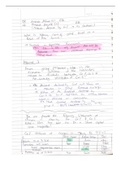
Chapter 2 – Booms and Recessions: The Keynesian cross
A macroeconomic model should explain why an economy produces a specific
volume of goods and services (and no other) -> why do incomes differ between
countries and differ over time.
Steady-state income: level of income that is generated if all factors of
production are being used at normal rates, and if the economy’s capital stock is
at its long-run equilibrium level/growth path.
Potential income: level of income that can be produced with current labour and
capital.
Business cycle: fluctuations of income relative to potential income (booms &
recessions). These appear because, in the short run, firms employ freely available
capital and/or labour and decide this on the level of demand.
The IS-LM model
Y = C + I + G + EX – IM = total/aggregate expenditure
This equals income if firms succeed in setting output to a level that does not
require unplanned investments.
3 leakages of income; taxes, savings & imports.
Aggregate expenditure: sum of all planned demand (I = planned investment)
Actual expenditure: sum of all demand, planned & unplanned.
- The category government G is the government purchases of goods and
services, T tax are net taxes.
- Consumption is determined by the function C = C 0 + cY with C0 is the
minimum consumption needed and c is the marginal propensity to
consume, showing consumption depends on income.
The Keynesian cross is called a demand-side equilibrium, assuming firms
produce any amount of goods demanded.
Equilibrium income: all spending is planned spending (or income = aggregate
expenditure).
,Multiplier: measures the income change resulting from a one-unit increase in
autonomous expenditure. The multiplier becomes smaller as the leaks of
income become bigger.
Note;
Consumption is not only determined by the level of income, but these factors are
(mostly) micro-economic based and neglectable. Additionally, people spread their
income on their weekly/monthly period, also people can spend more than they
earn by taking on loans or saving in earlier periods. By saving, people expect
income as interest from this money.
Investment of firms depend on capital costs (costs of financing the purchase of
capital goods; interest rate) and the internal rate of return (revenue generated
by a project as a percentage of the invested funds).
Chapter 3 – Money, interest rates and the global
economy
The money market ( + interest rate and the LM curve)
Demand
Transactions demand for money: money held to cover routine expenditures.
If assumed 2 assets; a savings account, paying interest, and money, not paying
interest. An individual will want to hold as many of its wealth/income in the
savings account to generate interest income. The demand for money then
depends on the level of consumption of the individual and on how often the
individual receives income. This concludes; the demand for money goes down
when the interest rate goes up.
Precautionary demand for money: wealth is held in the form of money for the
purpose of covering unexpected expenditures (also, inversely, related to the
interest rate).
Speculative demand for money: wealth is held as money at times when other
assets are considered excessively risky.
Supply
, In the money market, supply is determined by the central bank, which they can
do by manipulating money supply M of setting the interest rate i (or both). The
money supply is a vertical line, which can shift left or right by lowering or raising
the supply.
The LM-curve identifies combinations of income and the interest rate for which
the demand for money equals the money supply.
So a change in the money supply will affect the interest rate, an increase in
supply will decrease the interest rate and a decrease in supply will increase the
interest rate (to maintain equilibrium)
When the central bank targets to determine the interest rate, the money supply
is a horizontal curve instead of a vertical one (this will result in a horizontal line of
the money market equilibrium). They will differ the supply of money in any way
to maintain their targeted interest rate. In all other cases, the line of the money
market equilibrium (LM-curve) has a positive slope.
Exports & imports
If the real exchange rate of the euro (any currency) falls below purchasing power
parity, it is cheaper to buy imported goods. Opposite: if the real exchange rate
A macroeconomic model should explain why an economy produces a specific
volume of goods and services (and no other) -> why do incomes differ between
countries and differ over time.
Steady-state income: level of income that is generated if all factors of
production are being used at normal rates, and if the economy’s capital stock is
at its long-run equilibrium level/growth path.
Potential income: level of income that can be produced with current labour and
capital.
Business cycle: fluctuations of income relative to potential income (booms &
recessions). These appear because, in the short run, firms employ freely available
capital and/or labour and decide this on the level of demand.
The IS-LM model
Y = C + I + G + EX – IM = total/aggregate expenditure
This equals income if firms succeed in setting output to a level that does not
require unplanned investments.
3 leakages of income; taxes, savings & imports.
Aggregate expenditure: sum of all planned demand (I = planned investment)
Actual expenditure: sum of all demand, planned & unplanned.
- The category government G is the government purchases of goods and
services, T tax are net taxes.
- Consumption is determined by the function C = C 0 + cY with C0 is the
minimum consumption needed and c is the marginal propensity to
consume, showing consumption depends on income.
The Keynesian cross is called a demand-side equilibrium, assuming firms
produce any amount of goods demanded.
Equilibrium income: all spending is planned spending (or income = aggregate
expenditure).
,Multiplier: measures the income change resulting from a one-unit increase in
autonomous expenditure. The multiplier becomes smaller as the leaks of
income become bigger.
Note;
Consumption is not only determined by the level of income, but these factors are
(mostly) micro-economic based and neglectable. Additionally, people spread their
income on their weekly/monthly period, also people can spend more than they
earn by taking on loans or saving in earlier periods. By saving, people expect
income as interest from this money.
Investment of firms depend on capital costs (costs of financing the purchase of
capital goods; interest rate) and the internal rate of return (revenue generated
by a project as a percentage of the invested funds).
Chapter 3 – Money, interest rates and the global
economy
The money market ( + interest rate and the LM curve)
Demand
Transactions demand for money: money held to cover routine expenditures.
If assumed 2 assets; a savings account, paying interest, and money, not paying
interest. An individual will want to hold as many of its wealth/income in the
savings account to generate interest income. The demand for money then
depends on the level of consumption of the individual and on how often the
individual receives income. This concludes; the demand for money goes down
when the interest rate goes up.
Precautionary demand for money: wealth is held in the form of money for the
purpose of covering unexpected expenditures (also, inversely, related to the
interest rate).
Speculative demand for money: wealth is held as money at times when other
assets are considered excessively risky.
Supply
, In the money market, supply is determined by the central bank, which they can
do by manipulating money supply M of setting the interest rate i (or both). The
money supply is a vertical line, which can shift left or right by lowering or raising
the supply.
The LM-curve identifies combinations of income and the interest rate for which
the demand for money equals the money supply.
So a change in the money supply will affect the interest rate, an increase in
supply will decrease the interest rate and a decrease in supply will increase the
interest rate (to maintain equilibrium)
When the central bank targets to determine the interest rate, the money supply
is a horizontal curve instead of a vertical one (this will result in a horizontal line of
the money market equilibrium). They will differ the supply of money in any way
to maintain their targeted interest rate. In all other cases, the line of the money
market equilibrium (LM-curve) has a positive slope.
Exports & imports
If the real exchange rate of the euro (any currency) falls below purchasing power
parity, it is cheaper to buy imported goods. Opposite: if the real exchange rate