Week 1: Lead Lessons
Photosynthesis I
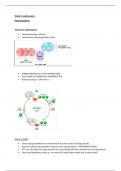
Adenosine triphosphate
Universal energy currency
Interference with production is fatal
ENERGY NEEDED by cell ATP HYDROLYSED
Forms ADP and INORGANIC PHOSPHATE (Pi)
Releases energy = 34kJ mol^-1
How is it used?
Some energy transferred to environment but most used in biology activity
Reverse reaction also possible (requires same energy input) => PHOPHORYLATION)
ATP can’t be stored in large amounts so is manufactured when needed from raw ingredients
Once raw ingredients used up = no more ATP made [rigor mortis sets in post death]
, Making ATP
ELECTRON TRANSPORT CHAIN (ETC)
Also made by energy released in catabolic reactions
Removal of hydrogen atoms from intermediate compounds in metabolic pathway
Hydrogen atoms collected by carrier (REDUCED) and when hydrogen atoms given up
(OXIDISED)
High energy e- from hydrogen atoms passed along ETC
As e- passed along = small quantity of energy which drives synthesis of ATP
Photosynthesis
Split in light dependent reactions (LDRs) and light independent reactions (LIRs or Calvin
Cycle)
1. Light energy used to break O-H bonds in water molecules
2. Hydrogen reacts with CO2 to form glucose
3. Oxygen released as waste product
Chloroplast structure
Photosynthesis I
Adenosine triphosphate
Universal energy currency
Interference with production is fatal
ENERGY NEEDED by cell ATP HYDROLYSED
Forms ADP and INORGANIC PHOSPHATE (Pi)
Releases energy = 34kJ mol^-1
How is it used?
Some energy transferred to environment but most used in biology activity
Reverse reaction also possible (requires same energy input) => PHOPHORYLATION)
ATP can’t be stored in large amounts so is manufactured when needed from raw ingredients
Once raw ingredients used up = no more ATP made [rigor mortis sets in post death]
, Making ATP
ELECTRON TRANSPORT CHAIN (ETC)
Also made by energy released in catabolic reactions
Removal of hydrogen atoms from intermediate compounds in metabolic pathway
Hydrogen atoms collected by carrier (REDUCED) and when hydrogen atoms given up
(OXIDISED)
High energy e- from hydrogen atoms passed along ETC
As e- passed along = small quantity of energy which drives synthesis of ATP
Photosynthesis
Split in light dependent reactions (LDRs) and light independent reactions (LIRs or Calvin
Cycle)
1. Light energy used to break O-H bonds in water molecules
2. Hydrogen reacts with CO2 to form glucose
3. Oxygen released as waste product
Chloroplast structure