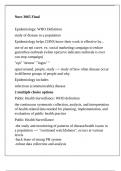
Nurs 3065 Final
Epidemiology: WHO Definition
study of disease in a population
Epidemiology helps CHNS know their work is effective by...
use of an epi curve. ex. social marketing campaign to reduce
gonorrhea outbreak (when epicurve indicates outbreak is over
can stop campaign)
"epi" "demos" "logos" "
upon/around, people, study --> study of how often disease occur
in different groups of people and why
Epidemiology includes
infectious (communicable) disease
2 multiple choice options
Public Health Surveillance: WHO definition
the continuous systematic collection, analysis, and interpretation
of health-related data needed for planning, implementation, and
evaluation of public health practice
Public Health Surveillance
-the study and monitoring of patterns of disease/health issues in
a population --> "continued watchfulness", occurs at various
levels
-back bone of strong PH system
-robust data collection and analysis
,Epidemic/Outbreak
increase, often sudden, in the number of cases of a
disease/health issue above what is normally expected in that
population in that area (based on surveillance data)
"Epi curve"
visual depiction of when outbreak cases begin, peak, decline and
when disease returns to expected levels --> helpful with process
evaluation
Epidemiologic Triad
model based on the belief that health status is determined by the
interaction of the characteristics of the host, agent, and
environment
Epidemiologic Triad: Host
living species (populations at risk) capable of being infected or
affected by an agent
Epidemiologic Triad: Agent
animate or inanimate factor that must be capable of causing
disease or coordination
, Epidemiologic Triad: Environment
biologic, physical, social factors
internal or external to host or agent
capable of influencing or being influenced by the host or agent
Epidemiologic Models: Person-Place-Time
-identifies patterns in timing
-characteristics of the persons affected (host in triangle)
the place (environment)
-location, time period involved (could relate to agent, host or
enviornment)
ex. Covid-19 in grocery stores in a certain time frame
Epidemiologic Models: Life Course Approach
latent effects (fetal and infancy)
pathway effects (early life events and environments)
cumulative effects (multiple environmental risks at different
ages combine to increase risk of disease in childhood)
Endemic
disease with a constant presence in a particular population or
geographical location
ex. malaria
Pandemic
epidemic occurring in geographically widespread area or in a
large population
ex. covid-19
Incidence
Epidemiology: WHO Definition
study of disease in a population
Epidemiology helps CHNS know their work is effective by...
use of an epi curve. ex. social marketing campaign to reduce
gonorrhea outbreak (when epicurve indicates outbreak is over
can stop campaign)
"epi" "demos" "logos" "
upon/around, people, study --> study of how often disease occur
in different groups of people and why
Epidemiology includes
infectious (communicable) disease
2 multiple choice options
Public Health Surveillance: WHO definition
the continuous systematic collection, analysis, and interpretation
of health-related data needed for planning, implementation, and
evaluation of public health practice
Public Health Surveillance
-the study and monitoring of patterns of disease/health issues in
a population --> "continued watchfulness", occurs at various
levels
-back bone of strong PH system
-robust data collection and analysis
,Epidemic/Outbreak
increase, often sudden, in the number of cases of a
disease/health issue above what is normally expected in that
population in that area (based on surveillance data)
"Epi curve"
visual depiction of when outbreak cases begin, peak, decline and
when disease returns to expected levels --> helpful with process
evaluation
Epidemiologic Triad
model based on the belief that health status is determined by the
interaction of the characteristics of the host, agent, and
environment
Epidemiologic Triad: Host
living species (populations at risk) capable of being infected or
affected by an agent
Epidemiologic Triad: Agent
animate or inanimate factor that must be capable of causing
disease or coordination
, Epidemiologic Triad: Environment
biologic, physical, social factors
internal or external to host or agent
capable of influencing or being influenced by the host or agent
Epidemiologic Models: Person-Place-Time
-identifies patterns in timing
-characteristics of the persons affected (host in triangle)
the place (environment)
-location, time period involved (could relate to agent, host or
enviornment)
ex. Covid-19 in grocery stores in a certain time frame
Epidemiologic Models: Life Course Approach
latent effects (fetal and infancy)
pathway effects (early life events and environments)
cumulative effects (multiple environmental risks at different
ages combine to increase risk of disease in childhood)
Endemic
disease with a constant presence in a particular population or
geographical location
ex. malaria
Pandemic
epidemic occurring in geographically widespread area or in a
large population
ex. covid-19
Incidence