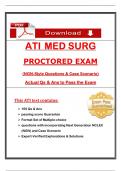
ATI MED SURG
PROCTORED EXAM
(NGN-Style Questions & Case Scenario)
Actual Qs & Ans to Pass the Exam
This ATI test contains:
100 Qs & Ans
passing score Guarantee
Format Set of Multiple-choice
questions with incorporating Next Generation NCLEX
(NGN) and Case Scenario
Expert-Verified Explanations & Solutions
,### Question 1:
A nurse is caring for a client diagnosed with atopic dermatitis who has a
prescription for triamcinolone ointment. During the follow-up assessment,
the nurse should monitor for which of the following adverse effects?
A. Increased pigmentation of the skin
B. Localized hair loss
C. Thinning of the skin
D. Increased sensitivity to sunlight
Answer: C. Thinning of the skin
Explanation:
Triamcinolone is a topical glucocorticoid, and its prolonged use can lead to
skin atrophy, thinning, and potentially delayed wound healing. The client
should only apply the cream as instructed, avoiding sensitive areas or thin
skin to minimize adverse effects. Education update: Teach the client to
monitor for signs of skin sensitivity and avoid prolonged use without
provider supervision.
---
### Question 2 (NGN-Style Case Study):
Case Details:
A 70-year-old male client presents to the clinic with complaints of difficulty
breathing and fatigue. Past medical history includes long-standing
hypertension and diabetes. He denies chest pain but reports waking up at
night short of breath.
,Vital Signs:
- BP: 160/95 mmHg
- HR: 110/min, irregular
- RR: 24/min
- O2 Saturation: 88% (room air)
- Temperature: 98.6°F (37°C)
Which clinical finding would indicate left-sided heart failure in this client?
A. Dependent edema in bilateral lower extremities
B. Jugular vein distention (JVD)
C. Frothy, pink-tinged sputum
D. Significant weight gain in the past week
Answer: C. Frothy, pink-tinged sputum
Explanation:
Left-sided heart failure results in pulmonary congestion, which may present
as dyspnea, crackles, and frothy sputum production. Classic manifestations
include exertional dyspnea, orthopnea, and paroxysmal nocturnal dyspnea.
JVD and dependent edema are more indicative of right-sided heart failure.
---
### Question 3:
A nurse is caring for a client who is anxious and reporting numbness and
tingling of the lips and fingers. The client’s ABGs are as follows:
- pH: 7.48
,- PCO2: 30 mm Hg
- HCO3–: 24 mEq/L
- PaO2: 85 mm Hg
Which acid-base imbalance should the nurse identify?
A. Respiratory alkalosis
B. Metabolic alkalosis
C. Respiratory acidosis
D. Metabolic acidosis
Answer: A. Respiratory alkalosis
Explanation:
In this scenario, the increased pH (alkaline) and decreased PCO2 indicate
respiratory alkalosis caused by hyperventilation. Numbness and tingling
around the lips and fingers are classic findings of this condition.
Interventions should focus on managing the anxiety and slowing the client’s
respirations using guided breathing exercises (non-invasive).
---
### Question 4:
A nurse is assessing a client diagnosed with Cushing's syndrome. Which
clinical finding should the nurse expect?
A. Vitiligo on the hands and face
B. Osteoporosis and increased risk of fractures
C. Myxedema and periorbital swelling
,D. Heat intolerance and tachycardia
Answer: B. Osteoporosis and increased risk of fractures
Explanation:
Chronic excess corticosteroids in Cushing’s syndrome lead to osteoporosis
due to mineral loss from bones. Other findings include abdominal weight
gain, moon face, buffalo hump, and muscle wasting. Vitiligo is associated
with autoimmune conditions like Addison's disease, not Cushing's syndrome.
---
### Question 5:
A nurse is inspecting the skin of a client who has a diagnosis of basal cell
carcinoma. Which lesion characteristic should the nurse document as most
consistent with this condition?
A. A pearly, waxy nodule with well-defined borders
B. Irregularly shaped lesion with variegated coloring
C. A crusty, ulcerated lesion that is firm to touch
D. A weeping, vesicular lesion
Answer: A. A pearly, waxy nodule with well-defined borders
Explanation:
Basal cell carcinoma (BCC) is associated with prolonged sun exposure and is
commonly found on the head, neck, or face. This slow-growing lesion
typically appears pearly or waxy, which differentiates it from squamous cell
carcinoma or melanoma. Early diagnosis and intervention are key.
,---
### Question 6 (NGN-Style Case Study):
Scenario:
A nurse is assessing a client with a long-standing history of hypocalcemia.
The client reports experiencing muscle spasms and facial twitching. The
nurse performs an assessment to confirm Chvostek’s sign.
Which action should the nurse take?
A. Tap below the client's cheekbone, near the zygomatic arch
B. Instruct the client to drink a glass of milk and monitor for symptoms
C. Flex the client’s wrist to assess for carpal spasms
D. Check for numbness on the client’s lips and fingers
Answer: A. Tap below the client’s cheekbone, near the zygomatic arch
Explanation:
Chvostek's sign is used to evaluate hypocalcemia. Tapping just below the
zygomatic arch will cause a facial muscle twitch if the client is hypocalcemic.
Trousseau's sign (flexing the wrist with a BP cuff) is another critical test for
calcium balance disorders.
---
### Question 7:
,A nurse is caring for a client who is *overusing prescribed diuretics*. The
client’s sodium level is 127 mEq/L. Which laboratory findings should the
nurse expect?
A. Increased lipase level
B. Low urine specific gravity
C. Elevated hemoglobin level
D. High creatine kinase-MB (CK-MB) levels
Answer: B. Low urine specific gravity
Explanation:
Hypovolemia and hyponatremia caused by excessive diuretic use often result
in diluted urine with a low specific gravity (<1.005). Additional findings
include symptoms like confusion, headaches, and muscle cramps. Treatment
involves discontinuation of the diuretic and use of isotonic fluids.
---
### Question 8:
A home health nurse is providing education to the caregiver of a client with
moderate Alzheimer's disease. Which instruction should the nurse include in
the teaching plan?
A. Remove clutter and potential tripping hazards from walkways.
B. Place a monthly calendar in the client’s room as a visual guide.
C. Use short-term confrontation when the client becomes agitated.
D. Keep a quiet routine, avoiding discussion of the daily schedule.
,Answer: A. Remove clutter and potential tripping hazards from walkways.
Explanation:
Clients with Alzheimer’s disease are at an increased risk for falls, especially
in late stages due to impaired judgment and coordination. Removing clutter
and providing fall prevention measures are key interventions. Introducing a
daily schedule also helps maintain familiarity, but calendars are less effective
in later stages.
---
### Question 9:
A nurse is caring for a client who has recently developed acute respiratory
distress syndrome (ARDS). Which clinical finding should the nurse identify as
a hallmark sign of ARDS?
A. Persistent hypoxemia unresponsive to oxygen therapy
B. Audible pleural friction rub on auscultation
C. Bloody sputum with coughing episodes
D. Tracheal deviation from the midline
Answer: A. Persistent hypoxemia unresponsive to oxygen therapy
Explanation:
Refractory hypoxemia, a failure of oxygen levels to improve despite
supplementation, is a hallmark of ARDS. This condition is due to alveolar-
capillary inflammation, leading to pulmonary edema and decreased gas
exchange. Immediate interventions include mechanical ventilation with high
PEEP.
, ---
### Question 10:
A client with status asthmaticus comes to the emergency department in
respiratory distress. Which assessment findings should the nurse identify as
indicative of this condition?
A. Coughing and wheezing heard bilaterally
B. Flat neck veins and BP 110/70 mmHg
C. Use of accessory muscles during respiration
D. Presence of coarse crackles throughout all lung fields
Answer: C. Use of accessory muscles during respiration
Explanation:
Status asthmaticus is a life-threatening prolonged asthma attack that results
in severe respiratory distress. The use of accessory muscles (e.g.,
intercostals, sternocleidomastoid) is a key finding, signaling significant
airflow obstruction. Coarse crackles are typically seen in other conditions like
pneumonia or CHF.
### Question 11 (NGN-Style):
Scenario:
A nurse is teaching a client who has a new prescription for phenytoin to treat
a seizure disorder. During a follow-up visit, the client reports several new
symptoms.
PROCTORED EXAM
(NGN-Style Questions & Case Scenario)
Actual Qs & Ans to Pass the Exam
This ATI test contains:
100 Qs & Ans
passing score Guarantee
Format Set of Multiple-choice
questions with incorporating Next Generation NCLEX
(NGN) and Case Scenario
Expert-Verified Explanations & Solutions
,### Question 1:
A nurse is caring for a client diagnosed with atopic dermatitis who has a
prescription for triamcinolone ointment. During the follow-up assessment,
the nurse should monitor for which of the following adverse effects?
A. Increased pigmentation of the skin
B. Localized hair loss
C. Thinning of the skin
D. Increased sensitivity to sunlight
Answer: C. Thinning of the skin
Explanation:
Triamcinolone is a topical glucocorticoid, and its prolonged use can lead to
skin atrophy, thinning, and potentially delayed wound healing. The client
should only apply the cream as instructed, avoiding sensitive areas or thin
skin to minimize adverse effects. Education update: Teach the client to
monitor for signs of skin sensitivity and avoid prolonged use without
provider supervision.
---
### Question 2 (NGN-Style Case Study):
Case Details:
A 70-year-old male client presents to the clinic with complaints of difficulty
breathing and fatigue. Past medical history includes long-standing
hypertension and diabetes. He denies chest pain but reports waking up at
night short of breath.
,Vital Signs:
- BP: 160/95 mmHg
- HR: 110/min, irregular
- RR: 24/min
- O2 Saturation: 88% (room air)
- Temperature: 98.6°F (37°C)
Which clinical finding would indicate left-sided heart failure in this client?
A. Dependent edema in bilateral lower extremities
B. Jugular vein distention (JVD)
C. Frothy, pink-tinged sputum
D. Significant weight gain in the past week
Answer: C. Frothy, pink-tinged sputum
Explanation:
Left-sided heart failure results in pulmonary congestion, which may present
as dyspnea, crackles, and frothy sputum production. Classic manifestations
include exertional dyspnea, orthopnea, and paroxysmal nocturnal dyspnea.
JVD and dependent edema are more indicative of right-sided heart failure.
---
### Question 3:
A nurse is caring for a client who is anxious and reporting numbness and
tingling of the lips and fingers. The client’s ABGs are as follows:
- pH: 7.48
,- PCO2: 30 mm Hg
- HCO3–: 24 mEq/L
- PaO2: 85 mm Hg
Which acid-base imbalance should the nurse identify?
A. Respiratory alkalosis
B. Metabolic alkalosis
C. Respiratory acidosis
D. Metabolic acidosis
Answer: A. Respiratory alkalosis
Explanation:
In this scenario, the increased pH (alkaline) and decreased PCO2 indicate
respiratory alkalosis caused by hyperventilation. Numbness and tingling
around the lips and fingers are classic findings of this condition.
Interventions should focus on managing the anxiety and slowing the client’s
respirations using guided breathing exercises (non-invasive).
---
### Question 4:
A nurse is assessing a client diagnosed with Cushing's syndrome. Which
clinical finding should the nurse expect?
A. Vitiligo on the hands and face
B. Osteoporosis and increased risk of fractures
C. Myxedema and periorbital swelling
,D. Heat intolerance and tachycardia
Answer: B. Osteoporosis and increased risk of fractures
Explanation:
Chronic excess corticosteroids in Cushing’s syndrome lead to osteoporosis
due to mineral loss from bones. Other findings include abdominal weight
gain, moon face, buffalo hump, and muscle wasting. Vitiligo is associated
with autoimmune conditions like Addison's disease, not Cushing's syndrome.
---
### Question 5:
A nurse is inspecting the skin of a client who has a diagnosis of basal cell
carcinoma. Which lesion characteristic should the nurse document as most
consistent with this condition?
A. A pearly, waxy nodule with well-defined borders
B. Irregularly shaped lesion with variegated coloring
C. A crusty, ulcerated lesion that is firm to touch
D. A weeping, vesicular lesion
Answer: A. A pearly, waxy nodule with well-defined borders
Explanation:
Basal cell carcinoma (BCC) is associated with prolonged sun exposure and is
commonly found on the head, neck, or face. This slow-growing lesion
typically appears pearly or waxy, which differentiates it from squamous cell
carcinoma or melanoma. Early diagnosis and intervention are key.
,---
### Question 6 (NGN-Style Case Study):
Scenario:
A nurse is assessing a client with a long-standing history of hypocalcemia.
The client reports experiencing muscle spasms and facial twitching. The
nurse performs an assessment to confirm Chvostek’s sign.
Which action should the nurse take?
A. Tap below the client's cheekbone, near the zygomatic arch
B. Instruct the client to drink a glass of milk and monitor for symptoms
C. Flex the client’s wrist to assess for carpal spasms
D. Check for numbness on the client’s lips and fingers
Answer: A. Tap below the client’s cheekbone, near the zygomatic arch
Explanation:
Chvostek's sign is used to evaluate hypocalcemia. Tapping just below the
zygomatic arch will cause a facial muscle twitch if the client is hypocalcemic.
Trousseau's sign (flexing the wrist with a BP cuff) is another critical test for
calcium balance disorders.
---
### Question 7:
,A nurse is caring for a client who is *overusing prescribed diuretics*. The
client’s sodium level is 127 mEq/L. Which laboratory findings should the
nurse expect?
A. Increased lipase level
B. Low urine specific gravity
C. Elevated hemoglobin level
D. High creatine kinase-MB (CK-MB) levels
Answer: B. Low urine specific gravity
Explanation:
Hypovolemia and hyponatremia caused by excessive diuretic use often result
in diluted urine with a low specific gravity (<1.005). Additional findings
include symptoms like confusion, headaches, and muscle cramps. Treatment
involves discontinuation of the diuretic and use of isotonic fluids.
---
### Question 8:
A home health nurse is providing education to the caregiver of a client with
moderate Alzheimer's disease. Which instruction should the nurse include in
the teaching plan?
A. Remove clutter and potential tripping hazards from walkways.
B. Place a monthly calendar in the client’s room as a visual guide.
C. Use short-term confrontation when the client becomes agitated.
D. Keep a quiet routine, avoiding discussion of the daily schedule.
,Answer: A. Remove clutter and potential tripping hazards from walkways.
Explanation:
Clients with Alzheimer’s disease are at an increased risk for falls, especially
in late stages due to impaired judgment and coordination. Removing clutter
and providing fall prevention measures are key interventions. Introducing a
daily schedule also helps maintain familiarity, but calendars are less effective
in later stages.
---
### Question 9:
A nurse is caring for a client who has recently developed acute respiratory
distress syndrome (ARDS). Which clinical finding should the nurse identify as
a hallmark sign of ARDS?
A. Persistent hypoxemia unresponsive to oxygen therapy
B. Audible pleural friction rub on auscultation
C. Bloody sputum with coughing episodes
D. Tracheal deviation from the midline
Answer: A. Persistent hypoxemia unresponsive to oxygen therapy
Explanation:
Refractory hypoxemia, a failure of oxygen levels to improve despite
supplementation, is a hallmark of ARDS. This condition is due to alveolar-
capillary inflammation, leading to pulmonary edema and decreased gas
exchange. Immediate interventions include mechanical ventilation with high
PEEP.
, ---
### Question 10:
A client with status asthmaticus comes to the emergency department in
respiratory distress. Which assessment findings should the nurse identify as
indicative of this condition?
A. Coughing and wheezing heard bilaterally
B. Flat neck veins and BP 110/70 mmHg
C. Use of accessory muscles during respiration
D. Presence of coarse crackles throughout all lung fields
Answer: C. Use of accessory muscles during respiration
Explanation:
Status asthmaticus is a life-threatening prolonged asthma attack that results
in severe respiratory distress. The use of accessory muscles (e.g.,
intercostals, sternocleidomastoid) is a key finding, signaling significant
airflow obstruction. Coarse crackles are typically seen in other conditions like
pneumonia or CHF.
### Question 11 (NGN-Style):
Scenario:
A nurse is teaching a client who has a new prescription for phenytoin to treat
a seizure disorder. During a follow-up visit, the client reports several new
symptoms.