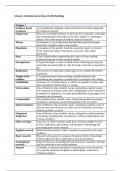
Glossary Introduction to Research Methodology
Chapter 1
Evidence-based A psychotherapy technique whose effectiveness has been supported
treatment by empirical research
Empiricism The use of verifiable evidence as the basis for conclusions; collecting
data systematically and using it to develop, support, or challenge a
theory. Also called empirical method, empirical research.
Theory A statement or set of statements that describes general principles
about how variables relate to one another
Hypothesis A statement of the specific result the researcher expects to observe
from a particular study, if the theory is accurate. Also called
prediction
Data A set of observations representing the values of some variable,
collected from one or more research studies.
Preregistered A term referring to a study in which, before collecting any data, the
researcher has stated publicly what the study’s outcome is expected to
be.
Replication The process of conducting a study again to test whether the result is
consistent.
Weight of the A conclusion drawn from reviewing scientific literature and
evidence considering the proportion of studies that is consistent with a theory.
Falsifiability A feature of a scientific theory, in which it is possible to collect data
that will indicate that the theory is wrong.
Universalism One of Merton’s four scientific norms, stating that scientific claims
are evaluated according to their merit, independent of the researcher’s
credentials or reputation. The same preestablished criteria apply to all
scientists and all research
Communality One of Merton’s four scientific norms, stating that scientific knowledge is
created by a community, and its findings belong to the community
Disinterestedness One of Merton’s four scientific norms, stating that scientists strive to
discover the truth whatever it is; they are not swayed by conviction,
idealism, politics, or profit
Organized One of Merton’s four scientific norms, stating that scientists question
skepticism everything, including their own theories, widely accepted ideas, and
“ancient wisdom.”
Self-correcting A process in which scientists make their research available for peer
review, replication, and critique, with the goal of identifying and
correcting errors in the research.
Applied research Research whose goal is to find a solution to a particular real-world
problem.
Basic research Research whose goal is to enhance the general body of knowledge,
without regard for direct application to practical problems.
Translational Research that uses knowledge derived from basic research to develop
research and test solutions to real-world problems
Journal A monthly or quarterly periodical containing peer-reviewed articles
on a specific academic discipline or subdiscipline, written for a
scholarly audience
,Journalism News and commentary published or broadcast in the popular media
and produced for a general audience
Chapter 2
Comparison A group in an experiment whose levels on the independent variable
group differ from those of the treatment group in some intended and
meaningful way. Also called comparison condition.
Confound A general term for a potential alternative explanation for a research
finding; a threat to internal validity.
Confederate An actor who is directed by the researcher to play a specific role in a
research study.
Probabilistic Describing the empirical method, stating that science is intended to
explain a certain proportion (but not necessarily all) of the possible
cases.
Availability A bias in intuition, in which people incorrectly estimate the frequency
heuristic of something, relying predominantly on instances that easily come to
mind rather than using all possible evidence in evaluating a
conclusion.
Present/present A bias in intuition, in which people incorrectly estimate the
bias relationship between an event and its outcome, focusing on times the
event and outcome are present, while failing to consider evidence that
is absent and harder to notice.
Confirmation bias The tendency to consider only the evidence that supports a
hypothesis,
including asking only the questions that will lead to the expected
answer
Bias blind spot The tendency for people to think that compared to others, they
themselves are less likely to engage in biased reasoning.
Empirical journal A scholarly article that reports for the first time the results of a
article research study.
Review journal An article summarizing all the studies that have been published in
article one research area
Effect size The magnitude, or strength, of a relationship between two or more
variables.
Paywalled Term referring to a peer-reviewed academic journal that the general
public must pay to access; only people who are members of
subscribing institutions can access the content
Open access Term referring to a peer-reviewed academic journal that anyone, even
the general public, can read without paying for access.
Disinformation A news story, photo, or video deliberately created to be false or
misleading.
Meta-analysis A way of mathematically averaging the effect sizes of all the studies
that have tested the same variables to see what conclusion that whole
body of evidence supports
, Chapter 3
Chapter 1
Evidence-based A psychotherapy technique whose effectiveness has been supported
treatment by empirical research
Empiricism The use of verifiable evidence as the basis for conclusions; collecting
data systematically and using it to develop, support, or challenge a
theory. Also called empirical method, empirical research.
Theory A statement or set of statements that describes general principles
about how variables relate to one another
Hypothesis A statement of the specific result the researcher expects to observe
from a particular study, if the theory is accurate. Also called
prediction
Data A set of observations representing the values of some variable,
collected from one or more research studies.
Preregistered A term referring to a study in which, before collecting any data, the
researcher has stated publicly what the study’s outcome is expected to
be.
Replication The process of conducting a study again to test whether the result is
consistent.
Weight of the A conclusion drawn from reviewing scientific literature and
evidence considering the proportion of studies that is consistent with a theory.
Falsifiability A feature of a scientific theory, in which it is possible to collect data
that will indicate that the theory is wrong.
Universalism One of Merton’s four scientific norms, stating that scientific claims
are evaluated according to their merit, independent of the researcher’s
credentials or reputation. The same preestablished criteria apply to all
scientists and all research
Communality One of Merton’s four scientific norms, stating that scientific knowledge is
created by a community, and its findings belong to the community
Disinterestedness One of Merton’s four scientific norms, stating that scientists strive to
discover the truth whatever it is; they are not swayed by conviction,
idealism, politics, or profit
Organized One of Merton’s four scientific norms, stating that scientists question
skepticism everything, including their own theories, widely accepted ideas, and
“ancient wisdom.”
Self-correcting A process in which scientists make their research available for peer
review, replication, and critique, with the goal of identifying and
correcting errors in the research.
Applied research Research whose goal is to find a solution to a particular real-world
problem.
Basic research Research whose goal is to enhance the general body of knowledge,
without regard for direct application to practical problems.
Translational Research that uses knowledge derived from basic research to develop
research and test solutions to real-world problems
Journal A monthly or quarterly periodical containing peer-reviewed articles
on a specific academic discipline or subdiscipline, written for a
scholarly audience
,Journalism News and commentary published or broadcast in the popular media
and produced for a general audience
Chapter 2
Comparison A group in an experiment whose levels on the independent variable
group differ from those of the treatment group in some intended and
meaningful way. Also called comparison condition.
Confound A general term for a potential alternative explanation for a research
finding; a threat to internal validity.
Confederate An actor who is directed by the researcher to play a specific role in a
research study.
Probabilistic Describing the empirical method, stating that science is intended to
explain a certain proportion (but not necessarily all) of the possible
cases.
Availability A bias in intuition, in which people incorrectly estimate the frequency
heuristic of something, relying predominantly on instances that easily come to
mind rather than using all possible evidence in evaluating a
conclusion.
Present/present A bias in intuition, in which people incorrectly estimate the
bias relationship between an event and its outcome, focusing on times the
event and outcome are present, while failing to consider evidence that
is absent and harder to notice.
Confirmation bias The tendency to consider only the evidence that supports a
hypothesis,
including asking only the questions that will lead to the expected
answer
Bias blind spot The tendency for people to think that compared to others, they
themselves are less likely to engage in biased reasoning.
Empirical journal A scholarly article that reports for the first time the results of a
article research study.
Review journal An article summarizing all the studies that have been published in
article one research area
Effect size The magnitude, or strength, of a relationship between two or more
variables.
Paywalled Term referring to a peer-reviewed academic journal that the general
public must pay to access; only people who are members of
subscribing institutions can access the content
Open access Term referring to a peer-reviewed academic journal that anyone, even
the general public, can read without paying for access.
Disinformation A news story, photo, or video deliberately created to be false or
misleading.
Meta-analysis A way of mathematically averaging the effect sizes of all the studies
that have tested the same variables to see what conclusion that whole
body of evidence supports
, Chapter 3