Glossary Social Psychology
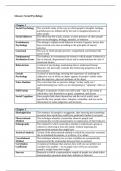
Chapter 1
Social Psychology The scientific study of the way in which people’s thoughts, feelings,
and behaviors are influenced by the real or imagined presence of
other people
Social influence The effect that the words, actions, or mere presence of other people
have on out thoughts, feelings, attitudes, or behavior
Evolutionary The attempt t explain social behavior in terms of genetic factors that
Psychology have evolved over time according to the principles of natural
selection
Construal The way in which people perceive, comprehend, and interpret the
social world
Fundamental The tendency to overestimate the extent to which people’s behavior is
Attribution Error due to internal, dispositional factors and to underestimate the role of
situational factors
Behaviorism A school of psychology maintaining that to understand human
behavior, one need only consider the reinforcing properties of the
environment
Gestalt A school of psychology stressing the importance of studying the
Psychology subjective way in which an object appears in people’s minds rather
than the objective, physical attributes of the object
Naïve Realism The conviction that we perceive things “as they really are,”
underestimating how much we are interpreting or “spinning” what we
see
Self-Esteem People’s evaluations of their own self-worth – that is, the extent to
which they view themselves as good, competent, and decent
Social Cognition How people think about themselves and the social world; more
specifically, how people select, interpret, remember, and use social
information to make judgments and decisions
Chapter 2
Hindsight Bias The tendency for people to exaggerate, after knowing that something
occurred, how much they could have predicted it before it occurred
Observational The technique whereby a researcher observes people and
Method systematically records measurements or impressions of their behavior
Ethnography The method by which researchers attempt to understand a group or
culture by observing it from the inside, without imposing any
preconceived notions they might have
Archival Analysis A form of the observational method in which the researcher examines
the accumulated documents, or archives, of a culture
Correlational The technique whereby two or more variables are systematically
Method measured and the relationship between them is assessed
Correlation A statistical technique that assesses how well you can predict one
Coefficient variable from another – for example, how well you can predict
people’s weight from their height
Surveys Research in which a representative sample of people are asked (often
anonymously) questions about their attitudes or behavior
, Random Selection A way of ensuring that a sample of people is representative of a
population by giving everyone in the population an equal chance of
being selected for the sample
Experimental The method in which the researcher randomly assigns participants to
Method different conditions and ensures that these conditions are identical
except for the independent variable (the one thought to have a causal
effect on people’s responses)
Independent The variable a researcher changes or varies to see if it has an effect
Variable on some other variable
Dependent The variable a researcher measures to see if it is influenced by the
Variable independent variable the researcher hypothesizes that the dependent
variable will depend on the level of the independent variable
Random A process ensuring that all participants have an equal chance of
Assignment to taking part in any condition of an experiment; through random
Condition assignment, researchers can be relatively certain that differences in
the participants’ personalities or backgrounds are distributed evenly
across conditions
Probability level A number calculated with statistical techniques that tells researchers
(p-value) how likely it is that the results of their experiment occurred by chance
and not because of the independent variable or variables; the
convention in science, including social psychology, is to consider
results significant (trustworthy) if the probability level is less that 5 in
100 that the results might be due to chance factors and not the
independent variables studied
Internal Validity Making sure that nothing besides the independent variable can affect
the dependent variable; this is accomplished by controlling all
extraneous variables and by randomly assigning people to different
experimental conditions
External Validity The extent to which the results of a study can be generalized to other
situations and to other people
Psychological The extent to which the psychological processes triggered in an
Realism experiment are similar to psychological processes that occur in
everyday life
Cover Story A description of the purpose of a study, given to participants, that is
different from its true purpose and is used to maintain psychological
realism
Field Experiments Experiments conducted in natural settings rather than in the
laboratory
Basic Dilemma of The trade-off between internal and external validity in conducting
the Social research; it is very difficult to do one experiment that is both high in
Psychologist internal validity and generalizable to other situations and people
Replications Repeating a study, often with different subject populations or in
different settings
Meta-Analysis A statistical technique that averages the results of two or more studies
to see if the effect of an independent variable is reliable
Basic Research Studies that are designed to find the best answer to the question of
why people behave as they do and that are conducted purely for
reasons of intellectual curiosity
Applied Research Studies designed to solve a particular social problem
Cross-Cultural Research conducted with members of different cultures, to see
Chapter 1
Social Psychology The scientific study of the way in which people’s thoughts, feelings,
and behaviors are influenced by the real or imagined presence of
other people
Social influence The effect that the words, actions, or mere presence of other people
have on out thoughts, feelings, attitudes, or behavior
Evolutionary The attempt t explain social behavior in terms of genetic factors that
Psychology have evolved over time according to the principles of natural
selection
Construal The way in which people perceive, comprehend, and interpret the
social world
Fundamental The tendency to overestimate the extent to which people’s behavior is
Attribution Error due to internal, dispositional factors and to underestimate the role of
situational factors
Behaviorism A school of psychology maintaining that to understand human
behavior, one need only consider the reinforcing properties of the
environment
Gestalt A school of psychology stressing the importance of studying the
Psychology subjective way in which an object appears in people’s minds rather
than the objective, physical attributes of the object
Naïve Realism The conviction that we perceive things “as they really are,”
underestimating how much we are interpreting or “spinning” what we
see
Self-Esteem People’s evaluations of their own self-worth – that is, the extent to
which they view themselves as good, competent, and decent
Social Cognition How people think about themselves and the social world; more
specifically, how people select, interpret, remember, and use social
information to make judgments and decisions
Chapter 2
Hindsight Bias The tendency for people to exaggerate, after knowing that something
occurred, how much they could have predicted it before it occurred
Observational The technique whereby a researcher observes people and
Method systematically records measurements or impressions of their behavior
Ethnography The method by which researchers attempt to understand a group or
culture by observing it from the inside, without imposing any
preconceived notions they might have
Archival Analysis A form of the observational method in which the researcher examines
the accumulated documents, or archives, of a culture
Correlational The technique whereby two or more variables are systematically
Method measured and the relationship between them is assessed
Correlation A statistical technique that assesses how well you can predict one
Coefficient variable from another – for example, how well you can predict
people’s weight from their height
Surveys Research in which a representative sample of people are asked (often
anonymously) questions about their attitudes or behavior
, Random Selection A way of ensuring that a sample of people is representative of a
population by giving everyone in the population an equal chance of
being selected for the sample
Experimental The method in which the researcher randomly assigns participants to
Method different conditions and ensures that these conditions are identical
except for the independent variable (the one thought to have a causal
effect on people’s responses)
Independent The variable a researcher changes or varies to see if it has an effect
Variable on some other variable
Dependent The variable a researcher measures to see if it is influenced by the
Variable independent variable the researcher hypothesizes that the dependent
variable will depend on the level of the independent variable
Random A process ensuring that all participants have an equal chance of
Assignment to taking part in any condition of an experiment; through random
Condition assignment, researchers can be relatively certain that differences in
the participants’ personalities or backgrounds are distributed evenly
across conditions
Probability level A number calculated with statistical techniques that tells researchers
(p-value) how likely it is that the results of their experiment occurred by chance
and not because of the independent variable or variables; the
convention in science, including social psychology, is to consider
results significant (trustworthy) if the probability level is less that 5 in
100 that the results might be due to chance factors and not the
independent variables studied
Internal Validity Making sure that nothing besides the independent variable can affect
the dependent variable; this is accomplished by controlling all
extraneous variables and by randomly assigning people to different
experimental conditions
External Validity The extent to which the results of a study can be generalized to other
situations and to other people
Psychological The extent to which the psychological processes triggered in an
Realism experiment are similar to psychological processes that occur in
everyday life
Cover Story A description of the purpose of a study, given to participants, that is
different from its true purpose and is used to maintain psychological
realism
Field Experiments Experiments conducted in natural settings rather than in the
laboratory
Basic Dilemma of The trade-off between internal and external validity in conducting
the Social research; it is very difficult to do one experiment that is both high in
Psychologist internal validity and generalizable to other situations and people
Replications Repeating a study, often with different subject populations or in
different settings
Meta-Analysis A statistical technique that averages the results of two or more studies
to see if the effect of an independent variable is reliable
Basic Research Studies that are designed to find the best answer to the question of
why people behave as they do and that are conducted purely for
reasons of intellectual curiosity
Applied Research Studies designed to solve a particular social problem
Cross-Cultural Research conducted with members of different cultures, to see