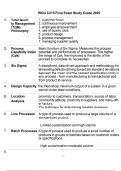
WGU C215 Final Exam Study Guide 2025
Total Quali- ty Management (TQM) Philosophy 2. Process Capability Index (Cpk) WGU C215 Final Exam Study Guide 2025 1. customer focus 2. continuous improvement 3. employee empowerment 4. use of quality tools 5. product design 6. process management 7. managing supplier quality Basic function of Six Sigma. Measures the process potential and performance of processes. The higher the range of Cpk, the improved is the ability of the process to complete its necessities. 3. Six Sigma A disciplined, data-driven approach and methodology for eliminating defects (driving toward six standard deviations between the mean and the nearest specification limit) in any process - from manufacturing to transactional and from product to service. 4. Design Capacity The theoretical maximum output of a system in a given period under ideal conditions. 5. Location Analysis proximity to customers, transportation, source of labor, community attitude, proximity to suppliers, and many oth-er factors. The technique for determining location decisions. 6. Line Processes A type of process used to produce a large volume of a standardized product. Limited customization and high volume 7. Batch Processes A type of process used to produce a small number of products in groups or batches based on customer orders or specifications. High customization moderate volume 8. 2 / 22 Project Processes 9. Continuous Processes A type of process used to make a one-at-a-time product exactly to customer specifications. Most custom and lowest volume A type of process that operates continually to produce a high volume of a fully standardized product. - No customization and as high a volume as possible 10. Bottleneck Longest task in the process. 11. Flexible Manu- A type of automated system that combines the flexibility facturing System of intermittent operations with the efficiency of continuous (FMS) 12. Output/Input Control operations. A technique for monitoring the flow of jobs between work centers. 13. Value-Added The net increase created during the transformation of inputs into final outputs. 14. Hybrid Layouts Layouts that combine characteristics of process and prod- uct layouts. - Group technology layouts. - Cell technology layouts. - Grocery stores use hybrid layouts 15. Relationship Chart (REL) 16. Rectilinear Distance Table that reflects opinions of managers with regard to the importance of having any two departments close togeth- er. The shortest distance between two locations using north-south and east-west movements. 17. From-To Matrix Table that gives the number of trips or units of product moved between any pair of departments. 18. Block Plan 3 / 22 19. Mean Observed Times Schematic showing the placement of resources in a facil- ity. The average of the observation times for each of the work elements. 20. Normal Time The mean observed time multiplied by the performance rating factor by the frequency of occurrence. 21. Standard Time The length of time it should take a qualified worker using appropriate process and tools to complete a specific job, allowing time for personal fatigue and unavoidable delays. 22. Just-in-Time (JIT) A philosophy designed to achieve high-volume production through elimination of waste and continuous improve- ment. Based on a "pull" system rather than a "push" sys- tem. The three elements are just-in-time manufacturing, total quality management, and respect for people. 23. Kanban card A card that specifies the exact quantity of product that needs to be produced. 24. Tier One Suppli- ers 25. Tier Two Suppli- ers 26. 26. Supplies materials or services directly to the processing facility. These are the suppliers that put products in specific con- tainers or packages. Internal Functions companies Directly supplies materials or services to a tier-one sup- plier in the supply chain. Suppliers of the specialty materials for the tier one sup- pliers to be able to produce the packaging necessary for different products. Think cardboard, plastic, glass, chemicals. 4 / 22 Tier Three Sup- pliers Directly supplies materials or services to a tier two sup- plier in the supply chain. These are companies that extract raw materials. Oil, raw chemical materials, wood. 27. Capacity Re- quirements Plan- ning (CRP) Determines the labor and machine resources needed to fill the open and planned orders generated by the MRP. Basically, checking if there is enough work scheduled for operations 28. Enterprise Re- source Planning (ERP) Large software programs used for planning and coordi- nating all resources throughout the entire enterprise. 29. Aggregate Plans - IN A BROAD SENSE Includes the budgeted levels of finished products, inven- tory, backlogs, workforce size, and aggregate production rate needed to support the marketing plan. Marketing Plan, TO, Operating and engineering Plans, TO, Start or revision of the strategic business plan. 30. Third-Party Lo- gistics (3PL) Businesses used to outsource elements of the company's distribution and fulfillment services. They typically spe- cialize in integrated operation, warehousing and trans- portation services which can be scaled and customized to customers' needs based on market conditions, such as the demands and delivery service requirements for their products and materials. 31. Supply Chain Operations Ref- erence model (SCOR) the world's leading supply chain framework, linking busi- ness processes, performance metrics, practices and peo- ple skills into a unified structure. The goals are to increase the speed of system implementations, support organiza- tional learning goals, and improve inventory turns. 32. Project Life Cy- cle Phases Conception, Feasibility/Study analysis, Planning, Execu- tion, Termination 5 / 22 33. Master Produc- tion Schedule (MPS) A plan for individual commodities to be produced in each time period.It is usually linked to manufacturing where the plan indicates when and how much of each product will be demanded. It gives production, planning, purchasing, and top management the information needed to plan and control the manufacturing operation. 34. Total Quali- ty Management (TQM) The meaning of quality as defined by the customer. 35. Advertising rev- enue model Provides users with information on services and products and provides an opportunity for suppliers to advertise 36. Affiliate revenue model Companies receive a referral fee for directing business to an affiliate 37. Appraisal cost The cost associated with uncovering defects 38. Automated order entry systems A method using telephone models to send digital orders to suppliers. 39. Backwards inte- gration Owning or controlling sources of raw materials and com- ponents. 40. Benchmarking Studying other companies business practices for compar- ison. 41. Bullwhip effect Inaccurate or distorted demand information created in the supply chain. 42. Business to Business com- merce Businesses buying and selling to other businesses. 43. Business to consumer com- merce Businesses selling to individual consumers. 6 / 22 44. Cause and effect diagrams A chart that identifies potential causes of particular quality problems. 45. Checklist A list of common defects and the number of observed occurrences of each. 46. Conformance to specifications - TQM 47. Continuous im- provement how well a product or service meets the targets and tolerances set by designers. A philosophy of never-ending improvement. 48. Control charts Charts used to evaluate whether a process is operating within expectations. 49. Crossdocking Eliminates storage and order picking functions of a distri- bution warehouse. 50. Customer de- fined quality an integrated effort designed to improve quality perfor- mance at every level of the organization. 51. Deming Prize Japanese award for companies to recognize efforts in quality improvement. 52. Distribution management 53. Distribution warehouse 54. Distributor crossdocking Responsible for the movement of material from the man- ufacturer to the customer. Used for short term storage, consolidation, and product mixing. the receiving and consolidating of inbound products from different vendors into a multi-SKU pallet. 55. E-commerce Using the internet and web to do business. 56. E-distributors Independently owned net marketplaces having catalogs representing thousands of suppliers and designed for spot purchases.
Written for
- Institution
-
Western Governors University
- Course
-
WGU C215 (WGUC215)
Document information
- Uploaded on
- April 8, 2025
- Number of pages
- 22
- Written in
- 2024/2025
- Type
- Exam (elaborations)
- Contains
- Questions & answers
Subjects
- wgu
- wgu c215
- wgu c215 final exam
-
wgu c215 final exam study guide

Also available in package deal