
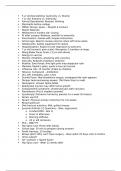
5 yr old bed wetting: Autonomy vs. Shame
7 yr old: Industry vs. Inferiority
Formal Operational: Abstract thinking
Meningitis before college
MRSA: Gloves, Gown – Droplet & Contact
Report Babinski
Milestones 6 months old: Cooing
Pt after surgery: Redness, warmth to extremity
Preschoolers: Games with simple instructions
School age: Need to review rules for when left home alone
Adolescents: Safety equipment for sports
Hospitalization: Expect to see regression & tantrums
7 yr old (numeric pain scale): Recognize 2 numbers at large
Wong-Baker Faces Scale: (3 yrs and above)
Allergy to vaccine
Monitor irritability, wheezing with vaccines
Varicella, Rubeola (measles): Airborne
Rubella: Sore throat; fine light pink maculopapular rash
Measles: Koplik's spots, spots in buccal mucosa
Influenza risk: 15 months (infant & children)
Tetanus: Cut/wound – Antibiotics
ACL CM: Instability, pain, knee
Scarlet Fever: Red strawberry tongue, sandpaper-like rash appears
Temper tantrums/wrong answer: (Tell them they’re mad)
Neurogenic: Answer Spina bifida
Epiphyseal injuries may affect bone growth
Compartment syndrome: Unrelieved pain with narcotics
Paresthesia: Pins & needles (answer)
Syndactyly: Distractor turned by parents 2x a week (Fo bases)
Sprain use ICE
Sprain: Physical activity restriction for 4-6 weeks
Broad spectrum
Diet fracture nutrition: Milk, grilled cheese
Juvenile Arthritis 12 Questions – (Box, regression)
o Limited ROM – Box Q
o Fever in afternoon
o Morning stiffness
o 24 yr old remission
PCA – ONLY PT
Hip Spica cast: Prone with eating
School age: 10 min to prepare (wrong answer)
Pavlik Harness: 23 hrs/day
Browe splint: Why can’t have surgery – Near splint 25 days until 3 months
Urine output?
40° scoliosis = Spinal fusion
Hip Spica cast – Wear 12 weeks after
, Osteomyelitis – CM is bone pain
Duchenne syndrome – Waddling
UNIT 1
Erikson’s Growth and Development
Infants: Trust vs. Mistrust (NB–12 months) → Faith and optimism.
Toddler: Autonomy vs. Shame and Doubt (1–3 years) → Self-control and
power.
Preschool: Initiative vs. Guilt (3–6 years) → Purpose.
School Age: Industry vs. Inferiority (6–12 years) → Competence.
Adolescents: Identity vs. Role Confusion (12–18 years) → Fidelity to
others and individual value.
Piaget’s Stages
Sensorimotor (0–2 years): Egocentric thinking.
Preoperational (2–7 years): Magical thinking.
Concrete Operational (7–11 years): Logical thinking.
Formal Operational (11–15 years): Abstract thinking, philosophy, and
moral reasoning.
Pain Scales
FLACC: For infants and non-verbal children.
Faces (Wong-Baker): Ages 4–7 (Preschool to School Age).
Number Scale: For children 12 years and older.
School Age may use Stalling behavior “wait a minute”
o Muscle rigidity
o May use all behaviors of younger child
Types of Play
Preschoolers: Associative play (role-playing, board games,
alphabet/color games).
School Age: Cooperative Play- Play by the rules
Function of Play: Self-awareness-children learn who they are and their
place in the world.
Atraumatic Care:
Focus on "first, do no harm" by:
o Preventing separation.
o Promoting a sense of control.
o Minimizing bodily injury.
Provide activities to relieve anxiety or distract child (dolls, drawings, books,
handling equipment)
7 yr old: Industry vs. Inferiority
Formal Operational: Abstract thinking
Meningitis before college
MRSA: Gloves, Gown – Droplet & Contact
Report Babinski
Milestones 6 months old: Cooing
Pt after surgery: Redness, warmth to extremity
Preschoolers: Games with simple instructions
School age: Need to review rules for when left home alone
Adolescents: Safety equipment for sports
Hospitalization: Expect to see regression & tantrums
7 yr old (numeric pain scale): Recognize 2 numbers at large
Wong-Baker Faces Scale: (3 yrs and above)
Allergy to vaccine
Monitor irritability, wheezing with vaccines
Varicella, Rubeola (measles): Airborne
Rubella: Sore throat; fine light pink maculopapular rash
Measles: Koplik's spots, spots in buccal mucosa
Influenza risk: 15 months (infant & children)
Tetanus: Cut/wound – Antibiotics
ACL CM: Instability, pain, knee
Scarlet Fever: Red strawberry tongue, sandpaper-like rash appears
Temper tantrums/wrong answer: (Tell them they’re mad)
Neurogenic: Answer Spina bifida
Epiphyseal injuries may affect bone growth
Compartment syndrome: Unrelieved pain with narcotics
Paresthesia: Pins & needles (answer)
Syndactyly: Distractor turned by parents 2x a week (Fo bases)
Sprain use ICE
Sprain: Physical activity restriction for 4-6 weeks
Broad spectrum
Diet fracture nutrition: Milk, grilled cheese
Juvenile Arthritis 12 Questions – (Box, regression)
o Limited ROM – Box Q
o Fever in afternoon
o Morning stiffness
o 24 yr old remission
PCA – ONLY PT
Hip Spica cast: Prone with eating
School age: 10 min to prepare (wrong answer)
Pavlik Harness: 23 hrs/day
Browe splint: Why can’t have surgery – Near splint 25 days until 3 months
Urine output?
40° scoliosis = Spinal fusion
Hip Spica cast – Wear 12 weeks after
, Osteomyelitis – CM is bone pain
Duchenne syndrome – Waddling
UNIT 1
Erikson’s Growth and Development
Infants: Trust vs. Mistrust (NB–12 months) → Faith and optimism.
Toddler: Autonomy vs. Shame and Doubt (1–3 years) → Self-control and
power.
Preschool: Initiative vs. Guilt (3–6 years) → Purpose.
School Age: Industry vs. Inferiority (6–12 years) → Competence.
Adolescents: Identity vs. Role Confusion (12–18 years) → Fidelity to
others and individual value.
Piaget’s Stages
Sensorimotor (0–2 years): Egocentric thinking.
Preoperational (2–7 years): Magical thinking.
Concrete Operational (7–11 years): Logical thinking.
Formal Operational (11–15 years): Abstract thinking, philosophy, and
moral reasoning.
Pain Scales
FLACC: For infants and non-verbal children.
Faces (Wong-Baker): Ages 4–7 (Preschool to School Age).
Number Scale: For children 12 years and older.
School Age may use Stalling behavior “wait a minute”
o Muscle rigidity
o May use all behaviors of younger child
Types of Play
Preschoolers: Associative play (role-playing, board games,
alphabet/color games).
School Age: Cooperative Play- Play by the rules
Function of Play: Self-awareness-children learn who they are and their
place in the world.
Atraumatic Care:
Focus on "first, do no harm" by:
o Preventing separation.
o Promoting a sense of control.
o Minimizing bodily injury.
Provide activities to relieve anxiety or distract child (dolls, drawings, books,
handling equipment)



