

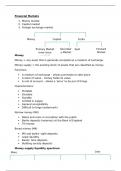
Financial Markets
1. Money market
2. Capital market
3. Foreign exchange market
Money Capital ForEx
Market Market Market
Primary Market Secondar Spot Forward
(new issue y Market Market Market
Money market)
Money = any asset that is generally accepted as a medium of exchange.
Money supply = the existing stock of assets that are classified as money.
Functions:
A medium of exchange – allows purchases to take place
A store of value – money holds its value
A unit of account – allows a ‘price’ to be put of things.
Characteristics:
Portable
Divisible
Durable
Limited in supply
General acceptability
Difficult to forge (watermark)
Narrow money (M0)
Notes and coins in circulation with the public
Banks deposits (reserves) at the Bank of England
Till money
Broad money (M4)
M0 and banks’ sight deposits
Least liquidity
Banks’ time deposits
Building society deposits
Money supply liquidity spectrum
More Less
Liquid Liquid
,Cash Savings Investment Guilt-edged Physical
accounts accounts securities assets
Medium of Store of value
exchange function
function
Narrow money Broad money
Money Market
Money market = a financial market providing short-term finance
Short term debt maturity = 24 hours to 12 months
Interbank market = banks lend to each other to balance their books
to increase liquidity (often make by electronic transfer from Bank of
England reserves)
Capital Market
The capital market provides medium and long-term finance to firm and
governments
Companies may raise long-term finance by issuing shares or corporate
bonds to borrow from the book
Governments issue bonds to finance their borrowing needs.
The banks raise money on capital markets to support their lending by
issuing bonds.
Primary (new issue) market:
Primary market = companies issue a new security, not previously
traded on any exchange.
Sold for the first time
Secondary market:
Increase liquidity of previously issued securities, making it easier for
firms and governments to raise new finance.
Trades previously issued securities (e.g. world stock exchange,
pension funds)
, Foreign Exchange Market
Foreign Exchange market = different currencies are bought and sold.
International trade and investment flows mean economic agents will need
to convert the funds they provide or receive from one currency.
Spot transactions:
Immediate exchange of foreign currency at the current exchange
rate.
Non commercial transactions (e.g. on Holiday)
Forward transactions :
The exchange of foreign currencies at some specified time in the
future.
To avoid the risks of fluctuating exchange rates by importers and
exporters.
Debt = borrowing money which has to be repaid with regular interest.
Equity = the provider of the funds receives an ownership state in the
business.
Shares = equity
Central Banks
Functions:
Maintain the value of currency
Manage monetary policy (money supply – QE and bonds, interest
rate, exchange rate)
The regulation of banks has become more prominent since the financial
crisis
Largest central banks (+ international reserve assets held):
1) People’s Bank of China - $3,379b
2) Bank of Japan - $1,257b
3) Swiss National Bank - $894b
Lenders of last resort:
2008 financial crisis and the Fed
2012 ECB and Eurozone
2020 COVID and UK and India
Bank capital = the money invested in the bank that they can fall back on.
1. Money market
2. Capital market
3. Foreign exchange market
Money Capital ForEx
Market Market Market
Primary Market Secondar Spot Forward
(new issue y Market Market Market
Money market)
Money = any asset that is generally accepted as a medium of exchange.
Money supply = the existing stock of assets that are classified as money.
Functions:
A medium of exchange – allows purchases to take place
A store of value – money holds its value
A unit of account – allows a ‘price’ to be put of things.
Characteristics:
Portable
Divisible
Durable
Limited in supply
General acceptability
Difficult to forge (watermark)
Narrow money (M0)
Notes and coins in circulation with the public
Banks deposits (reserves) at the Bank of England
Till money
Broad money (M4)
M0 and banks’ sight deposits
Least liquidity
Banks’ time deposits
Building society deposits
Money supply liquidity spectrum
More Less
Liquid Liquid
,Cash Savings Investment Guilt-edged Physical
accounts accounts securities assets
Medium of Store of value
exchange function
function
Narrow money Broad money
Money Market
Money market = a financial market providing short-term finance
Short term debt maturity = 24 hours to 12 months
Interbank market = banks lend to each other to balance their books
to increase liquidity (often make by electronic transfer from Bank of
England reserves)
Capital Market
The capital market provides medium and long-term finance to firm and
governments
Companies may raise long-term finance by issuing shares or corporate
bonds to borrow from the book
Governments issue bonds to finance their borrowing needs.
The banks raise money on capital markets to support their lending by
issuing bonds.
Primary (new issue) market:
Primary market = companies issue a new security, not previously
traded on any exchange.
Sold for the first time
Secondary market:
Increase liquidity of previously issued securities, making it easier for
firms and governments to raise new finance.
Trades previously issued securities (e.g. world stock exchange,
pension funds)
, Foreign Exchange Market
Foreign Exchange market = different currencies are bought and sold.
International trade and investment flows mean economic agents will need
to convert the funds they provide or receive from one currency.
Spot transactions:
Immediate exchange of foreign currency at the current exchange
rate.
Non commercial transactions (e.g. on Holiday)
Forward transactions :
The exchange of foreign currencies at some specified time in the
future.
To avoid the risks of fluctuating exchange rates by importers and
exporters.
Debt = borrowing money which has to be repaid with regular interest.
Equity = the provider of the funds receives an ownership state in the
business.
Shares = equity
Central Banks
Functions:
Maintain the value of currency
Manage monetary policy (money supply – QE and bonds, interest
rate, exchange rate)
The regulation of banks has become more prominent since the financial
crisis
Largest central banks (+ international reserve assets held):
1) People’s Bank of China - $3,379b
2) Bank of Japan - $1,257b
3) Swiss National Bank - $894b
Lenders of last resort:
2008 financial crisis and the Fed
2012 ECB and Eurozone
2020 COVID and UK and India
Bank capital = the money invested in the bank that they can fall back on.


