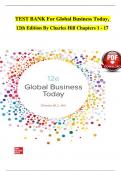
TEST BANK For Global Business Today,
12th Edition By Charles Hill Chapters 1 - 17
,Chapter One Globalization
PART TWO National Differences
Chapter Two National Differences in Political, Economic, and Legal Systems
Chapter Three National Differences in Economic Development
Chapter Four Differences in Culture
Chapter Five Ethics, Corporate Social Responsibility, and Sustainability
PART THREE The Global Trade and Investment Environment
Chapter Six International Trade Theory
Chapter Seven Government Policy and International Trade
Chapter Eight Foreign Direct Investment
Chapter Nine Regional Economic Integration
PART FOUR The Global Monetary System
Chapter Ten The Foreign Exchange Market
Chapter Eleven The International Monetary System
PART FIVE The Strategy of International Business
Chapter Twelve The Strategy of International Business
Chapter Thirteen Entering Developed and Emerging Markets
PART SIX International Business Functions
Chapter Fourteen Exporting, Importing, and Countertrade
Chapter Fifteen Global Production and Supply Chain Management
Chapter Sixteen Global Marketing and Business Analytics
Chapter Seventeen Global Human Resource Management
,Answers are at the end of each chapter
Chapter 01 Globalization
True / False Questions
1. As a result of globalization, we have been moving toward a world in which national economies
are relatively self-contained entities.
True False
2. By offering the same basic product worldwide, firms help to create a global market.
True False
3. A company has to be the size of a multinational giant to facilitate, and benefit from, the
globalization of markets.
True False
4. As a result of globalization, companies rarely need to customize marketing strategies, product
features, and operating practices in different countries.
True False
5. Globalization has resulted in greater uniformity replacing diversity across national markets.
True False
6. As firms follow each other around the world, they bring with them many of the assets that
served them well in other national markets. Thus, greater diversity replaces uniformity.
True False
7. Substantial impediments, such as barriers to foreign direct investment, make it difficult for firms
to achieve the optimal dispersion of their productive activities to locations around the globe.
True False
8. The World Trade Organization, the International Monetary Fund and its sister institution the
World Bank, and the United Nations were all created by voluntary agreement between individual
nation- states.
True False
, 9. The International Monetary Fund and the World Bank were both created in 1944 by 44 nations
that met at Bretton Woods, New Hampshire.
True False
10. The WTO is seen as the lender of last resort to nation-states whose economies are in turmoil
and whose currencies are losing value against those of other nations.
True False
11. The IMF is less controversial than its sister institution, the World Bank.
True False
12. In return for loans, the IMF requires nation-states to adopt specific economic policies aimed at
returning their troubled economies to stability and growth.
True False
13. Foreign direct investment (FDI) occurs when a firm invests resources in business activities
outside its home country.
True False
14. After World War II, the advanced nations of the West committed themselves to increasing
barriers to the free flow of goods, services, and capital between nations.
True False
15. The Uruguay Round, held under the umbrella of GATT, extended GATT to cover services as well
as manufactured goods.
True False
16. The lowering of trade and investment barriers allows firms to base production at the optimal
location for that activity.
True False
17. As a result of international trade, the economies of the world’s nation-states are becoming less
intertwined.
True False
18. The globalization of markets and production and the resulting growth of world trade, foreign
direct investment, and imports all imply that firms are finding it easier to protect themselves from
the attack of foreign competitors.
12th Edition By Charles Hill Chapters 1 - 17
,Chapter One Globalization
PART TWO National Differences
Chapter Two National Differences in Political, Economic, and Legal Systems
Chapter Three National Differences in Economic Development
Chapter Four Differences in Culture
Chapter Five Ethics, Corporate Social Responsibility, and Sustainability
PART THREE The Global Trade and Investment Environment
Chapter Six International Trade Theory
Chapter Seven Government Policy and International Trade
Chapter Eight Foreign Direct Investment
Chapter Nine Regional Economic Integration
PART FOUR The Global Monetary System
Chapter Ten The Foreign Exchange Market
Chapter Eleven The International Monetary System
PART FIVE The Strategy of International Business
Chapter Twelve The Strategy of International Business
Chapter Thirteen Entering Developed and Emerging Markets
PART SIX International Business Functions
Chapter Fourteen Exporting, Importing, and Countertrade
Chapter Fifteen Global Production and Supply Chain Management
Chapter Sixteen Global Marketing and Business Analytics
Chapter Seventeen Global Human Resource Management
,Answers are at the end of each chapter
Chapter 01 Globalization
True / False Questions
1. As a result of globalization, we have been moving toward a world in which national economies
are relatively self-contained entities.
True False
2. By offering the same basic product worldwide, firms help to create a global market.
True False
3. A company has to be the size of a multinational giant to facilitate, and benefit from, the
globalization of markets.
True False
4. As a result of globalization, companies rarely need to customize marketing strategies, product
features, and operating practices in different countries.
True False
5. Globalization has resulted in greater uniformity replacing diversity across national markets.
True False
6. As firms follow each other around the world, they bring with them many of the assets that
served them well in other national markets. Thus, greater diversity replaces uniformity.
True False
7. Substantial impediments, such as barriers to foreign direct investment, make it difficult for firms
to achieve the optimal dispersion of their productive activities to locations around the globe.
True False
8. The World Trade Organization, the International Monetary Fund and its sister institution the
World Bank, and the United Nations were all created by voluntary agreement between individual
nation- states.
True False
, 9. The International Monetary Fund and the World Bank were both created in 1944 by 44 nations
that met at Bretton Woods, New Hampshire.
True False
10. The WTO is seen as the lender of last resort to nation-states whose economies are in turmoil
and whose currencies are losing value against those of other nations.
True False
11. The IMF is less controversial than its sister institution, the World Bank.
True False
12. In return for loans, the IMF requires nation-states to adopt specific economic policies aimed at
returning their troubled economies to stability and growth.
True False
13. Foreign direct investment (FDI) occurs when a firm invests resources in business activities
outside its home country.
True False
14. After World War II, the advanced nations of the West committed themselves to increasing
barriers to the free flow of goods, services, and capital between nations.
True False
15. The Uruguay Round, held under the umbrella of GATT, extended GATT to cover services as well
as manufactured goods.
True False
16. The lowering of trade and investment barriers allows firms to base production at the optimal
location for that activity.
True False
17. As a result of international trade, the economies of the world’s nation-states are becoming less
intertwined.
True False
18. The globalization of markets and production and the resulting growth of world trade, foreign
direct investment, and imports all imply that firms are finding it easier to protect themselves from
the attack of foreign competitors.