,HED4806 Assignment 2 (COMPLETE ANSWERS)
2025;100% TRUSTED Complete, trusted solutions
and explanations.
SECTION A: COMPULSORY SECTION [40]
Question 1 Answer both sub-questions 1(a) (20 marks) and 1(b) (20
marks). Both are compulsory.
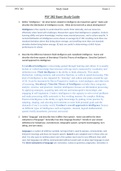
1(a) Comparative education (chapter 8 of the prescribed book)
1. Define “Comparative and International Education.” (4)
2. Discuss any four phases in the historical evolution of the field of
Comparative and International Education. (8)
3. Discuss four areas that show the value and purpose of comparative
education and its contribution to education. (8) [20]
1. Definition of “Comparative and International Education” (4
marks)
Comparative and International Education (CIE) is an
interdisciplinary field that examines education systems, processes, and
outcomes across different countries and cultures. It seeks to understand
how educational practices and structures vary globally and how
historical, cultural, political, and economic contexts influence education.
The comparative aspect focuses on analyzing and contrasting education
in different regions, while the international component emphasizes
global trends, transnational influences, and international cooperation in
education.
, 2. Four Phases in the Historical Evolution of Comparative and
International Education (8 marks)
1. Descriptive Phase (Early 19th century):
This phase focused on the description of foreign education systems
without deep analysis. Scholars like Marc-Antoine Jullien de
Paris emphasized the systematic comparison of different
countries’ education systems to identify best practices.
2. Analytical Phase (Mid-20th century):
During this phase, researchers began analyzing educational
systems more critically. Influences from social sciences, especially
sociology and economics, helped deepen understanding of how
education interacts with society.
3. Scientific Phase (1960s – 1970s):
Comparative education began incorporating quantitative research
methods and scientific tools. Influenced by modernization theory,
this phase sought to find universal laws and development patterns
in education globally.
4. Critical/Contemporary Phase (1980s – present):
Scholars started questioning the neutrality and objectivity of
comparative studies, especially from a post-colonial and decolonial
perspective. There is now more focus on contextual, qualitative
approaches and the impact of globalization, equity, and
indigenous knowledge systems.
3. Four Areas That Show the Value and Purpose of Comparative
Education and Its Contribution to Education (8 marks)
1. Policy Borrowing and Reform:
Comparative education allows countries to learn from others’
successes and failures, aiding in policy formulation and reform.
For example, lessons from Finland’s education system have
influenced teacher training in several countries.
2025;100% TRUSTED Complete, trusted solutions
and explanations.
SECTION A: COMPULSORY SECTION [40]
Question 1 Answer both sub-questions 1(a) (20 marks) and 1(b) (20
marks). Both are compulsory.
1(a) Comparative education (chapter 8 of the prescribed book)
1. Define “Comparative and International Education.” (4)
2. Discuss any four phases in the historical evolution of the field of
Comparative and International Education. (8)
3. Discuss four areas that show the value and purpose of comparative
education and its contribution to education. (8) [20]
1. Definition of “Comparative and International Education” (4
marks)
Comparative and International Education (CIE) is an
interdisciplinary field that examines education systems, processes, and
outcomes across different countries and cultures. It seeks to understand
how educational practices and structures vary globally and how
historical, cultural, political, and economic contexts influence education.
The comparative aspect focuses on analyzing and contrasting education
in different regions, while the international component emphasizes
global trends, transnational influences, and international cooperation in
education.
, 2. Four Phases in the Historical Evolution of Comparative and
International Education (8 marks)
1. Descriptive Phase (Early 19th century):
This phase focused on the description of foreign education systems
without deep analysis. Scholars like Marc-Antoine Jullien de
Paris emphasized the systematic comparison of different
countries’ education systems to identify best practices.
2. Analytical Phase (Mid-20th century):
During this phase, researchers began analyzing educational
systems more critically. Influences from social sciences, especially
sociology and economics, helped deepen understanding of how
education interacts with society.
3. Scientific Phase (1960s – 1970s):
Comparative education began incorporating quantitative research
methods and scientific tools. Influenced by modernization theory,
this phase sought to find universal laws and development patterns
in education globally.
4. Critical/Contemporary Phase (1980s – present):
Scholars started questioning the neutrality and objectivity of
comparative studies, especially from a post-colonial and decolonial
perspective. There is now more focus on contextual, qualitative
approaches and the impact of globalization, equity, and
indigenous knowledge systems.
3. Four Areas That Show the Value and Purpose of Comparative
Education and Its Contribution to Education (8 marks)
1. Policy Borrowing and Reform:
Comparative education allows countries to learn from others’
successes and failures, aiding in policy formulation and reform.
For example, lessons from Finland’s education system have
influenced teacher training in several countries.