Midterm internationaal recht
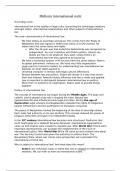
Hoorcollege week 1
International law is the totality of legal rules concerning the (sovereign) relations
amongst states, international organisations and other subjects of international
law
The main characteristics of international law:
- We treat states as sovereign and equal. This comes from the Treaty of
Westphalia that was signed in 1648 (now article 2(1) UN Charter). All
states have the same status and rights
o After the 30 year was had ended the Netherlands was recognised as
independent. You can’t interfere with Dutch politics, citizens etc.
States are free to do whatever they want, unless there’s an
international law that they agreed to be bound by.
- We have a horizontal system (=All sources have the same status): there’s
no global parliament, military etc. We have very little organisation.
- Legal practice (consent) matters for understanding law. International law
depends on what states agreed to
- Universal character in tension with legal cultural differences.
- Tension between law and politics. States will decide in a way that serves
their own interest. Powerful states influence how law is made and applied.
Law is important to distinguish between international law en politics.
- Move from co-existence to cooperation. States want to provide things
together
History of international law
The concept of international law began during the Middle Ages. The pope and
catholic church played a big role in shaping the rules. Natural law
(gewoonterecht) also influenced early legal principles. During the age of
Exploration legal scholars (rechtsgeleerden) debated the rights of indigenous
people (inheemsen) and the justification for European conquests.
The peace of Westphalia marked the beginning of the idea of sovereign states.
Each state had authority on its own territory. This concept reduced the power of
religious authorities and gave it to independent states.
In the 19th century international law became more structured. Positivism (het
recht heeft gelijk en is leidend) became dominant. International organisations
came up and treaties were created to regulate war. After World War I there were
important developments, per example the establishment of the Court of
International Justice. After World War II the UN came up and created rules about
war. The Security Council was given the authority to enforce them. The
Neurenberg Trials, where war crimes were prosecuted, set a precedent for
international criminal law.
Who is subject to international law? And what does this mean?
- Actors: any individual, body or entity that has an impact on international
relations. We can refer to them as international actors.
, o For example Greenpeace International: it’s a none governmental
organisation. It’s individuals and states are not part of it. However, it
doesn’t have the capacity to make law. It can influence law
o For example Donald Trump as an individual. He has an elevated role.
He does have the duty to respect international law. But it’s limited to
that which makes him an actor and not a subject.
- Subjects: an individual, body or entity possessing international rights and
duties. They have to have international rights and duties (= full
personality).
o States enjoy full international legal personality. They have the
highest level of legal authority over their people and territory
International organisations are secondary subjects. States give them
their rights. They have partial legal personality (international
organisations, individuals, multi-national corporations, insurgents)
(Private) corporate actors don’t have responsibilities/ duties.
But these corporations do have rights.
Capabilities of subject varies: it depends on what the law says.
Legal subjects are not identical in their nature (Reparation case). Their
status depends on the needs of the international community
o Het Rode Kruis: It had been created by a treaty (this makes it a
secondary subject). It had elevated power. It’s a secondary subject.
They can write international humanitarian law (this makes it an
actor)
There are different theories of legal personality for international organizations:
- Will theory: it depends on the founders’ intention when creating the
organization
- Objective theory: they gain it automatically when they exist as a matter of
law
- Presumptive personality theory: it has to act like a state and perform legal
functions. It’s actions determine.
What is a state?
- They have full international legal personality. States decide who becomes a
subject. One of their responsibilities is respecting the international law.
They have the right to do what they want in their border and they have the
right to enter into treaties of other states. They have the power to create
international law. States can dispute against another state before the Court
of Justice.
- Definition of statehood (Montevideo Convention article 1):
o A permanent population
o A defined territory
o Government (that can exercise authority)
o Capacity to enter into relations with other states
The two theories of statehood:
1. Declaratory theory: It doesn’t matter if other states recognize you as a
state. The four criteria of being a statehood need to be satisfied in line with
article 1 of the Montevideo Convention
, Once you meet the definition of a state, you’re a state. It doesn’t
matter if other states recognise you as a state. It could mean that other
states have been satisfied and it can be used as evidence.
2. Constitutive theory: other states need to recognize you as a state. The
recognition gives legal statehood
Sources of international law (article 38 of the ICJ Statute):
- International treaties
o Treaties: an international agreement between states in written form
governed by international law. It can be embodied in a single
instrument or in two or more related instruments and whatever its
particular designation (article 2(1) Vienna) Treaties are the clearest
expression of a state’s consent. It will bind only the states who
consent to it. The Vienna Convention on the law of Treaties is
the most authoritative. Its accepted as customary international law
by the ICJ
Pacta sunt sevanda: states are bound to honour their treaty-based
obligations
Bilateral treaty: agreement between two states concerning
a specific issue of mutual interest
Multilateral treaty: general rules for multiple states
Constituent treaty: a treaty that creates an international
organisation
Law-making treaty: brings together many states to achieve
goals together and all states will have to ratify that treaty
(universal ratification)
Treaty-contract: treaty between two or a handful of states.
It’s only binding to these states and regulates specific matters
between them.
- Customary international law: behaviour that states think is legally
required. Once a rule becomes customary law it becomes binding on all
states. Two elements must exist:
o Opinio juris (subjectieve element): you have to show that your
state believes that an international legal right or obligations exists
o State practice (objectieve element): the state is behaving
consistently with that right or obligation
Widespread and virtually uniform practice. All states must behave
consistently. If you find all this you have identified a law that is binding
upon all states. However, a custom cannot bind a state that is a
persistent objector (a state has consistently opposed from the
beginning)
Why custom? Not every state has ratified the treaties
- The general principles of international law
o Legal principles existing in national legal systems that are so
generally recognised that their existence under international law
must be assumed
o They tend to be used for cases that could not otherwise be decided.
There are no treaties or customs, so there’s a legal solution needed.
They are gap fillers
- Subsidiary:
Hoorcollege week 1
International law is the totality of legal rules concerning the (sovereign) relations
amongst states, international organisations and other subjects of international
law
The main characteristics of international law:
- We treat states as sovereign and equal. This comes from the Treaty of
Westphalia that was signed in 1648 (now article 2(1) UN Charter). All
states have the same status and rights
o After the 30 year was had ended the Netherlands was recognised as
independent. You can’t interfere with Dutch politics, citizens etc.
States are free to do whatever they want, unless there’s an
international law that they agreed to be bound by.
- We have a horizontal system (=All sources have the same status): there’s
no global parliament, military etc. We have very little organisation.
- Legal practice (consent) matters for understanding law. International law
depends on what states agreed to
- Universal character in tension with legal cultural differences.
- Tension between law and politics. States will decide in a way that serves
their own interest. Powerful states influence how law is made and applied.
Law is important to distinguish between international law en politics.
- Move from co-existence to cooperation. States want to provide things
together
History of international law
The concept of international law began during the Middle Ages. The pope and
catholic church played a big role in shaping the rules. Natural law
(gewoonterecht) also influenced early legal principles. During the age of
Exploration legal scholars (rechtsgeleerden) debated the rights of indigenous
people (inheemsen) and the justification for European conquests.
The peace of Westphalia marked the beginning of the idea of sovereign states.
Each state had authority on its own territory. This concept reduced the power of
religious authorities and gave it to independent states.
In the 19th century international law became more structured. Positivism (het
recht heeft gelijk en is leidend) became dominant. International organisations
came up and treaties were created to regulate war. After World War I there were
important developments, per example the establishment of the Court of
International Justice. After World War II the UN came up and created rules about
war. The Security Council was given the authority to enforce them. The
Neurenberg Trials, where war crimes were prosecuted, set a precedent for
international criminal law.
Who is subject to international law? And what does this mean?
- Actors: any individual, body or entity that has an impact on international
relations. We can refer to them as international actors.
, o For example Greenpeace International: it’s a none governmental
organisation. It’s individuals and states are not part of it. However, it
doesn’t have the capacity to make law. It can influence law
o For example Donald Trump as an individual. He has an elevated role.
He does have the duty to respect international law. But it’s limited to
that which makes him an actor and not a subject.
- Subjects: an individual, body or entity possessing international rights and
duties. They have to have international rights and duties (= full
personality).
o States enjoy full international legal personality. They have the
highest level of legal authority over their people and territory
International organisations are secondary subjects. States give them
their rights. They have partial legal personality (international
organisations, individuals, multi-national corporations, insurgents)
(Private) corporate actors don’t have responsibilities/ duties.
But these corporations do have rights.
Capabilities of subject varies: it depends on what the law says.
Legal subjects are not identical in their nature (Reparation case). Their
status depends on the needs of the international community
o Het Rode Kruis: It had been created by a treaty (this makes it a
secondary subject). It had elevated power. It’s a secondary subject.
They can write international humanitarian law (this makes it an
actor)
There are different theories of legal personality for international organizations:
- Will theory: it depends on the founders’ intention when creating the
organization
- Objective theory: they gain it automatically when they exist as a matter of
law
- Presumptive personality theory: it has to act like a state and perform legal
functions. It’s actions determine.
What is a state?
- They have full international legal personality. States decide who becomes a
subject. One of their responsibilities is respecting the international law.
They have the right to do what they want in their border and they have the
right to enter into treaties of other states. They have the power to create
international law. States can dispute against another state before the Court
of Justice.
- Definition of statehood (Montevideo Convention article 1):
o A permanent population
o A defined territory
o Government (that can exercise authority)
o Capacity to enter into relations with other states
The two theories of statehood:
1. Declaratory theory: It doesn’t matter if other states recognize you as a
state. The four criteria of being a statehood need to be satisfied in line with
article 1 of the Montevideo Convention
, Once you meet the definition of a state, you’re a state. It doesn’t
matter if other states recognise you as a state. It could mean that other
states have been satisfied and it can be used as evidence.
2. Constitutive theory: other states need to recognize you as a state. The
recognition gives legal statehood
Sources of international law (article 38 of the ICJ Statute):
- International treaties
o Treaties: an international agreement between states in written form
governed by international law. It can be embodied in a single
instrument or in two or more related instruments and whatever its
particular designation (article 2(1) Vienna) Treaties are the clearest
expression of a state’s consent. It will bind only the states who
consent to it. The Vienna Convention on the law of Treaties is
the most authoritative. Its accepted as customary international law
by the ICJ
Pacta sunt sevanda: states are bound to honour their treaty-based
obligations
Bilateral treaty: agreement between two states concerning
a specific issue of mutual interest
Multilateral treaty: general rules for multiple states
Constituent treaty: a treaty that creates an international
organisation
Law-making treaty: brings together many states to achieve
goals together and all states will have to ratify that treaty
(universal ratification)
Treaty-contract: treaty between two or a handful of states.
It’s only binding to these states and regulates specific matters
between them.
- Customary international law: behaviour that states think is legally
required. Once a rule becomes customary law it becomes binding on all
states. Two elements must exist:
o Opinio juris (subjectieve element): you have to show that your
state believes that an international legal right or obligations exists
o State practice (objectieve element): the state is behaving
consistently with that right or obligation
Widespread and virtually uniform practice. All states must behave
consistently. If you find all this you have identified a law that is binding
upon all states. However, a custom cannot bind a state that is a
persistent objector (a state has consistently opposed from the
beginning)
Why custom? Not every state has ratified the treaties
- The general principles of international law
o Legal principles existing in national legal systems that are so
generally recognised that their existence under international law
must be assumed
o They tend to be used for cases that could not otherwise be decided.
There are no treaties or customs, so there’s a legal solution needed.
They are gap fillers
- Subsidiary: