100% satisfaction guarantee Immediately available after payment Both online and in PDF No strings attached 4.2 TrustPilot
logo-home
Class notes

"Finance 101: Clear, Concise & Exam-Ready"

Rating
-
Sold
-
Pages
7
Uploaded on
07-04-2025
Written in
2024/2025

Comprehensive Finance Study Guide: Key Concepts, Formulas, & Practice Questions for Exam Success This Finance Study Guide covers everything you need to master the fundamental concepts of finance, whether you’re preparing for exams, assignments, or simply looking to deepen your understanding of financial principles. The guide is divided into easily digestible sections, perfect for students at any level. What’s Inside: Introduction to Finance: A clear breakdown of personal, corporate, and public finance, highlighting the importance of finance in decision-making, economic growth, and risk management. Time Value of Money (TVM): A deep dive into present and future value concepts with real-life examples to help you understand how money grows over time. Financial Ratios & Analysis: Key liquidity, profitability, leverage, and efficiency ratios, with formulas and explanations to assess a company's financial health. Financial Statements: Breakdown of the balance sheet, income statement, and cash flow statement, including key equations to understand and interpret financial performance. Corporate Finance Basics: Understanding capital structure, working capital management, and capital budgeting techniques like NPV, IRR, and Payback Period. Investment Fundamentals: A guide to types of investments, risk vs. return, and how diversification helps lower investment risk. Markets and Institutions: Learn the differences between primary and secondary financial markets and explore the roles of financial institutions like banks and insurance companies. Personal Finance Deep Dive: Key budgeting strategies, credit management tips, and retirement planning advice, including useful tools like 401(k) and IRAs. Ethics and Regulation: An overview of financial ethics and the regulatory bodies that govern the industry, ensuring transparency and integrity in financial markets. Practice Questions & Summary: Test your knowledge with multiple-choice questions and a case study prompt, along with final tips to ensure you’re well-prepared for exams. Why This Guide is Perfect for You: Comprehensive & Structured: Easy-to-follow sections, clearly explaining complex topics with formulas and real-world examples. Practical Examples: Application of concepts to real business scenarios, ensuring that you understand not just the theory, but how to apply it in real life. Exam Ready: With practice questions and case study prompts, this guide is designed to help you test your understanding and prepare effectively for any finance exam. Perfect for Finance Students: Whether you’re in college, university, or studying for certifications, these notes cover all the essentials you’ll need. Get ready to ace your finance exams and enhance your understanding of this key field with these detailed, easy-to-understand notes!

Show more Read less
Institution
Course


Whoops! We can’t load your doc right now. Try again or contact support.

Written for

Institution
Course

Document information

Uploaded on
April 7, 2025
Number of pages
7
Written in
2024/2025
Type
Class notes
Professor(s)
Aswath damodaran
Contains
All classes

Subjects

Content preview

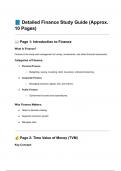
📘 Detailed Finance Study Guide (Approx.
10 Pages)

📖 Page 1: Introduction to Finance
What is Finance?

Finance is the study and management of money, investments, and other financial instruments.

Categories of Finance:

1.​ Personal Finance​

○​ Budgeting, saving, investing, debt, insurance, retirement planning.​

2.​ Corporate Finance​

○​ Managing business capital, risk, and returns.​

3.​ Public Finance​

○​ Government income and expenditures.​


Why Finance Matters:

●​ Helps in decision-making​

●​ Supports economic growth​

●​ Manages risks​


💰 Page 2: Time Value of Money (TVM)
Key Concept:

, ●​ Money now is worth more than money later due to earning potential.​


Formulas:

1.​ Future Value (FV):​
FV=PV×(1+r)nFV = PV \times (1 + r)^nFV=PV×(1+r)n​

2.​ Present Value (PV):​
PV=FV(1+r)nPV = \frac{FV}{(1 + r)^n}PV=(1+r)nFV​​


Examples:

●​ Investing $1,000 at 5% for 3 years →​
FV=1000×(1.05)3=1157.63FV = 1000 \times (1.05)^3 =
1157.63FV=1000×(1.05)3=1157.63​


📊 Page 3: Financial Ratios and Analysis
Categories:

1.​ Liquidity Ratios​

○​ Current Ratio: Current Assets / Current Liabilities​

○​ Quick Ratio: (Current Assets - Inventory) / Current Liabilities​

2.​ Profitability Ratios​

○​ Net Profit Margin: Net Income / Revenue​

○​ Return on Equity (ROE): Net Income / Shareholder's Equity​

3.​ Leverage Ratios​

○​ Debt-to-Equity: Total Debt / Equity​

○​ Interest Coverage: EBIT / Interest Expense​
$12.49
Get access to the full document:

100% satisfaction guarantee
Immediately available after payment
Both online and in PDF
No strings attached

Get to know the seller
Seller avatar
mairakhan2

Also available in package deal

Get to know the seller

Seller avatar
mairakhan2 (self)
Follow You need to be logged in order to follow users or courses
Sold
0
Member since
8 months
Number of followers
0
Documents
9
Last sold
-

0.0

0 reviews

5
0
4
0
3
0
2
0
1
0

Recently viewed by you

Why students choose Stuvia

Created by fellow students, verified by reviews

Quality you can trust: written by students who passed their tests and reviewed by others who've used these notes.

Didn't get what you expected? Choose another document

No worries! You can instantly pick a different document that better fits what you're looking for.

Pay as you like, start learning right away

No subscription, no commitments. Pay the way you're used to via credit card and download your PDF document instantly.

Student with book image

“Bought, downloaded, and aced it. It really can be that simple.”

Alisha Student

Frequently asked questions