Touch part 3
1. Touch vs. Haptics
If we are using the skin = tactile
If we are using the muscle = kinesthetic
Both = haptic
🖐️ What’s the difference?
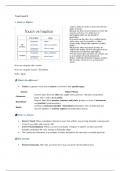
• Touch is a general word, but in science, we divide it into specific types:
System What it Means
Sensory input from the skin only. (Light touch, pressure, vibration, temperature,
Cutaneous
pain.) This is often called tactile.
Sensory input from muscles, tendons, and joints, giving us a sense of movement
Kinesthetic
and position (proprioception).
Combines cutaneous (tactile) + kinesthetic information. We use both skin and
Haptic
muscles together to actively explore and understand objects.
🟢 Active vs. Passive
• Passive Touch: When something is placed on your skin without you moving. Example: someone puts
a coin in your palm and you stay still.
• Active Touch (Haptics): When you move your hands or fingers to explore an object yourself.
Example: picking up the coin, turning it, feeling the edges.
• The 2-point discrimination is an example of tactile perception the skin only is touched passively
➡️ Key Concept:
• Passive Cutaneous: Skin only, you don’t move (e.g., two-point discrimination test).
, • Active Haptic: You move your muscles to explore, using both cutaneous (skin) and kinesthetic
(muscle) senses.
2. Active Touch Procedures (Lederman & Klatzky, 1990)
These are strategies we use automatically when exploring an object by touch. Each movement gives
different information about the object.
Examples of Active Touch Procedures:
Exploratory Procedure What It Tells You
Lateral Motion Texture (e.g., feeling fabric) - rub across
Pressure Hardness (is it squishy or firm?) press on
Static Contact Temperature (cold metal vs. warm wood)
Enclosure Global shape and volume (e.g., wrapping your hand around a ball)
Contour Following Exact shape and edges (e.g., tracing the outline of a key)
➡️ Key Concept:
You use different hand movements depending on what you want to find out about an object.
3. Haptic Object Recognition – recognize object by touch
▫ Haptic object recognition is both fast and accurate (96% correct)
▫ BUT the objects: Comb, glasses, hairdryer, watch, tennis racket, hammer, ashtray, safety pin, bottle
opener, key, sock, sweater, pen, pencil, sticky-tape, stapler, spoon, etc.
📦 What did the study find?
• We are really good at recognizing objects by touch.
, • In the study (Klatzky et al., 1985), participants identified common objects (e.g., combs, keys,
watches) by touch alone.
• Accuracy was about 96% correct!
🤔 But there’s a catch:
• The objects were very different from each other (e.g., a sock vs. a hammer).
• So, the brain might be relying on high-level processing, using complex clues rather than basic
shape or texture.
➡️ Key Concept:
• Haptic recognition can be fast and accurate, but it depends on how different the objects are.
4. Haptic Picture Perception – low level- spatial perception
🎨 Why is this difficult?
• People were asked to feel a picture and then draw it from touch.
Vision vs. Touch:
Vision Touch (Haptics)
Processes lots of info at once (parallel) Processes info one part at a time (serial)
Good at seeing spatial relationships Harder to feel the whole layout at once
We are practiced in vision We are less practiced at haptic perception
➡️ Key Concept:
• Touch samples one place at a time, making it harder to perceive whole objects or pictures.
• People often visualize the shape in their minds using vision skills, not pure touch skills.
• We are bad at haptic picture perception because we lack practice at that
5. Low-Level Haptic Perception
🧱 What did the experiment test?
• Researchers (Nefs et al., 2001) wanted to strip away complex object recognition and test basic
sensitivity.
They tested:
• Spatial Frequency: How often ridges or waves appear (how close together the bumps or lines are).
1. Touch vs. Haptics
If we are using the skin = tactile
If we are using the muscle = kinesthetic
Both = haptic
🖐️ What’s the difference?
• Touch is a general word, but in science, we divide it into specific types:
System What it Means
Sensory input from the skin only. (Light touch, pressure, vibration, temperature,
Cutaneous
pain.) This is often called tactile.
Sensory input from muscles, tendons, and joints, giving us a sense of movement
Kinesthetic
and position (proprioception).
Combines cutaneous (tactile) + kinesthetic information. We use both skin and
Haptic
muscles together to actively explore and understand objects.
🟢 Active vs. Passive
• Passive Touch: When something is placed on your skin without you moving. Example: someone puts
a coin in your palm and you stay still.
• Active Touch (Haptics): When you move your hands or fingers to explore an object yourself.
Example: picking up the coin, turning it, feeling the edges.
• The 2-point discrimination is an example of tactile perception the skin only is touched passively
➡️ Key Concept:
• Passive Cutaneous: Skin only, you don’t move (e.g., two-point discrimination test).
, • Active Haptic: You move your muscles to explore, using both cutaneous (skin) and kinesthetic
(muscle) senses.
2. Active Touch Procedures (Lederman & Klatzky, 1990)
These are strategies we use automatically when exploring an object by touch. Each movement gives
different information about the object.
Examples of Active Touch Procedures:
Exploratory Procedure What It Tells You
Lateral Motion Texture (e.g., feeling fabric) - rub across
Pressure Hardness (is it squishy or firm?) press on
Static Contact Temperature (cold metal vs. warm wood)
Enclosure Global shape and volume (e.g., wrapping your hand around a ball)
Contour Following Exact shape and edges (e.g., tracing the outline of a key)
➡️ Key Concept:
You use different hand movements depending on what you want to find out about an object.
3. Haptic Object Recognition – recognize object by touch
▫ Haptic object recognition is both fast and accurate (96% correct)
▫ BUT the objects: Comb, glasses, hairdryer, watch, tennis racket, hammer, ashtray, safety pin, bottle
opener, key, sock, sweater, pen, pencil, sticky-tape, stapler, spoon, etc.
📦 What did the study find?
• We are really good at recognizing objects by touch.
, • In the study (Klatzky et al., 1985), participants identified common objects (e.g., combs, keys,
watches) by touch alone.
• Accuracy was about 96% correct!
🤔 But there’s a catch:
• The objects were very different from each other (e.g., a sock vs. a hammer).
• So, the brain might be relying on high-level processing, using complex clues rather than basic
shape or texture.
➡️ Key Concept:
• Haptic recognition can be fast and accurate, but it depends on how different the objects are.
4. Haptic Picture Perception – low level- spatial perception
🎨 Why is this difficult?
• People were asked to feel a picture and then draw it from touch.
Vision vs. Touch:
Vision Touch (Haptics)
Processes lots of info at once (parallel) Processes info one part at a time (serial)
Good at seeing spatial relationships Harder to feel the whole layout at once
We are practiced in vision We are less practiced at haptic perception
➡️ Key Concept:
• Touch samples one place at a time, making it harder to perceive whole objects or pictures.
• People often visualize the shape in their minds using vision skills, not pure touch skills.
• We are bad at haptic picture perception because we lack practice at that
5. Low-Level Haptic Perception
🧱 What did the experiment test?
• Researchers (Nefs et al., 2001) wanted to strip away complex object recognition and test basic
sensitivity.
They tested:
• Spatial Frequency: How often ridges or waves appear (how close together the bumps or lines are).